Effect of slag composition and atmosphere on the formation behavior of Ti(C,N) in titanium-bearing blast furnace slag
-
摘要: 钒钛磁铁矿高炉冶炼过程中,炉渣内析出的高熔点碳氮化钛(Ti(C,N))是诱发炉渣黏稠、渣铁分离恶化及炉况失常的重要原因。为明确炉渣成分及气氛条件对Ti(C,N)生成行为的影响规律,通过高温管式炉模拟试验,系统考察了TiO2含量、二元碱度R、MgO及Al2O3含量,以及N2、Ar、CO、H2及其混合气对Ti(C,N)生成行为的影响规律。结果表明:TiO2含量是决定Ti(C,N)生成量的主导因素,当TiO2含量升高至约24%及以上时,Ti(C,N)生成量明显增加,这与工业高炉“渣稠”现象高度吻合;提高炉渣碱度(R)和MgO含量均促进Ti(C,N)的生成,而增加Al2O3含量则略有抑制作用。气氛条件对Ti(C,N)生成类型和生成量均有显著影响,其中N2是TiN生成的必要条件,H2显著促进TiC生成,而高CO分压对TiC生成具有一定抑制作用。热力学分析表明,N2分压是影响TiN与TiC竞争生成关系的关键因素,H2主要通过增强体系还原性促进低价钛氧化物形成。研究结果可为钒钛磁铁矿高炉冶炼过程中Ti(C,N)析出风险评估及低碳高炉渣系-气氛协同调控提供参考。Abstract: During the blast furnace smelting of vanadium-titanium magnetite, the precipitation of titanium carbonitride (Ti(C,N)) in the slag is a primary cause of slag thickening, deterioration of slag-iron separation, and furnace operation irregularities. To clarify the influence patterns of slag composition and atmospheric conditions on the formation behavior of Ti(C,N), this study systematically investigated the effects of TiO2 content, binary basicity (R), MgO and Al2O3 contents, as well as N2, Ar, CO, H2, and their mixed gases on the formation behavior of Ti(C,N) through simulation experiments in a high-temperature tube furnace. The results indicate that the TiO2 content is the dominant factor determining the amount of Ti(C,N) generated. When the TiO2 content rises to approximately 24% or higher, the amount of Ti(C,N) formed increases significantly, which aligns well with the “viscous slag” phenomenon observed in industrial blast furnaces. Increasing slag basicity (R) and MgO content both promote the formation of Ti(C,N), while increasing Al2O3 content slightly inhibits it. The atmospheric conditions significantly affect both the type and amount of Ti(C,N), formed. Specifically, N2 is a necessary condition for the formation of TiN; H2 markedly promotes the formation of TiC; whereas a high CO partial pressure exhibits a certain inhibitory effect on TiC formation. Thermodynamic analysis reveals that the N2 partial pressure determines the competitive relationship between TiN and TiC, and H2 primarily promotes the formation of low-valent titanium oxides by enhancing the reducibility of the system. The findings of this study can provide a reference for assessing the risk of Ti(C,N) precipitation and for the coordinated control of slag systems and atmospheres in low-carbon blast furnace processes during the smelting of vanadium-titanium magnetite.
-
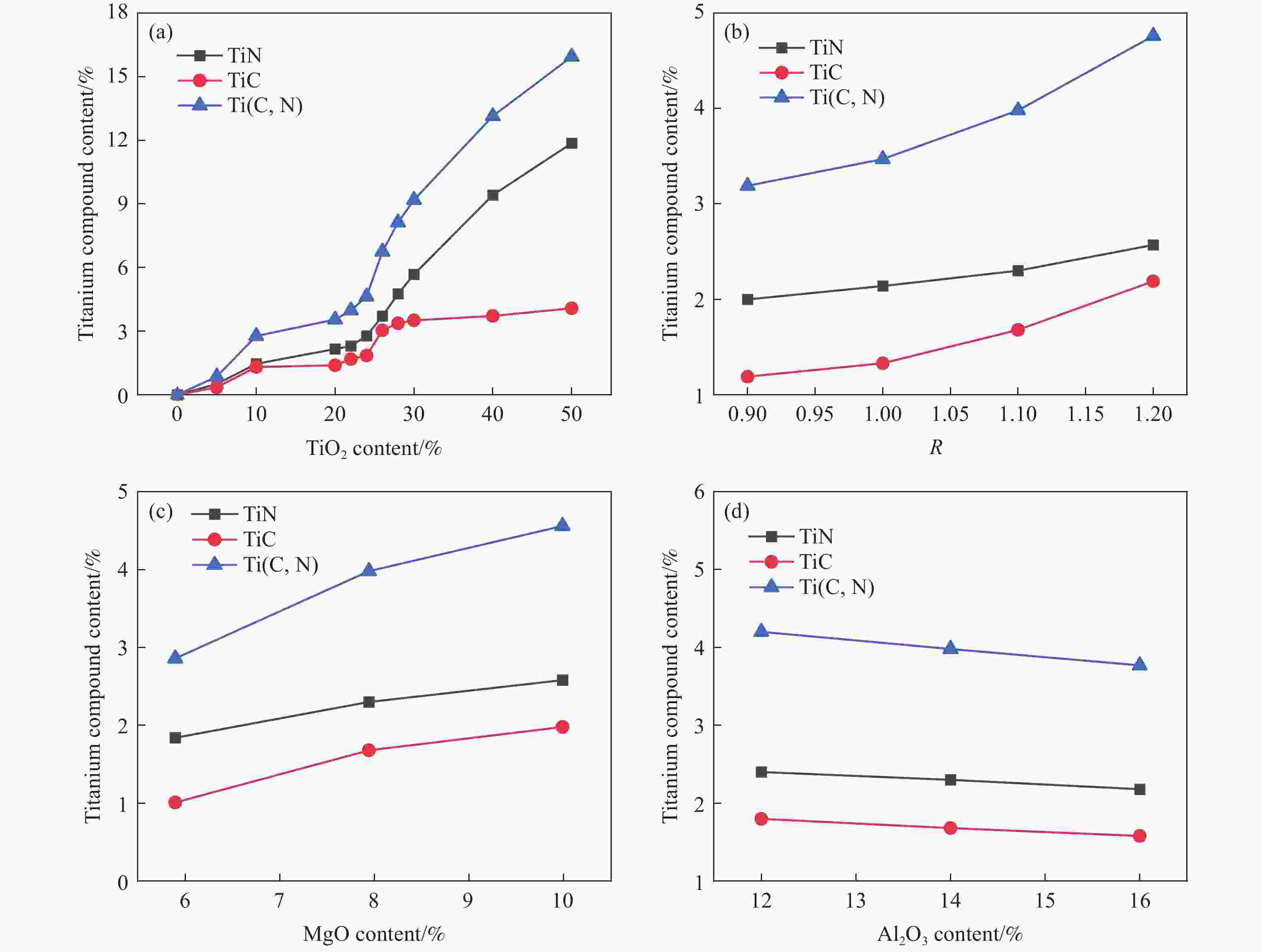
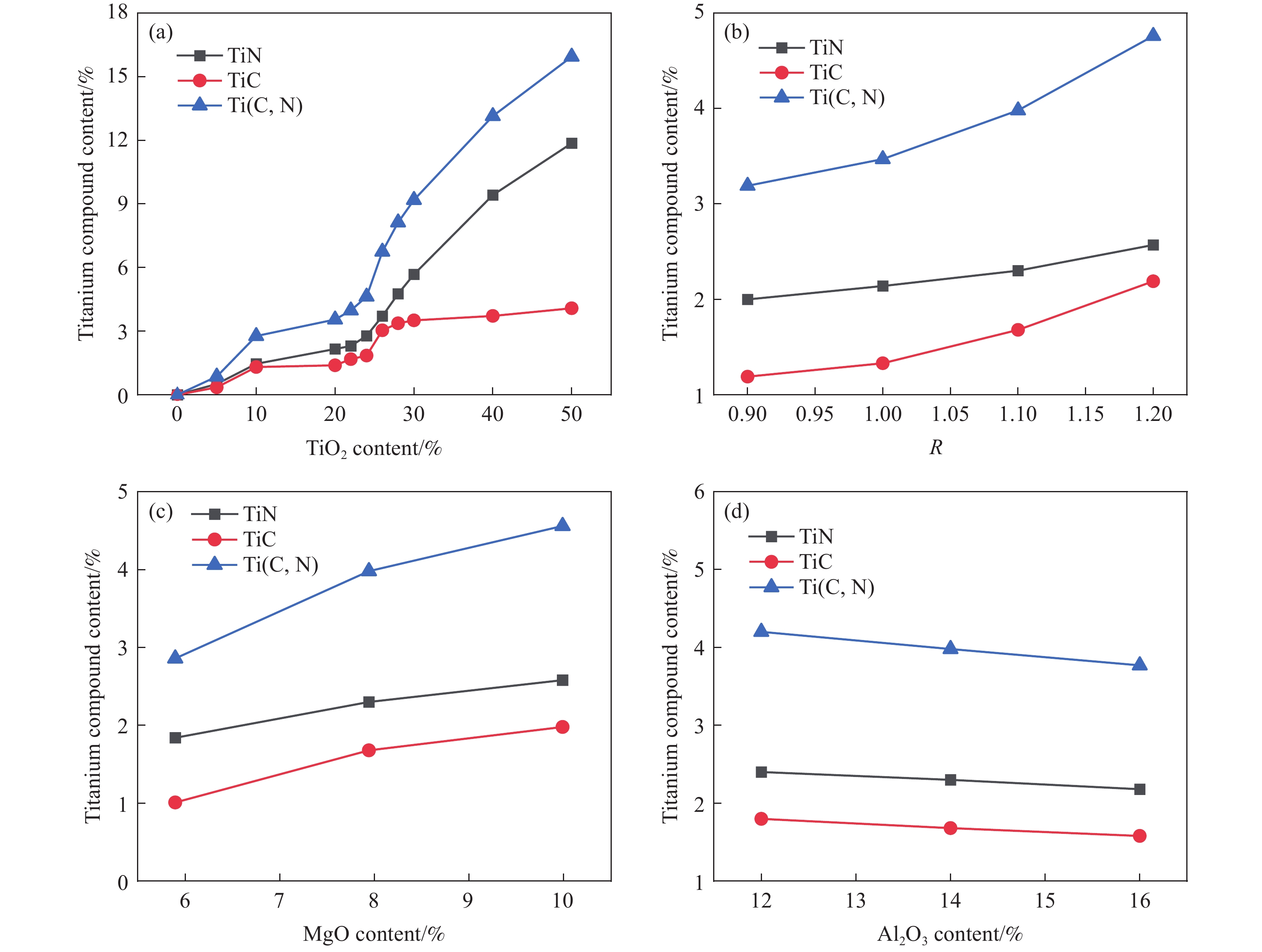
图 2 起始渣成分对Ti(C,N)生成规律的影响
(a)TiO2含量;(b)二元碱度;(c)MgO含量;(d)Al2O3含量
Figure 2. Effects of initial slag composition on Ti(C,N) formation
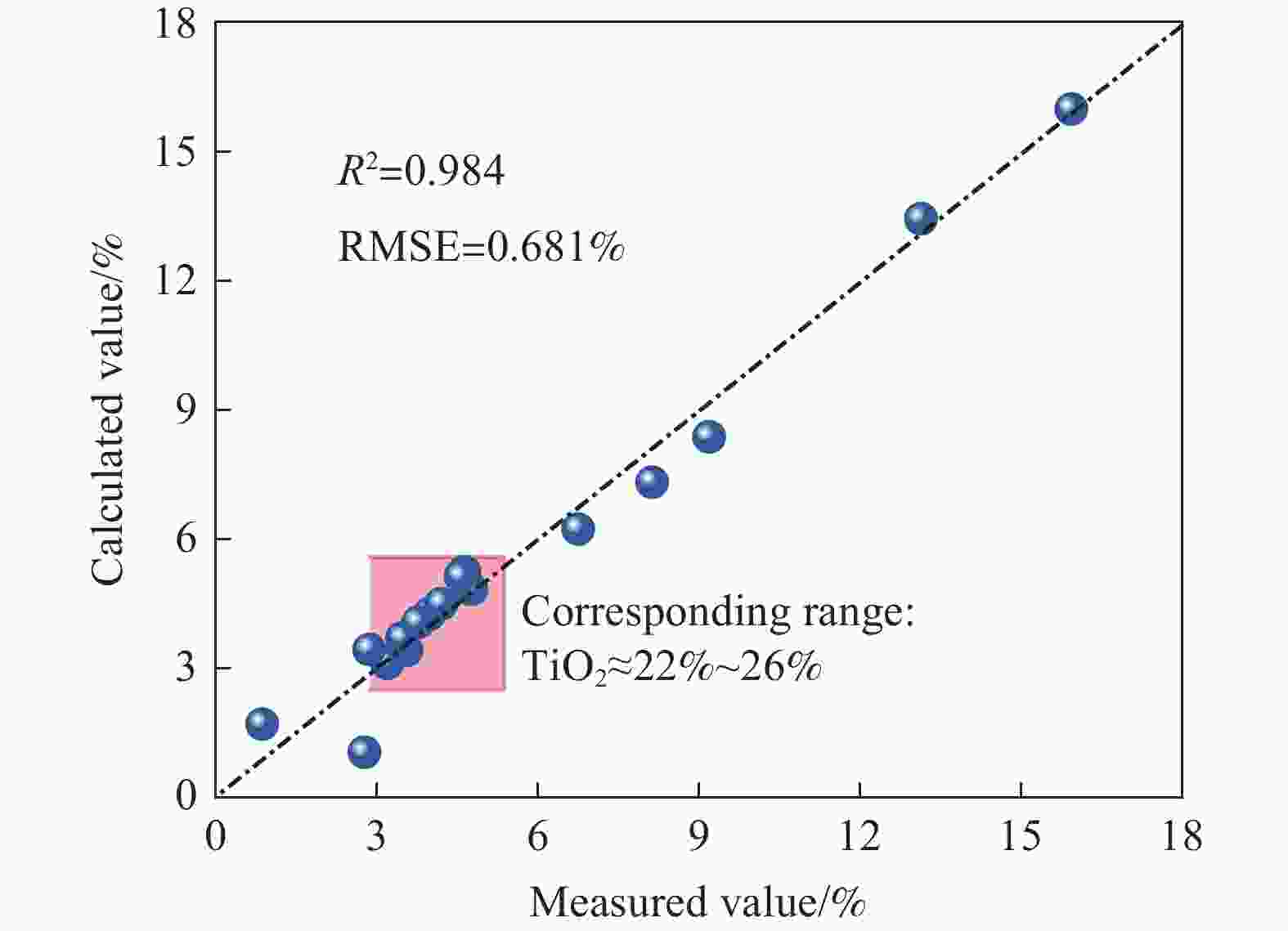
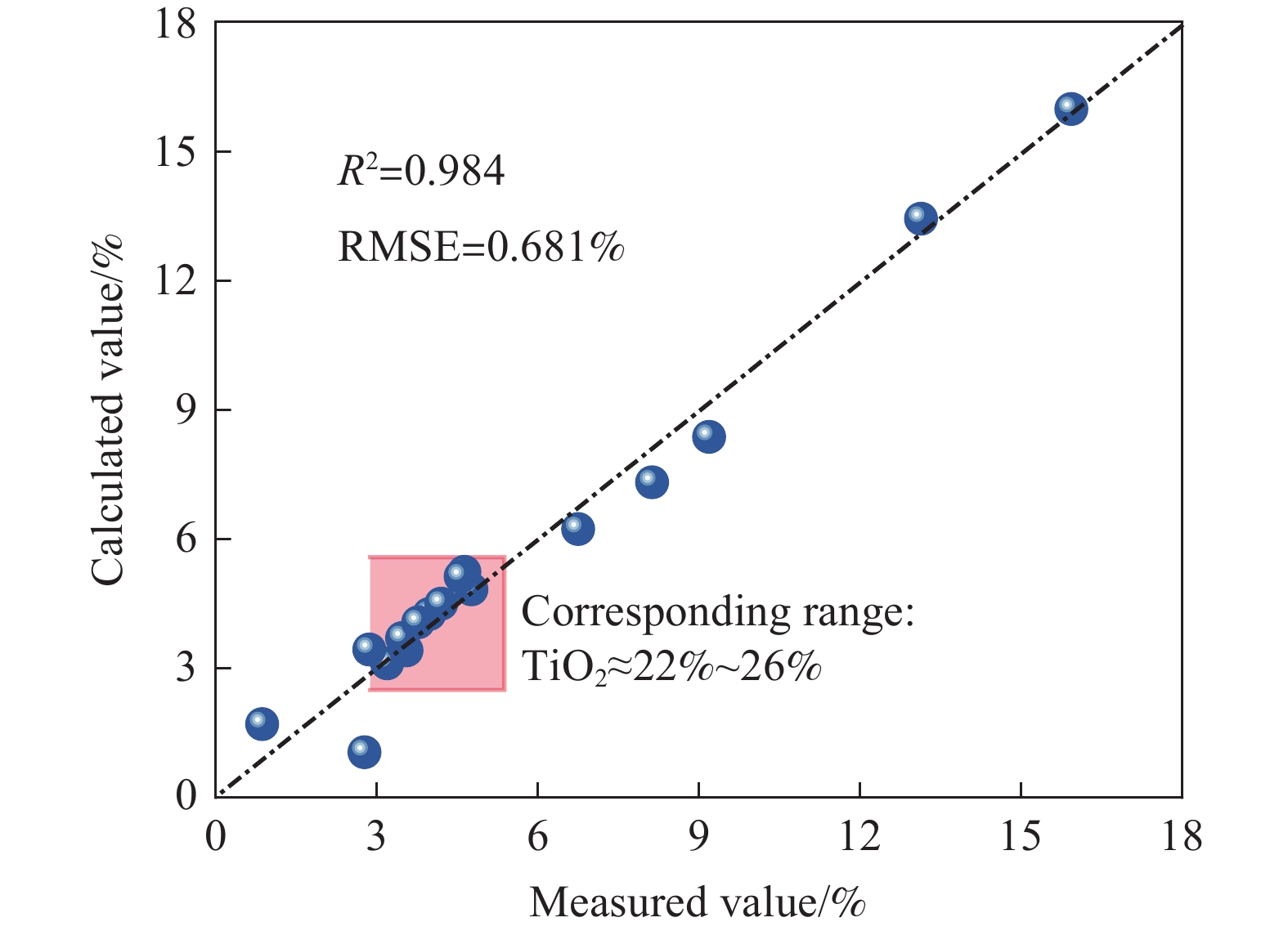
图 3 Ti(C,N)计算值与实测值的对比关系
Figure 3. Comparison between calculated and experimental Ti(C,N) contents
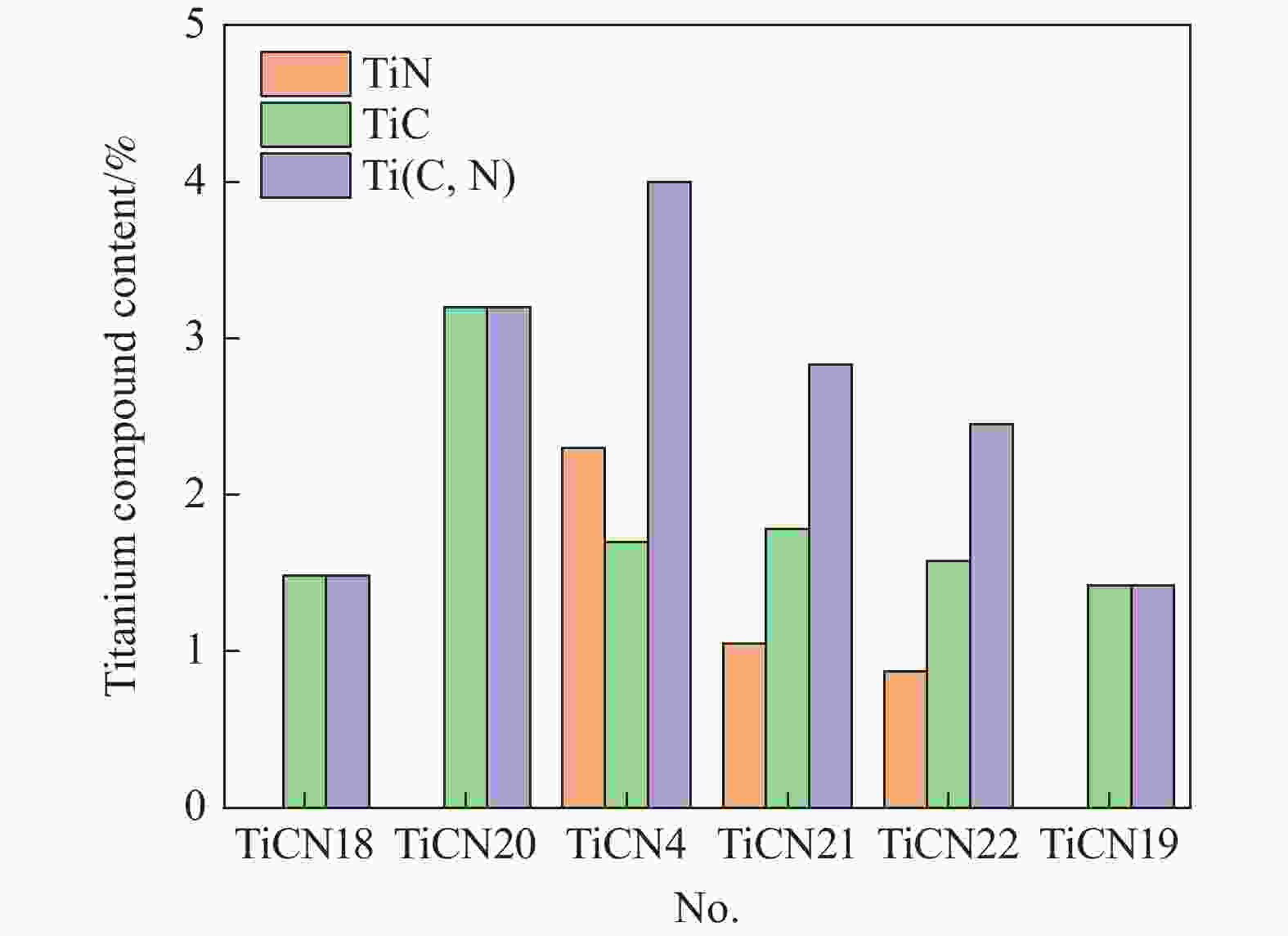
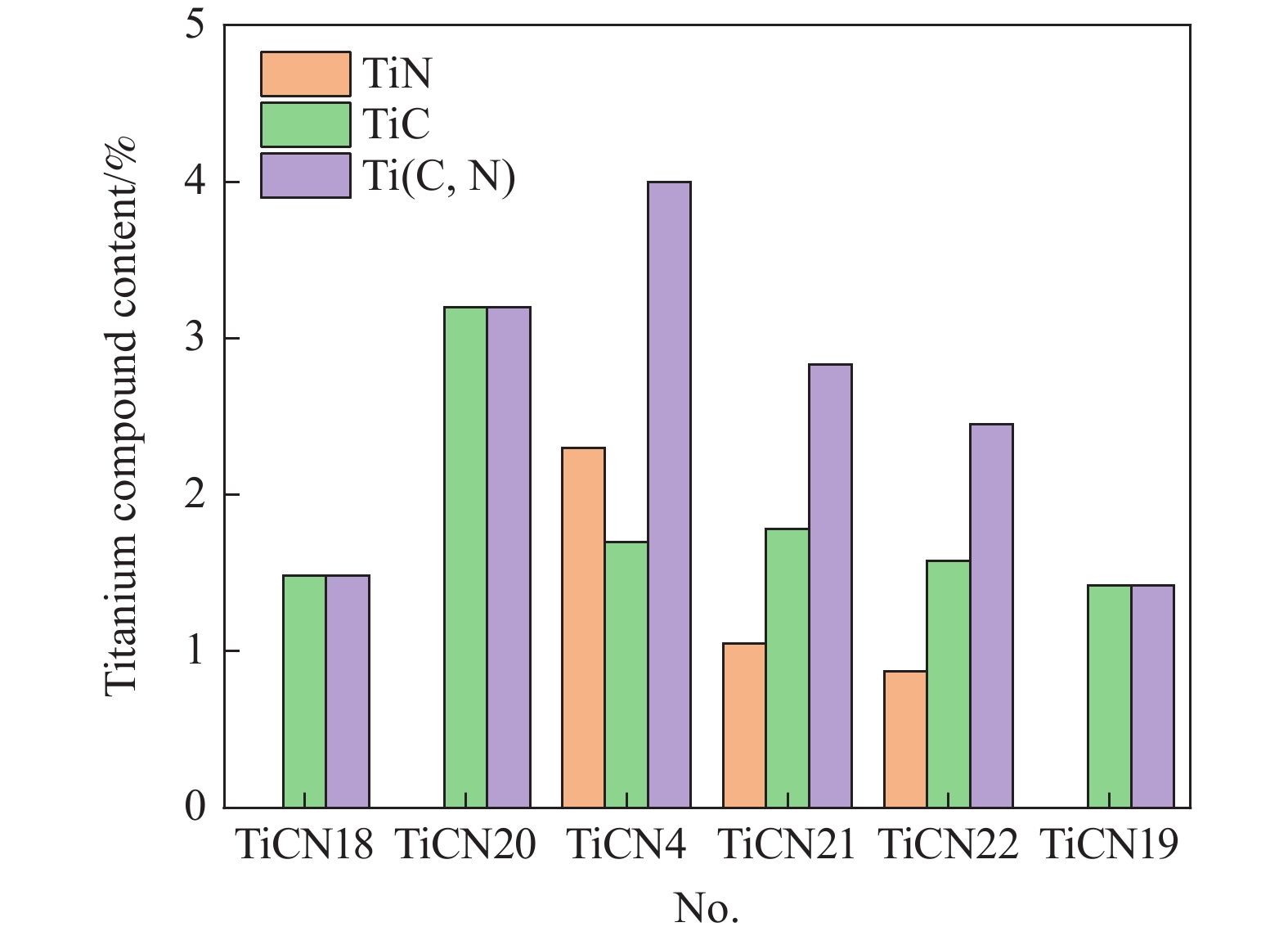
图 4 不同气氛条件对Ti(C,N)生成规律的影响
Figure 4. Effects of atmospheric conditions on Ti(C,N) formation
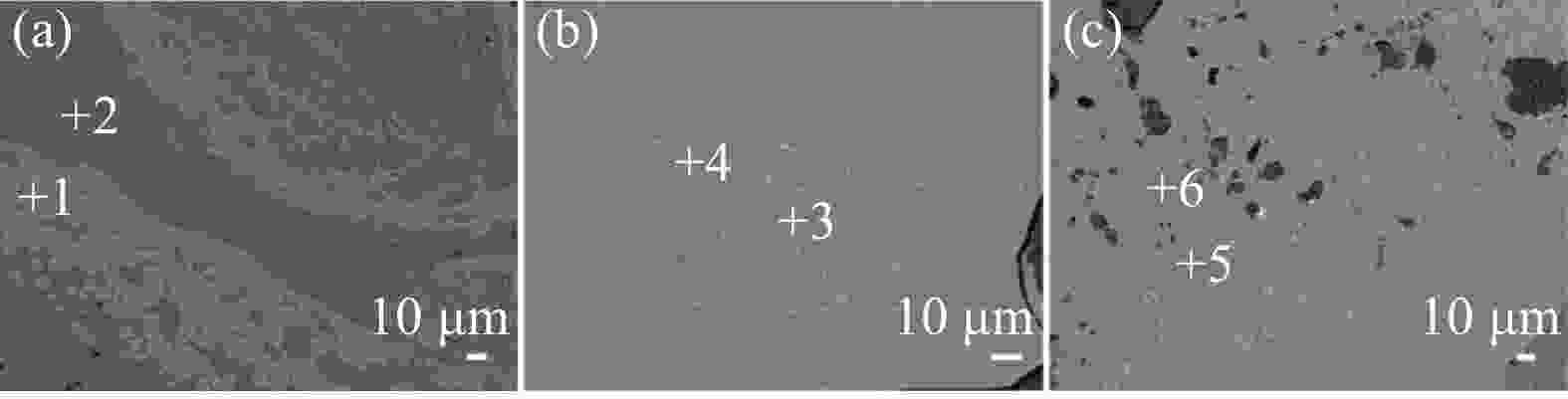
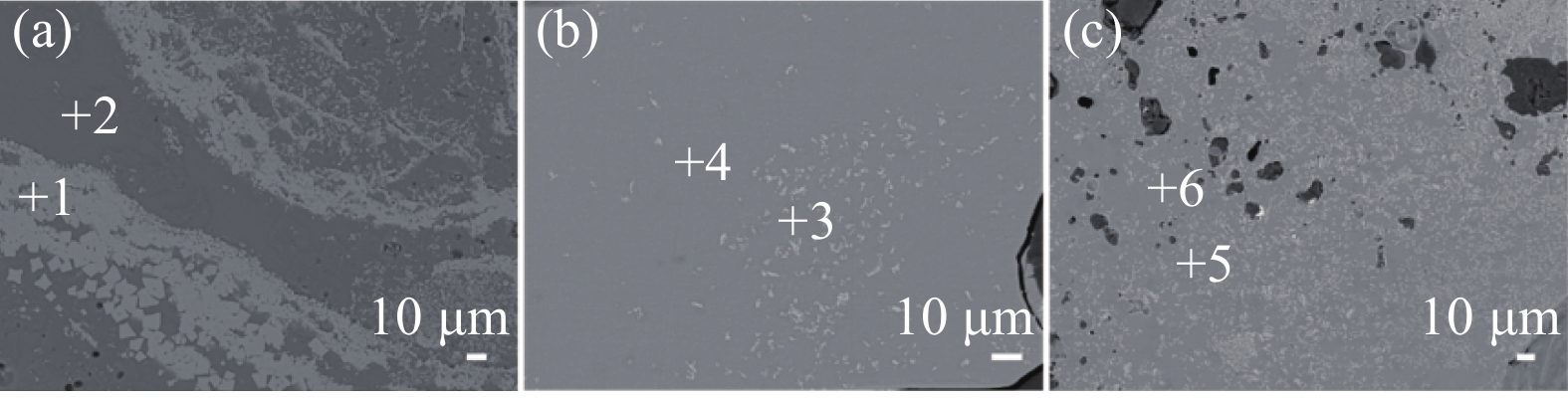
图 5 不同气氛下碳氮化钛样品微观结构
(a)30%CO-70%N2;(b)100%CO;(c)100%H2
Figure 5. Microstructures of samples after the Ti(C,N) formation experiments under different atmospheres
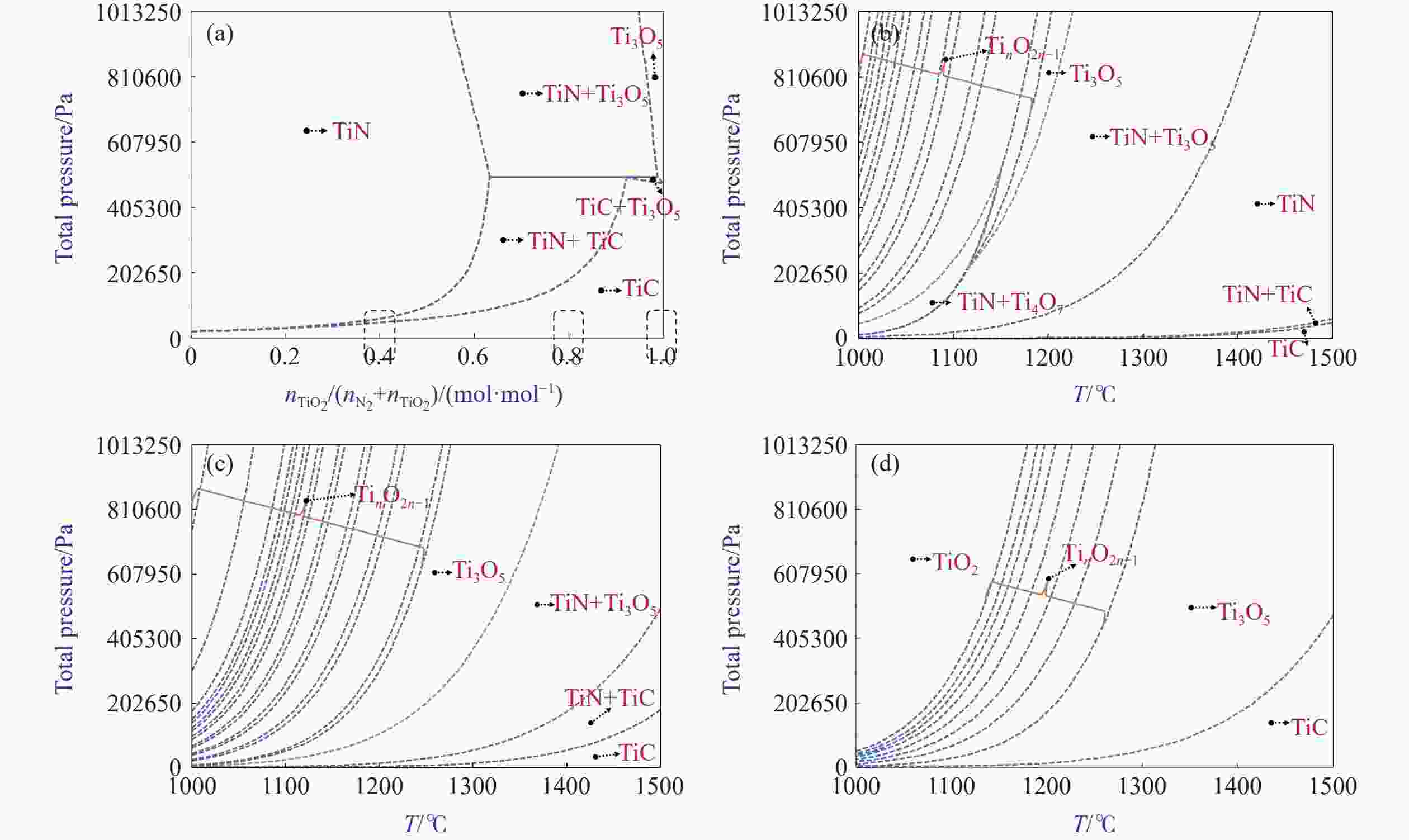
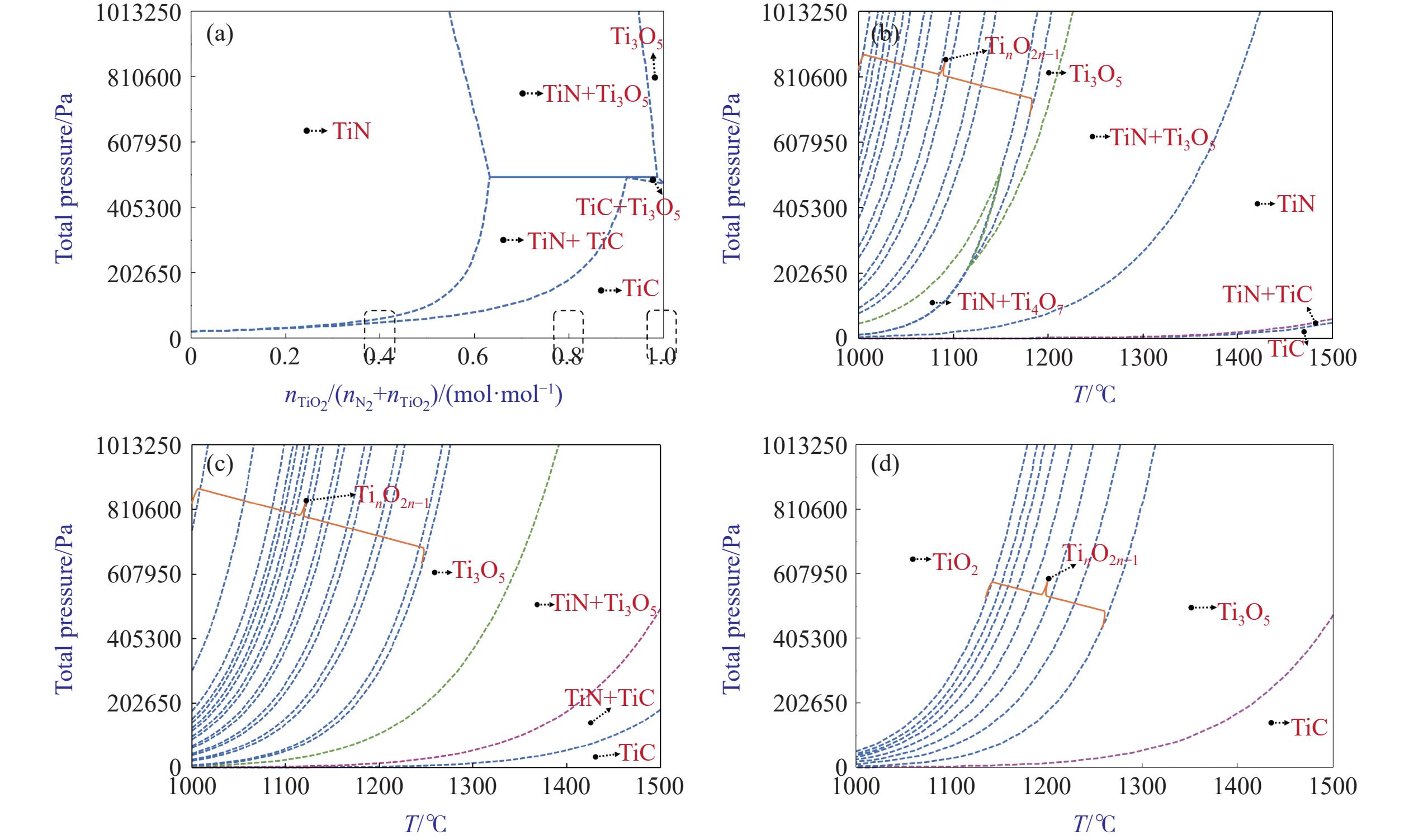
图 6 不同总压、N2含量、温度下N2+TiO2+C三元体系平衡相图
(a)温度为1500 ℃时总压、$n_{{\mathrm{TiO}}_2} $/($n_{{\mathrm{TiO}}_2} $+$n_{{\mathrm{N}}_2} $)比值变化;(b)$n_{{\mathrm{TiO}}_2} $/($n_{{\mathrm{TiO}}_2} $+$n_{{\mathrm{N}}_2} $)比值为0.4时总压、温度变化;(c)$n_{{\mathrm{TiO}}_2} $/($n_{{\mathrm{TiO}}_2} $+$n_{{\mathrm{N}}_2} $)比值为0.8时总压、温度变化;(d)$n_{{\mathrm{TiO}}_2} $/($n_{{\mathrm{TiO}}_2} $+$n_{{\mathrm{N}}_2} $)比值为1.0时总压、温度变化
Figure 6. Equilibrium phase diagrams of the N2-TiO2-C ternary system under different total pressures, N2 contents, and temperatures
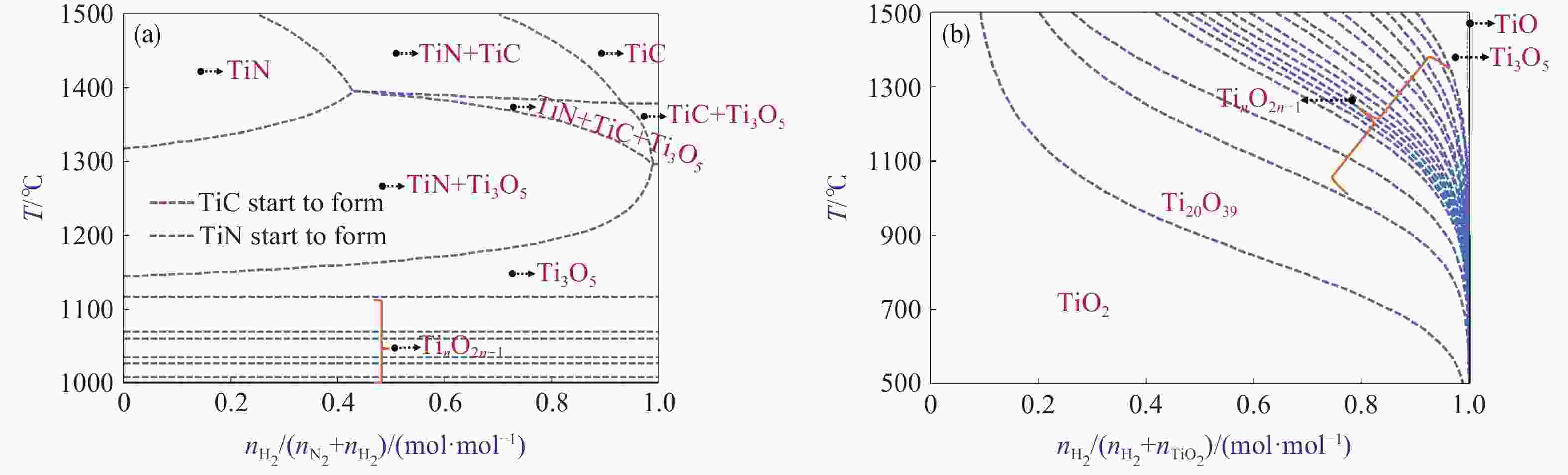
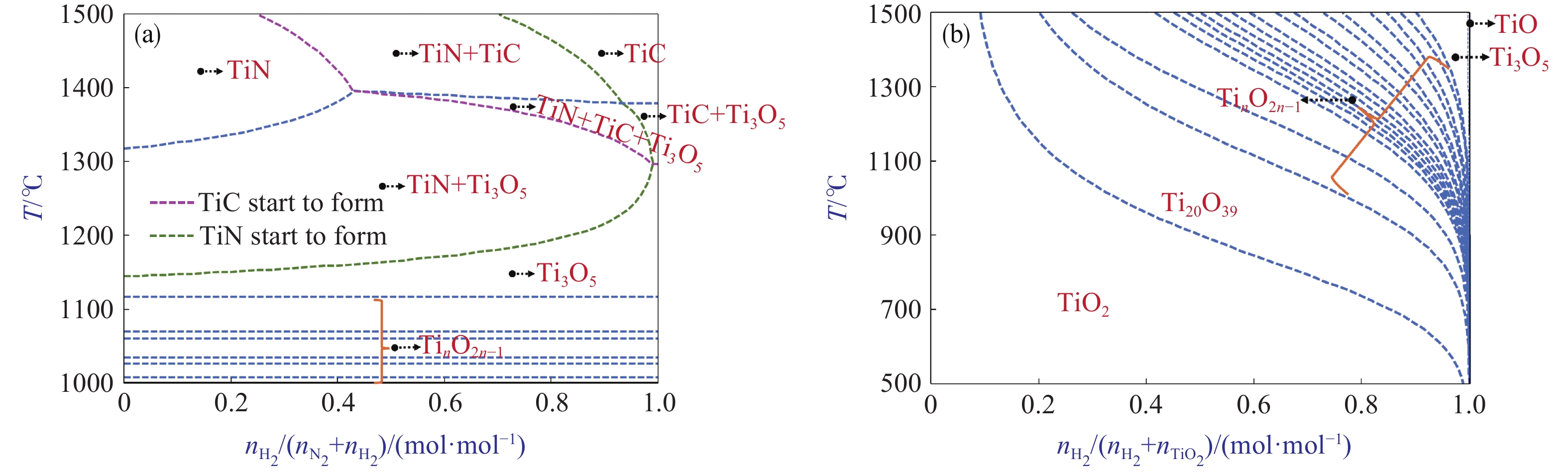
图 7 不同H2分压及温度下,不同体系下的平衡相图(
101325 Pa)(a)H2-N2-TiO2-C四元体系;(b)H2+TiO2体系
Figure 7. Equilibrium phase diagrams for different systems at different H2 partial pressures and temperatures (
101325 Pa)表 1 不同条件下Ti(C,N)生成试验方案
Table 1. Experimental schemes for Ti(C,N) formation under different conditions
No. R Initial composition/% Temper-
ature/oCAtmos-
phereCaO SiO2 MgO Al2O3 TiO2 TiCN1 1.1 38.3 34.7 8.0 14.0 5.0 1500 N2 TiCN2 1.1 35.6 32.4 8.0 14.0 10.0 1500 N2 TiCN3 1.1 30.4 27.6 8.0 14.0 20.0 1500 N2 TiCN4 1.1 29.3 26.7 8.0 14.0 22.0 1500 N2 TiCN5 1.1 28.3 25.7 8.0 14.0 24.0 1500 N2 TiCN6 1.1 27.2 24.8 8.0 14.0 26.0 1500 N2 TiCN7 1.1 26.2 23.8 8.0 14.0 28.0 1500 N2 TiCN8 1.1 25.1 22.9 8.0 14.0 30.0 1500 N2 TiCN9 1.1 19.9 18.1 8.0 14.0 40.0 1500 N2 TiCN10 1.1 14.7 13.3 8.0 14.0 50.0 1500 N2 TiCN11 0.9 26.5 29.5 8.0 14.0 22.0 1500 N2 TiCN12 1.0 28.0 28.0 8.0 14.0 22.0 1500 N2 TiCN13 1.2 30.5 25.5 8.0 14.0 22.0 1500 N2 TiCN14 1.1 30.4 27.6 6.0 14.0 22.0 1500 N2 TiCN15 1.1 28.3 25.7 10.0 14.0 22.0 1500 N2 TiCN16 1.1 30.4 27.6 8.0 12.0 22.0 1500 N2 TiCN17 1.1 28.3 25.7 8.0 16.0 22.0 1500 N2 TiCN18 1.1 29.3 26.7 8.0 14.0 22.0 1500 Ar TiCN19 1.1 29.3 26.7 8.0 14.0 22.0 1500 CO TiCN20 1.1 29.3 26.7 8.0 14.0 22.0 1500 H2 TiCN21 1.1 29.3 26.7 8.0 14.0 22.0 1500 CO-N2① TiCN22 1.1 29.3 26.7 8.0 14.0 22.0 1500 CO-N2② Note:①:30%CO-70%N2;②:65%CO-35%N2  下载: 导出CSV
表 2 含钛高炉渣反应后样品化学成分分析结果
Table 2. Chemical compositions of reacted titanium-bearing blast furnace slag samples
No. R Chemical composition/% CaO SiO2 MgO Al2O3 TiO2 TiN TiC Ti(C,N) TiCN1 1.08 38.12 35.22 7.95 13.68 4.17 0.51 0.35 0.86 TiCN2 1.10 36.24 32.83 8.05 13.98 6.13 1.46 1.31 2.77 TiCN3 1.12 30.85 27.55 8.49 14.06 15.51 2.16 1.39 3.55 TiCN4 1.12 29.75 26.51 8.24 14.25 17.27 2.30 1.68 3.98 TiCN5 1.12 28.99 25.88 8.33 14.21 17.95 2.78 1.85 4.63 TiCN6 1.11 27.32 24.65 8.32 14.35 18.61 3.71 3.04 6.75 TiCN7 1.09 26.50 24.32 7.84 14.19 19.02 4.76 3.37 8.13 TiCN8 1.09 26.16 23.98 8.23 14.25 18.19 5.68 3.51 9.19 TiCN9 1.12 21.58 19.33 8.54 14.37 23.04 9.42 3.72 13.14 TiCN10 1.09 15.74 14.39 8.79 14.07 31.07 11.86 4.08 15.94 TiCN11 0.95 27.37 28.95 8.24 14.32 17.92 2.0 1.19 3.19 TiCN12 1.04 28.76 27.78 8.41 14.26 17.31 2.14 1.33 3.47 TiCN13 1.23 31.35 25.51 8.28 14.20 15.90 2.57 2.19 4.76 TiCN14 1.12 31.10 27.67 6.40 14.32 17.65 1.84 1.01 2.86 TiCN15 1.11 28.56 25.81 10.23 14.12 16.72 2.58 1.98 4.56 TiCN16 1.09 30.32 27.82 8.41 12.35 16.89 2.40 1.80 4.20 TiCN17 1.09 28.02 25.80 8.25 15.99 18.18 2.18 1.58 3.77
下载: 导出CSV
表 3 不同气氛条件下反应后样品化学成分分析结果
Table 3. Chemical compositions of reacted samples under different atmospheric conditions
No. Atmosphere/% R Chemical composition/% CaO SiO2 MgO Al2O3 TiO2 TiN TiC Ti(C,N) TiCN18 Ar 1.12 29.52 26.42 8.24 14.08 20.26 0 1.48 1.48 TiCN19 CO 1.09 29.52 27.16 8.56 14.29 19.06 0 1.42 1.42 TiCN20 H2 1.13 30.87 27.36 8.26 14.87 15.44 0 3.20 3.20 TiCN21 CO-N2① 1.14 29.88 26.31 8.31 14.25 18.41 1.07 1.78 2.85 TiCN22 CO-N2② 1.11 29.69 26.64 8.37 14.26 18.57 0.88 1.58 2.46 Note:①:30%CO-70%N2;②:65%CO-35%N2
下载: 导出CSV
表 4 图5中典型区域EDS点分析结果(原子百分比)
Table 4. EDS point analysis results of typical regions in Fig. 5 (Atom percent)
% Point Ti C N Ca Si Mg Al O 1 48.19 29.96 19.96 0.42 0.37 0.12 0.13 0.84 2 5.66 0.12 0.22 13.14 10.80 5.12 3.44 61.51 3 48.99 49.06 0.31 0.46 0.34 0.11 0.16 0.57 4 5.74 0.31 0.47 12.71 10.91 5.16 3.38 61.32 5 48.67 49.20 0.58 0.43 0.35 0.13 0.19 0.46 6 4.72 0.28 0.83 13.47 11.15 5.05 3.56 60.94
下载: 导出CSV
-
[1] Yan Zhengpei, Zheng Shili, Zhang Ying, et al. Sodium carbonate roasting and mild acid leaching of vanadium titanomagnetite concentrates: Vanadium extraction and residue sodium decrease[J]. Process Safety and Environmental Protection, 2024, 185: 1132-1144. doi: 10.1016/j.psep.2024.03.046 [2] 陈露露. 我国钒钛磁铁矿资源利用现状[J]. 中国资源综合利用, 2015, 33(10): 31-33. Chen Lulu. Current situation of vanadium-titanium magnetite resource utilization[J]. China Resources Comprehensive Utilization, 2015, 33(10): 31-33. doi: 10.3969/j.issn.1008-9500.2015.10.014Chen Lulu. Current situation of vanadium-titanium magnetite resource utilization[J]. China Resources Comprehensive Utilization, 2015, 33(10): 31-33. doi: 10.3969/j.issn.1008-9500.2015.10.014 [3] Chen Junwei, Chen Weibin, Mi Liang, et al. Kinetic studies on gas-based reduction of vanadium titanomagnetite pellet[J]. Metals, 2019, 9(1): 95. doi: 10.3390/met9010095 [4] 邓青宇. 钒钛磁铁矿高炉冶炼过程中碳氮化钛形成条件与调控机制研究[D]. 北京: 北京科技大学, 2012. Deng Qingyu. Research on the formation of Ti(C, N) and regulation mechanism in blast furnace process treating vanadic titanomagnetite[D]. Beijing: University of Science and Technology Beijing, 2012.Deng Qingyu. Research on the formation of Ti(C, N) and regulation mechanism in blast furnace process treating vanadic titanomagnetite[D]. Beijing: University of Science and Technology Beijing, 2012. [5] Zheng Kui, Wang Wei, Huang Tao, et al. Influence of temperature and slag composition on wetting behavior of titanium-containing blast furnace slag and tuyere coke[J]. Journal of Iron and Steel Research International, 2025, 32(10): 3298-3307. doi: 10.1007/s42243-025-01577-3 [6] Zhang Guopeng, Shen Fengman, Zhang Shen, et al. Oxidation kinetics and mechanism of TiC with simulated blast-furnace gases[J]. Steel Research International, 2024, 95: 2300519. doi: 10.1002/srin.202300519 [7] Zhang Guopeng, Shen Fengman, Zhang Tianqing, et al. Effect of TiC and Ti(C, N) on the viscosity of CaO-SiO2-8.25%MgO-15%Al2O3-30%TiO2 slags[J]. Metallurgical Research & Technology, 2025, 122: 106. doi: 10.1051/metal/2024099 [8] Xie Honggen, Yu Wenzhou, You Zhixiong, et al. The effect of titanium carbonitride on the viscosity of high-titanium-type blast furnace slag[J]. Metals, 2019, 9(4): 395. doi: 10.3390/met9040395 [9] Liu Yuxin, Zhang Jianliang, Zhang Guohui, et al. Influence of Ti(C0.3N0.7) on viscosity of blast furnace slags[J]. Ironmaking & Steelmaking, 2017, 44(8): 609-618. doi: 10.1080/03019233.2016.1223907 [10] Zhen Yulan, Zhang Guohua, Chou K C. Viscosity of CaO-MgO-Al2O3-SiO2-TiO2 melts containing TiC particles[J]. Metallurgical and Materials Transactions B, 2015, 46(1): 155-161. doi: 10.1007/s11663-014-0169-x [11] Sui Jiaheng, Yang Songtao, Wang Qi, et al. Influence of blast furnace burden with different TiO2 contents on the process of reduction and slag formation in cohesive zone[J]. ISIJ International, 2025, 65(4): 521-532. doi: 10.2355/isijinternational.ISIJINT-2024-358 [12] 黄家旭, 龙盘忠. 含钛高炉渣碳热还原时熔渣泡沫化原因分析[J]. 轻金属, 2019(8): 46-50. Huang Jiaxu, Long Panzhong. Causes analysis for slag foaming in the carbothermal reduction process of Ti-bearing blast furnace slag[J]. Light Metals, 2019(8): 46-50. doi: 10.13662/j.cnki.qjs.2019.08.010Huang Jiaxu, Long Panzhong. Causes analysis for slag foaming in the carbothermal reduction process of Ti-bearing blast furnace slag[J]. Light Metals, 2019(8): 46-50. doi: 10.13662/j.cnki.qjs.2019.08.010 [13] Chen Mao, Chen Buxin, Jiang Yang, et al. Study of Ti(C, N) formations in TiO2-containing slags[J]. Metallurgical and Materials Transactions B, 2025, 56(1): 1018-1028. doi: 10.1007/s11663-024-03410-w [14] 张国鹏, 沈峰满, 章苇玲, 等. TiO2碳热还原机理及影响因素的研究[J]. 东北大学学报(自然科学版), 2025, 46(11): 66-72. Zhang Guopeng, Shen Fengman, Zhang Weiling, et al. Research on mechanism and influencing factors of TiO2 carbothermal reduction[J]. Journal of Northeastern University (Natural Science), 2025, 46(11): 66-72. doi: 10.12068/j.issn.1005-3026.2025.20240111Zhang Guopeng, Shen Fengman, Zhang Weiling, et al. Research on mechanism and influencing factors of TiO2 carbothermal reduction[J]. Journal of Northeastern University (Natural Science), 2025, 46(11): 66-72. doi: 10.12068/j.issn.1005-3026.2025.20240111 [15] Qiu Guibao, Ma Shiwei, Deng Qingyu, et al. Study on the formation of Ti(C, N) between blast furnace hot metal and slag bearing high TiO2[J]. Metalurgia International, 2012, 17(4): 94-99. [16] 李慈颖, 高运明, 李亚伟, 等. 碳热还原氮化攀钢高钛高炉渣制取Ti(C, N)的研究[J]. 耐火材料, 2007, 41(2): 113-117. Li Ciying, Gao Yunming, Li Yawei, et al. Preparation of Ti(C, N) from Pangang high-titanium blast furnace slag by carbothermal reduction and nitridation[J]. Refractories, 2007, 41(2): 113-117. doi: 10.3969/j.issn.1001-1935.2007.02.009Li Ciying, Gao Yunming, Li Yawei, et al. Preparation of Ti(C, N) from Pangang high-titanium blast furnace slag by carbothermal reduction and nitridation[J]. Refractories, 2007, 41(2): 113-117. doi: 10.3969/j.issn.1001-1935.2007.02.009 [17] Jing Jianfa, Wang Shuai, Guo Yufeng, et al. A thermodynamic model for predicting activity of CaO-SiO2-Al2O3-MgO-TiO2-V2O3-FeO slags during electric furnace smelting process[J]. Journal of Iron and Steel Research International, 2024, 31(9): 2156-2172. doi: 10.1007/s42243-024-01186-6 [18] Chen Buxin, Li Yehui, Chen Mao, et al. Effect of low-carbon atmosphere on Ti(C, N) formation in vanadium titanomagnetite blast furnace[J]. Metallurgical and Materials Transactions B, 2026, 57(4): 2211-2225. doi: 10.1007/s11663-026-03979-4 [19] Dang Jie, Fatollahi-fard F, Pistorius P C, et al. Synthesis of titanium oxycarbide from titanium slag by methane-containing gas[J]. Metallurgical and Materials Transactions B, 2018, 49(1): 123-131. doi: 10.1007/s11663-017-1123-5 [20] Dang Jie, Fatollahi-fard F, Pistorius P C, et al. Synthesis of titanium oxycarbide from concentrates of natural ilmenite (weathered and unweathered) and natural rutile, using a methane-hydrogen gas mixture[J]. Metallurgical and Materials Transactions B, 2017, 48(5): 2440-2446. doi: 10.1007/s11663-017-1048-z [21] Lü Zhipeng, Dang Jie, Sun Hui. Synthesis of titanium oxycarbide in TiO2-C-H2 system[J]. Materials Chemistry and Physics, 2020, 252: 123272. doi: 10.1016/j.matchemphys.2020.123272 [22] Rezan S A, Zhang Guangqing, Ostrovski O. Carbothermal reduction and nitridation of ilmenite concentrates[J]. ISIJ International, 2012, 52(3): 363-368. doi: 10.2355/isijinternational.52.363 [23] Rezan S A, Zhang Guangqing, Ostrovski O. Phase development in carbothermal reduction and nitridation of ilmenite concentrates[J]. High Temperature Materials and Processes, 2012, 31(4-5): 381-388. doi: 10.1515/htmp-2012-0070 [24] 胡文斌, 张龙, 王建江, 等. Ti(C, N)材料的研究进展[J]. 材料导报, 2010, 24(23): 29-33. Hu Wenbin, Zhang Long, Wang Jianjiang, et al. Research progress of Ti(C, N) materials[J]. Materials Review, 2010, 24(23): 29-33.Hu Wenbin, Zhang Long, Wang Jianjiang, et al. Research progress of Ti(C, N) materials[J]. Materials Review, 2010, 24(23): 29-33. [25] 焦克新, 张建良, 刘征建, 等. 高炉炉缸含钛保护层物相及TiC0.3N0.7形成机理[J]. 工程科学学报, 2019, 41(2): 190-198. Jiao Kexin, Zhang Jianliang, Liu Zhengjian, et al. Mineralogical phase and formation mechanism of titanium-bearing protective layers in a blast furnace hearth[J]. Chinese Journal of Engineering, 2019, 41(2): 190-198. doi: 10.13374/j.issn2095-9389.2019.02.005Jiao Kexin, Zhang Jianliang, Liu Zhengjian, et al. Mineralogical phase and formation mechanism of titanium-bearing protective layers in a blast furnace hearth[J]. Chinese Journal of Engineering, 2019, 41(2): 190-198. doi: 10.13374/j.issn2095-9389.2019.02.005 [26] 董择上, 薛庆国, 左海滨, 等. 氧气高炉喷吹焦炉煤气数学模型[J]. 钢铁, 2017, 52(4): 18-24. Dong Zeshang, Xue Qingguo, Zuo Haibin, et al. Mathematical model analysis on coke oven gas injection into oxygen blast furnace[J]. Iron and Steel, 2017, 52(4): 18-24. doi: 10.13228/j.boyuan.issn0449-749x.20160321Dong Zeshang, Xue Qingguo, Zuo Haibin, et al. Mathematical model analysis on coke oven gas injection into oxygen blast furnace[J]. Iron and Steel, 2017, 52(4): 18-24. doi: 10.13228/j.boyuan.issn0449-749x.20160321 [27] Zhang Shushi, Zhang Jianliang, Wang Zhenyang, et al. Advancements in oxygen blast furnace technology and its application in the smelting of vanadium-titanium magnetite: A comprehensive review[J]. Minerals Engineering, 2024, 212: 108732. doi: 10.1016/j.mineng.2024.108732 [28] 唐珏, 储满生, 李峰, 等. 我国氢冶金发展现状及未来趋势[J]. 河北冶金, 2020(8): 1-6, 51. Tang Jue, Chu Mansheng, Li Feng, et al. Current status and future trends of hydrogen metallurgy development in China[J]. Hebei Metallurgy, 2020(8): 1-6, 51. doi: 10.13630/j.cnki.13-1172.2020.0801Tang Jue, Chu Mansheng, Li Feng, et al. Current status and future trends of hydrogen metallurgy development in China[J]. Hebei Metallurgy, 2020(8): 1-6, 51. doi: 10.13630/j.cnki.13-1172.2020.0801 [29] Lan Chenchen, Hao Yuejun, Shao Jiannan, et al. Effect of H2 on blast furnace ironmaking: A review[J]. Metals, 2022, 12(11): 1864. doi: 10.3390/met12111864 [30] 杜诚波, 刘征建, 张建良, 等. 氢气含量对含铁炉料还原及软熔性能的影响[J]. 中国冶金, 2018, 28(12): 9-23,35. Du Chengbo, Liu Zhengjian, Zhang Jianliang, et al. Effect of hydrogen content on reduction and softening-melting properties of iron bearing charges[J]. China Metallurgy, 2018, 28(12): 19-23, 35.Du Chengbo, Liu Zhengjian, Zhang Jianliang, et al. Effect of hydrogen content on reduction and softening-melting properties of iron bearing charges[J]. China Metallurgy, 2018, 28(12): 19-23, 35. [31] Gao Xudong, Zhang Run, You Zhixiong, et al. Use of hydrogen-rich gas in blast furnace ironmaking of V-bearing titanomagnetite: Mass and energy balance calculations[J]. Materials, 2022, 15(17): 6078. doi: 10.3390/ma15176078 [32] Sun Mengmeng, Pang Kanglin, Gu Zeyu, et al. Analysis of the theory and practice of hydrogen-enriched blast furnace ironmaking[J]. International Journal of Hydrogen Energy, 2025, 127: 702-716. doi: 10.1016/j.ijhydene.2025.04.187 [33] Meijer K, Denys M, Lasar J, et al. ULCOS: Ultra-low CO2 steelmaking[J]. Ironmaking & Steelmaking, 2009, 36(4): 249-251. [34] 刘学燕, 毛雪芹, 薄涛, 等. 济钢4号高炉喷吹焦炉煤气工业试验[J]. 炼铁, 2019, 38(2): 39-41. Liu Xueyan, Mao Xueqin, Bo Tao, et al. Industrial test of coke oven gas injection in No. 4 blast furnace of Jinan Iron and Steel[J]. Ironmaking, 2019, 38(2): 39-41.Liu Xueyan, Mao Xueqin, Bo Tao, et al. Industrial test of coke oven gas injection in No. 4 blast furnace of Jinan Iron and Steel[J]. Ironmaking, 2019, 38(2): 39-41. [35] 王月秋, 赵冬云, 刘颖. 鞍钢鲅鱼圈高炉喷吹焦炉煤气技术[C]//中国钢铁年会论文集, 2013. Wang Yueqiu, Zhao Dongyun, Liu Ying. Technology of coke oven gas injection in blast furnace of Bayuquan, Ansteel[C]//Proceedings of China Iron and Steel Annual Conference, 2013.Wang Yueqiu, Zhao Dongyun, Liu Ying. Technology of coke oven gas injection in blast furnace of Bayuquan, Ansteel[C]//Proceedings of China Iron and Steel Annual Conference, 2013. [36] 高建军, 朱利, 克俊超, 等. 晋南钢铁高炉喷吹富氢气体工业化实践[J]. 钢铁, 2022, 57(9): 42-48. Gao Jianjun, Zhu Li, Ke Junchao, et al. Industrialized application of hydrogen-rich gas injection into blast furnace of Jinnan Steel[J]. Iron and Steel, 2022, 57(9): 42-48. doi: 10.13228/j.boyuan.issn0449-749x.20220075Gao Jianjun, Zhu Li, Ke Junchao, et al. Industrialized application of hydrogen-rich gas injection into blast furnace of Jinnan Steel[J]. Iron and Steel, 2022, 57(9): 42-48. doi: 10.13228/j.boyuan.issn0449-749x.20220075 [37] Li Guang, Wang Shuai, Guo Yufeng, et al. Progress in melting-flow characteristics of titanium-bearing blast furnace slag[J]. Metals, 2026, 16(7): 707. doi: 10.3390/met16070707 [38] 许仁泽, 张建良, 常治宇, 等. 二元碱度与Al2O3对酒钢炉渣流动性的影响[J]. 冶金能源, 2018, 37(5): 26-29. Xu Renze, Zhang Jianliang, Chang Zhiyu, et al. Effects of binary basicity and Al2O3 on fluidity of slag in Jiuquan Iron and Steel[J]. Energy for Metallurgical Industry, 2018, 37(5): 26-29. doi: 10.3969/j.issn.1001-1617.2018.05.006Xu Renze, Zhang Jianliang, Chang Zhiyu, et al. Effects of binary basicity and Al2O3 on fluidity of slag in Jiuquan Iron and Steel[J]. Energy for Metallurgical Industry, 2018, 37(5): 26-29. doi: 10.3969/j.issn.1001-1617.2018.05.006 [39] Yao Chaoquan, Zhang Jianliang, Li Xinyu, et al. Thermodynamic analysis for formation of Ti(C, N) in blast furnace and factors affecting TiO2 activity[C]//TMS 2015 Supplemental Proceedings. Hoboken: John Wiley & Sons, 2015: 887-893. [40] 何环宇, 王庆祥, 曾小宁. MgO含量对高炉炉渣粘度的影响[J]. 钢铁研究学报, 2006, 18(6): 11-13,21. He Huanyu, Wang Qingxiang, Zeng Xiaoning. Effect of MgO content on viscosity of blast furnace slag[J]. Journal of Iron and Steel Research, 2006, 18(6): 11-13,21. doi: 10.3321/j.issn:1001-0963.2006.06.003He Huanyu, Wang Qingxiang, Zeng Xiaoning. Effect of MgO content on viscosity of blast furnace slag[J]. Journal of Iron and Steel Research, 2006, 18(6): 11-13,21. doi: 10.3321/j.issn:1001-0963.2006.06.003 [41] 严志明. 铝硅酸盐基高炉渣结构和性能基础研究[D]. 重庆: 重庆大学, 2019. Yan Zhiming. Basic research on structure and properties of aluminosilicate-based blast furnace slag[D]. Chongqing: Chongqing University, 2019.Yan Zhiming. Basic research on structure and properties of aluminosilicate-based blast furnace slag[D]. Chongqing: Chongqing University, 2019. -

计量
- 文章访问数: 2
- HTML全文浏览量: 0
- PDF下载量: 6
- 被引次数: 0