Effect of carbide distribution on microstructure and properties of NM500 grade wear-resistant steel
-
摘要: 马氏体耐磨钢因其优异的耐磨性能在冶金、建材等领域得到广泛应用,但其韧性不足,限制了材料的使用寿命。为改善该钢种的韧性不足,对试验钢采用淬火后分段回火热处理,以促进碳化物在马氏体板条内部析出。结果表明,分段回火使碳化物在晶界上的占比由45%降至25%,试样的冲击韧性与耐磨性均优于常规回火工艺。通过正交试验及方差分析发现,第一段回火温度和时间分别对冲击韧性和硬度具有显著性影响。获得的最佳分段回火工艺为130 ℃保温45 min后再经200 ℃保温45 min,与常规200 ℃回火相比,其冲击功和耐磨性分别提高了20%和42%。Abstract: Martensitic wear-resistant steel is widely used in metallurgy, building materials due to its excellent wear resistance. However, its insufficient toughness limits the service life of the material. To address this issue, a two-step tempering heat treatment after quenching was adopted to promote the precipitation of carbides within the martensitic laths. The results show that the two-step tempering reduces the proportion of carbides at grain boundaries from 45% after conventional tempering to 25%, leading to superior impact toughness and wear resistance compared to conventional tempering. Orthogonal experimental analysis and variance analysis reveal that the temperature and duration of the first tempering step exert significant effects on impact toughness and hardness, respectively. The optimal two-step tempering process is identified as tempering at 130 ℃ for 45 minutes followed by 200 ℃ for 45 minutes. Compared with conventional tempering at 200 ℃ , this process improves impact energy and wear resistance by 20% and 42%, respectively.
-
Key words:
- carbides /
- martensitic wear-resistant steel /
- toughness /
- orthogonal experiment
-

图 2 不同第一段回火温度的试验钢显微组织
Figure 2. Microstructure of experimental steel at different one-step tempered temperatures
(a)80 ℃;(a)100 ℃;(c)130 ℃;(d)160 ℃
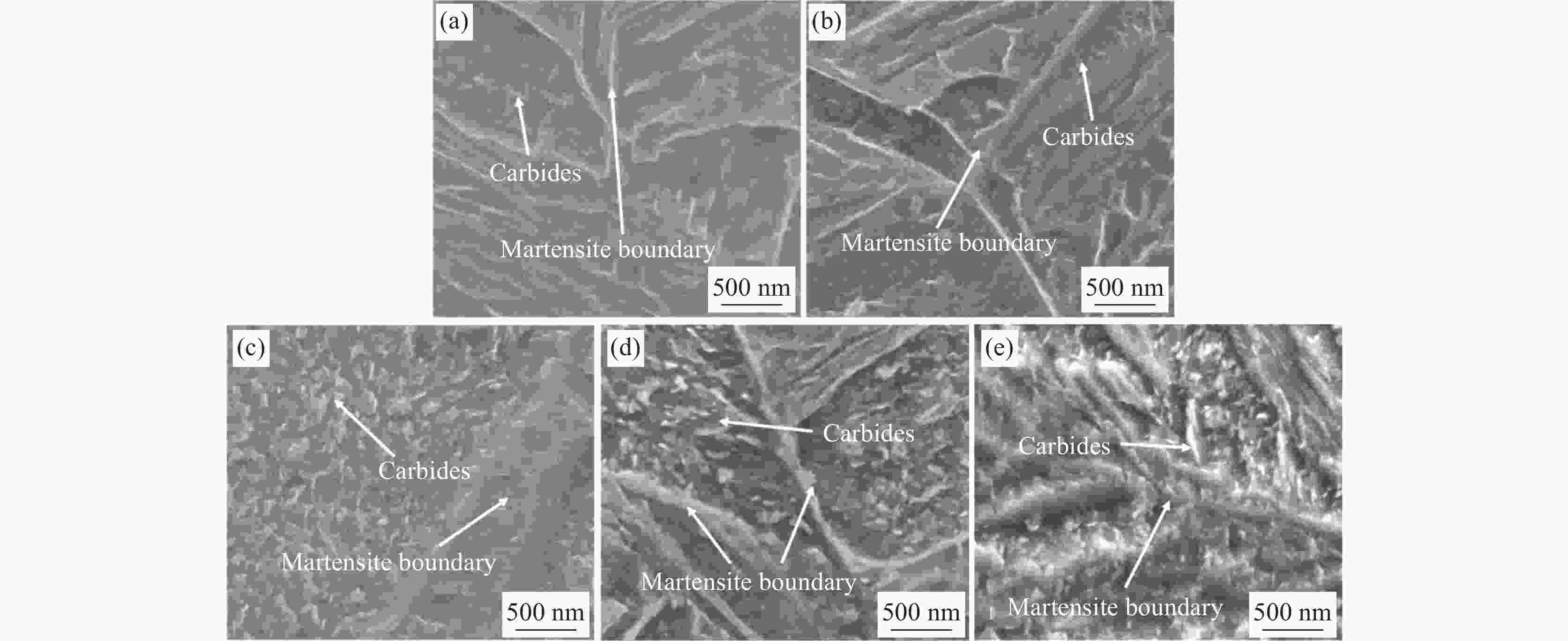
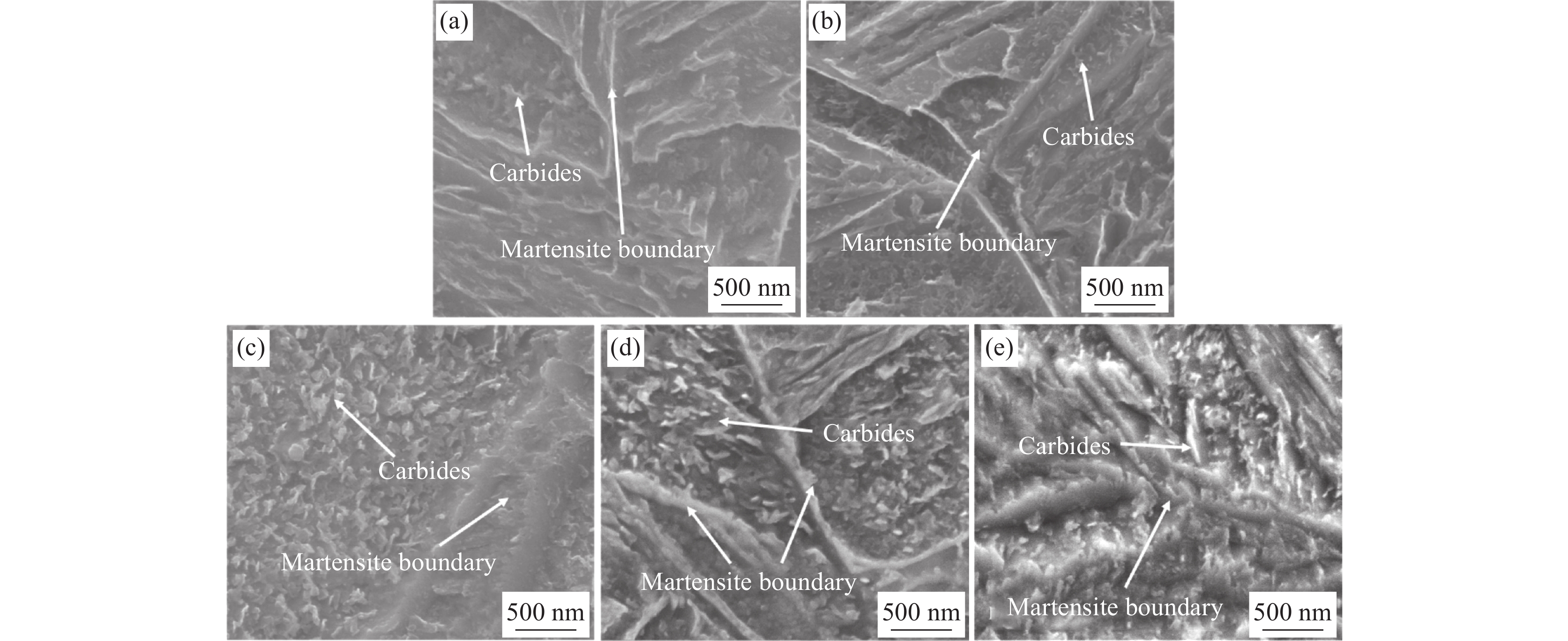
图 3 不同第一段回火温度和常规回火的试验钢SEM图
Figure 3. The SEM images of microstructure of samples after the different first step tempering temperature of two-step tempering and the traditional tempering
(a)80 ℃;(a)100 ℃;(c)130 ℃;(d)160 ℃;(e)200 ℃
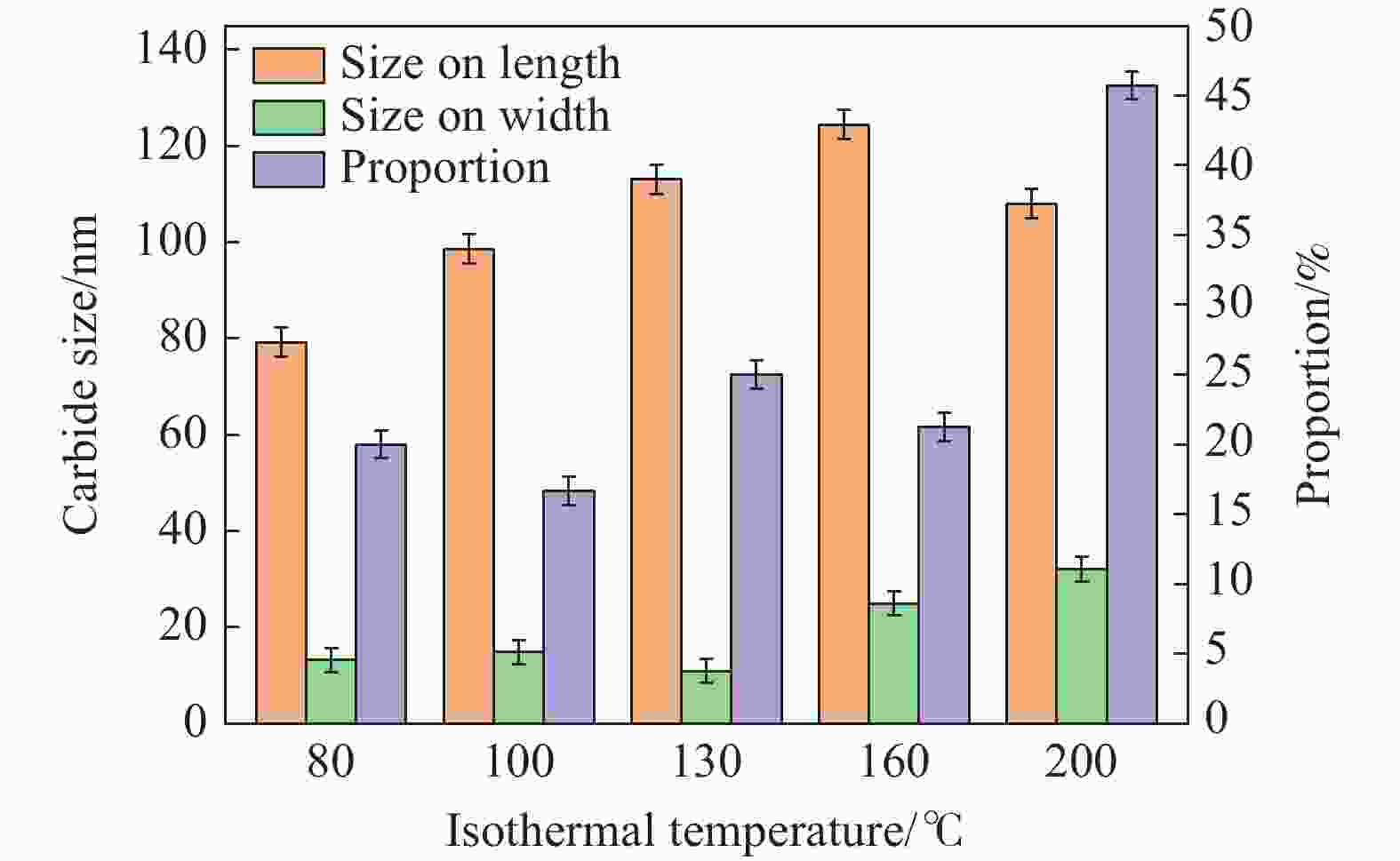
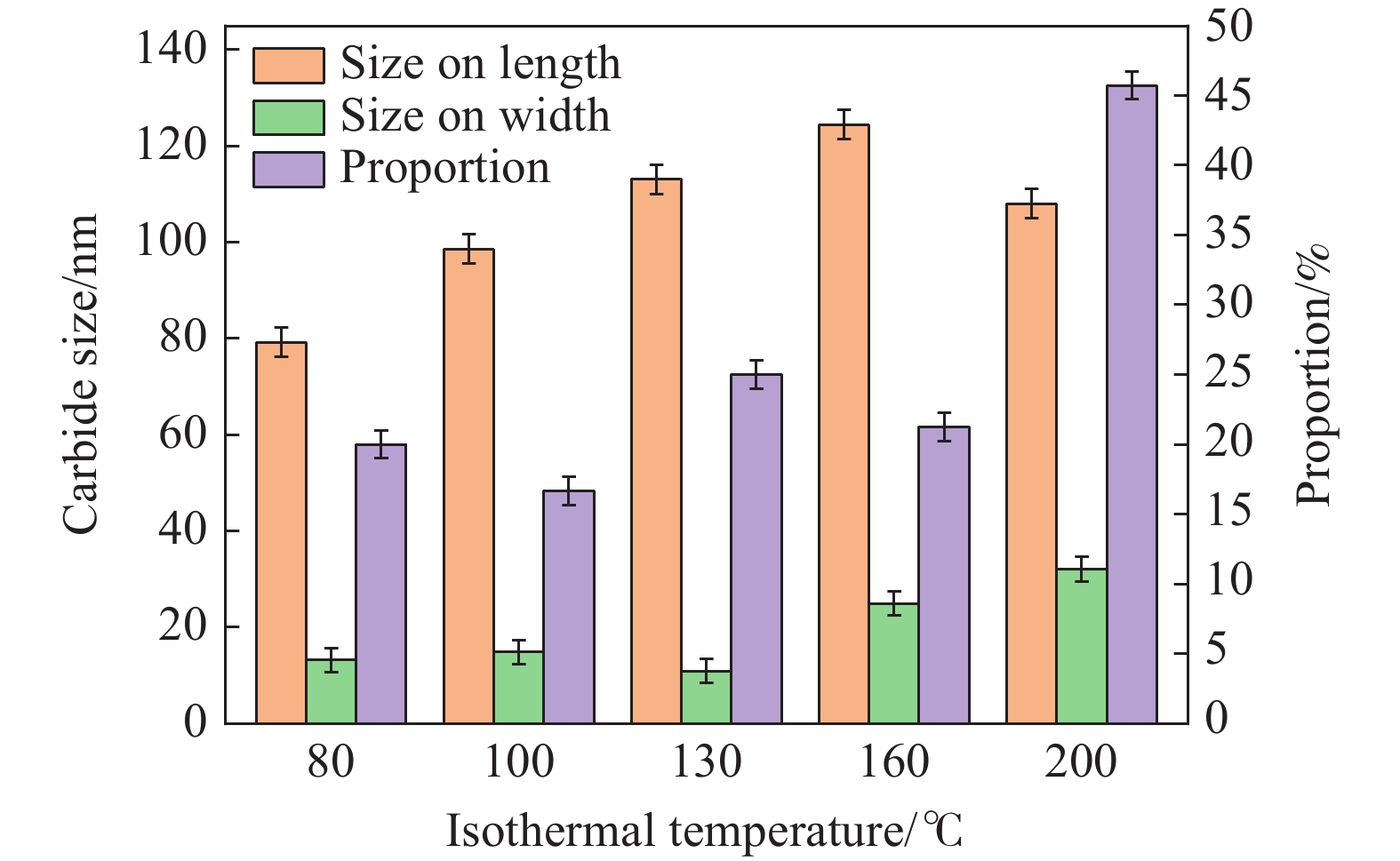
图 4 碳化物平均尺寸及其在马氏体板条界面处占比
Figure 4. Average size of carbides and their proportion at the martensite lath interfaces
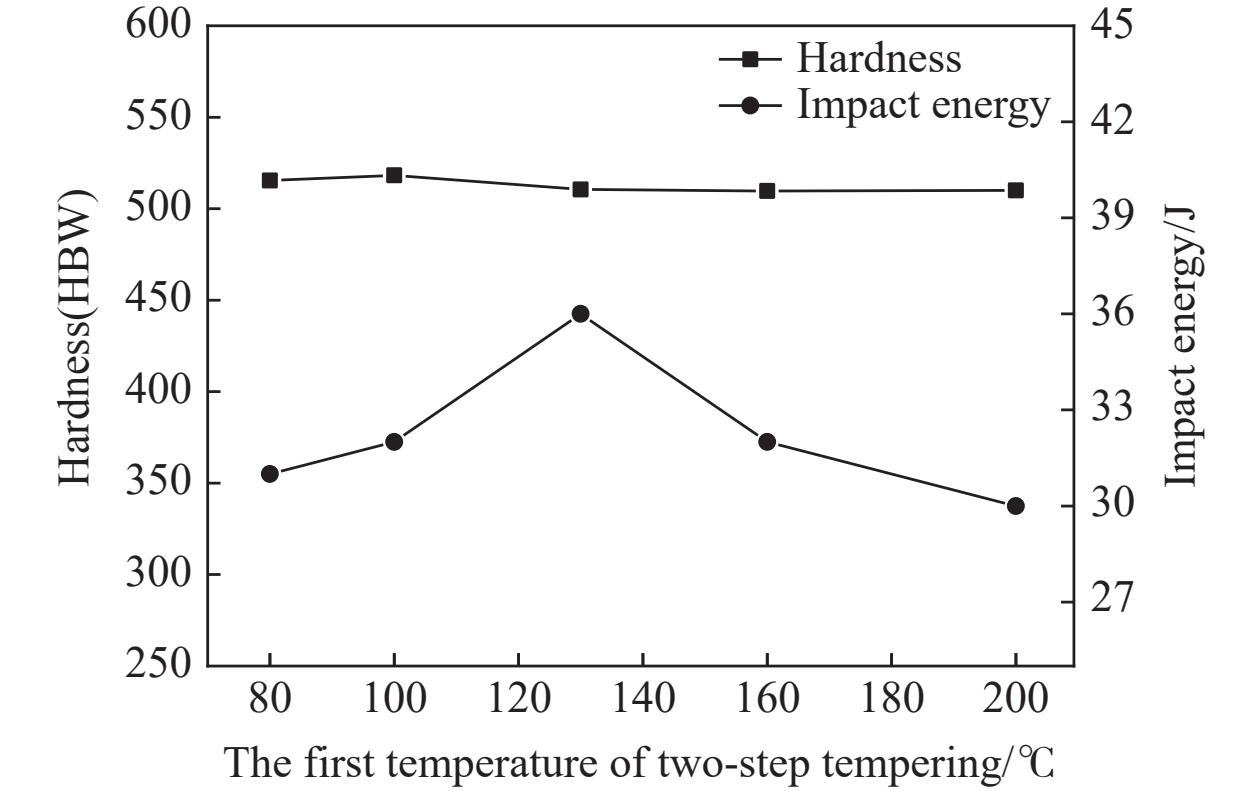
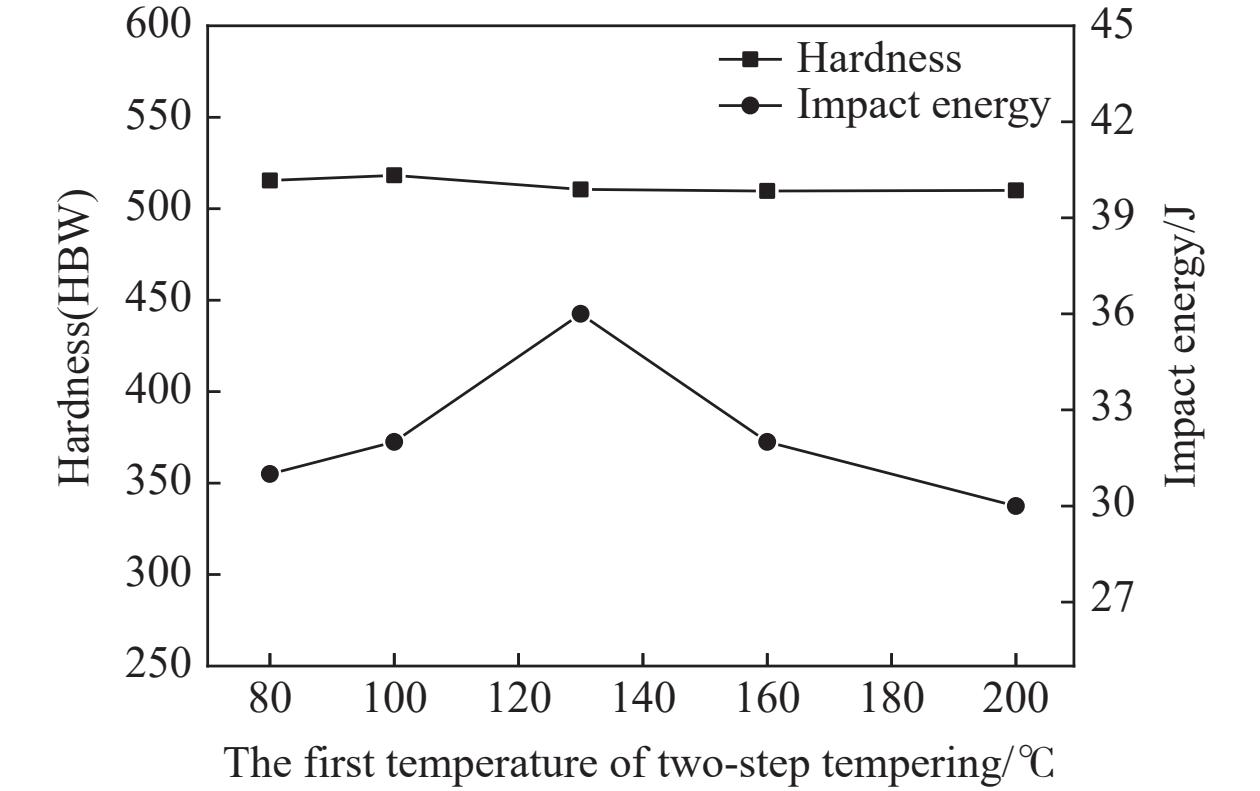
图 5 不同第一段回火温度和常规回火后试验钢的力学性能
Figure 5. The impact energy and hardness of the experimental steel treated at different first step tempering temperature of two-step tempering and the traditional tempering
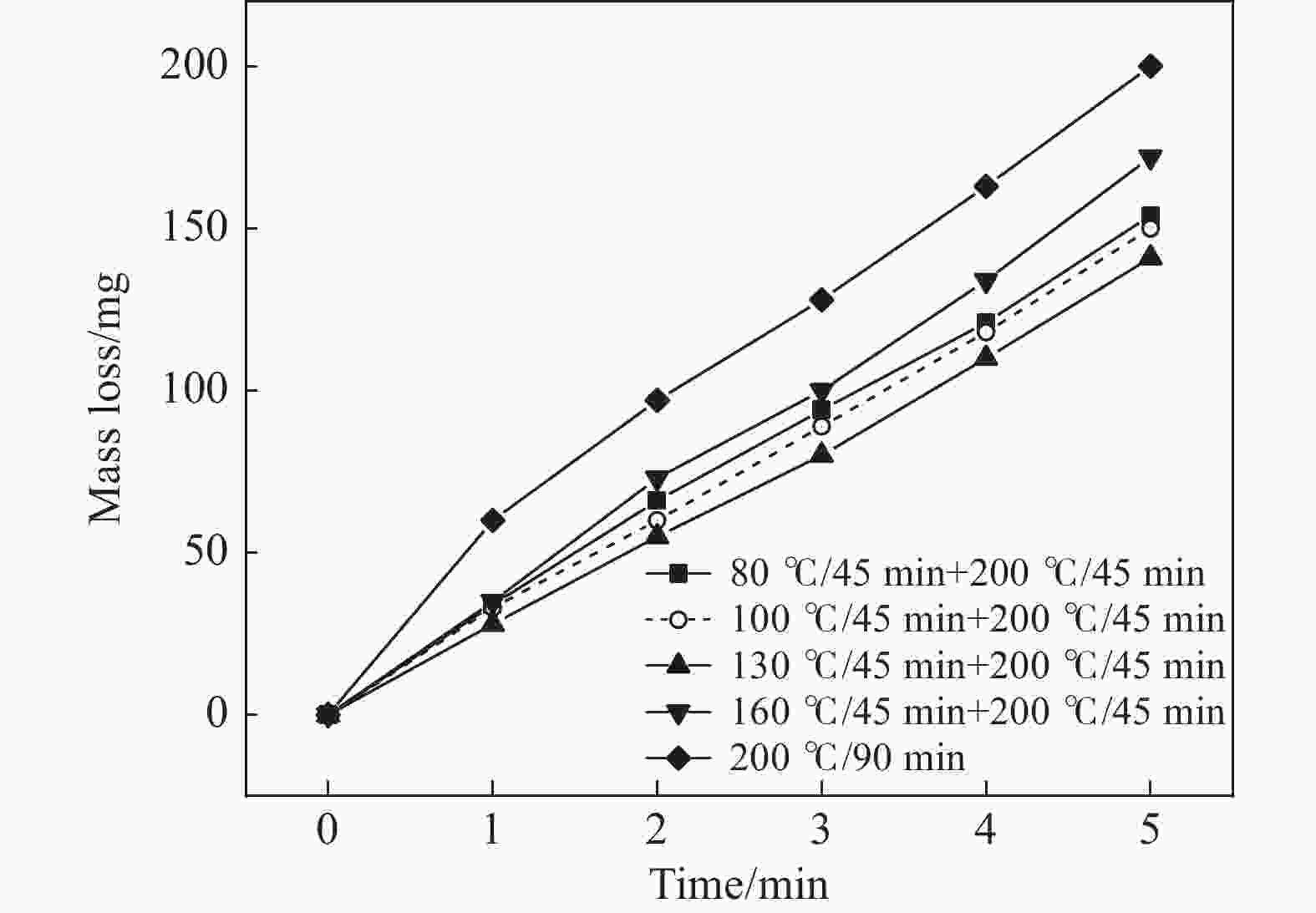
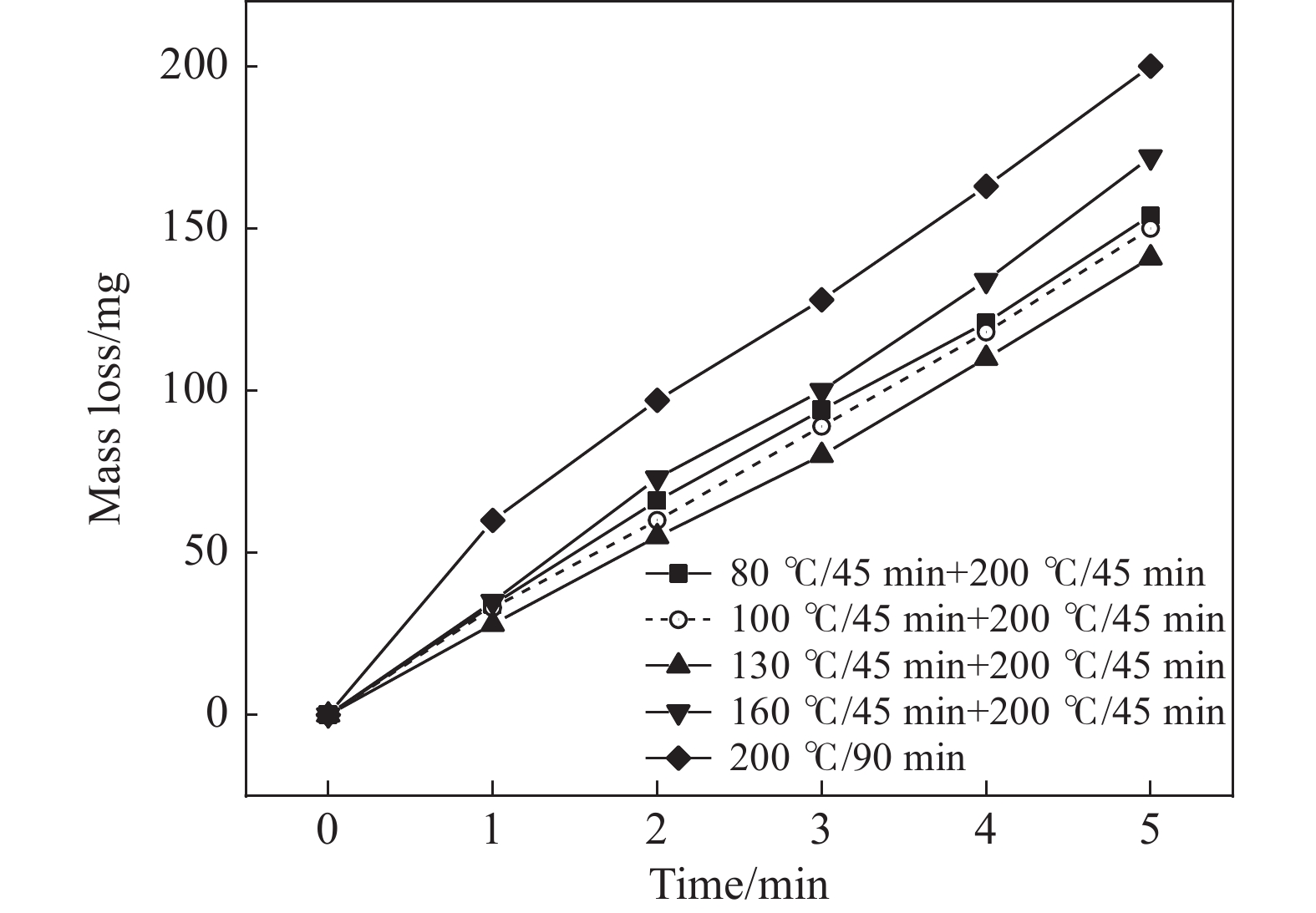
图 6 不同第一段回火温度和常规回火后试验钢的磨损失重量
Figure 6. Mass loss after sliding wear of experimental steel treated at different first step tempering temperature of two-step tempering and the traditional tempering
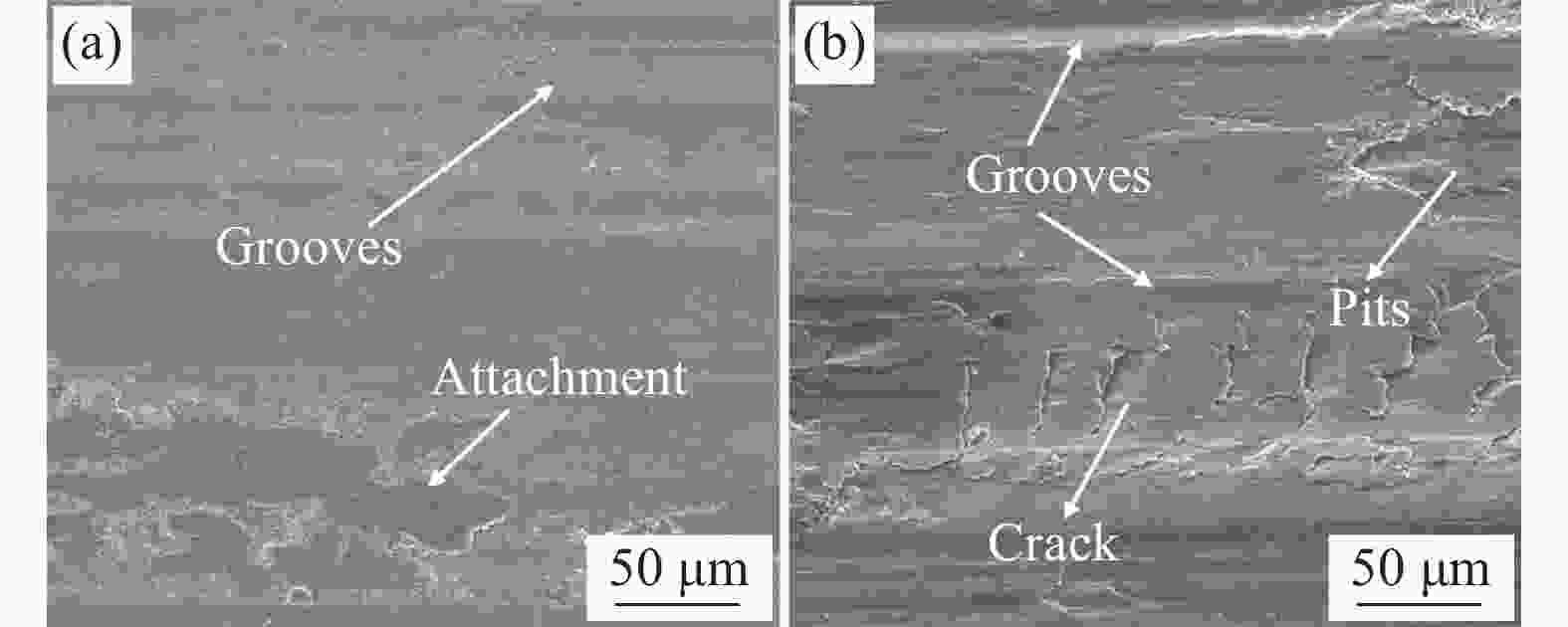
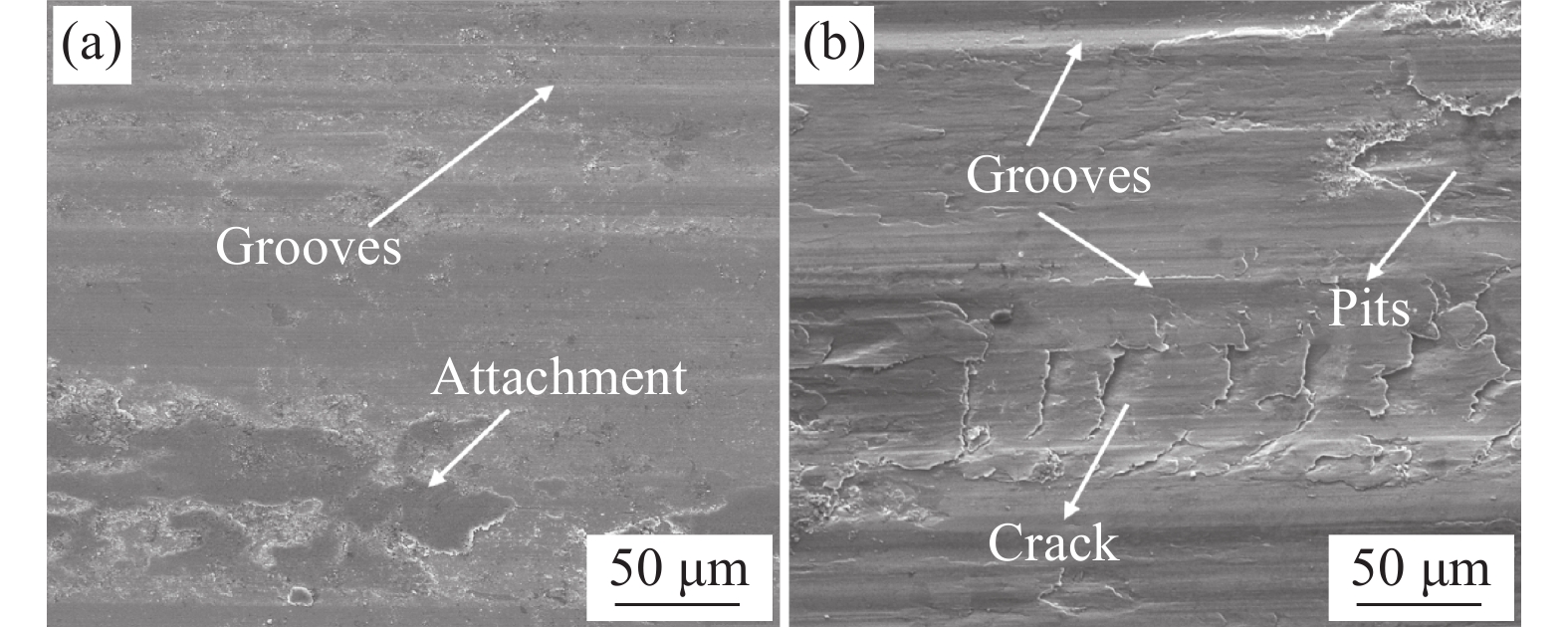
图 7 试验钢经分段回火和常规回火的磨损形貌
(a)130 ℃保温45 min随后200 ℃保温45 min;(b)常规200 ℃保温90 min
Figure 7. The morphologies of the samples treated by two-step tempering and the traditional tempering

图 8 不同第一段回火时间的试验钢显微组织
Figure 8. Microstructures of the samples treated by two-step tempering with different time of the first-step tempering
(a)15 min;(b)30 min;(c)45 min;(d)60 min
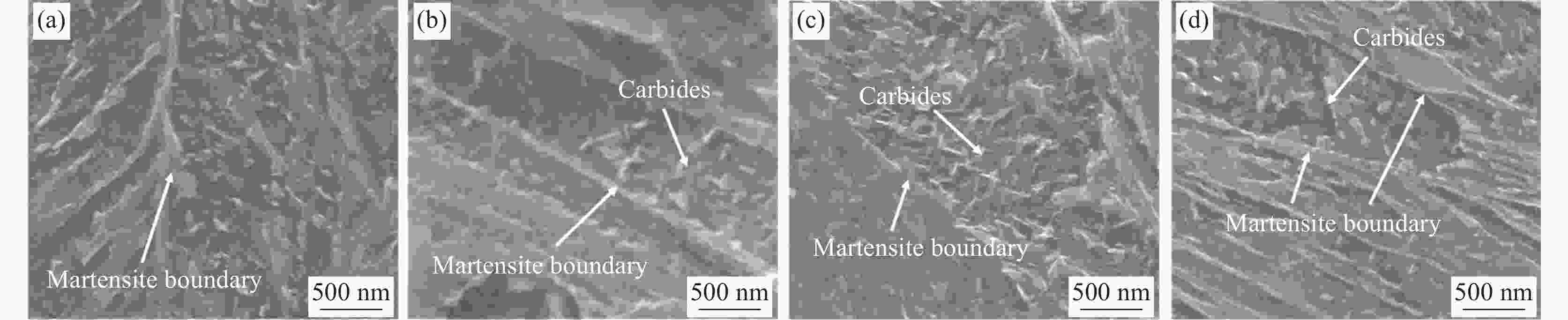
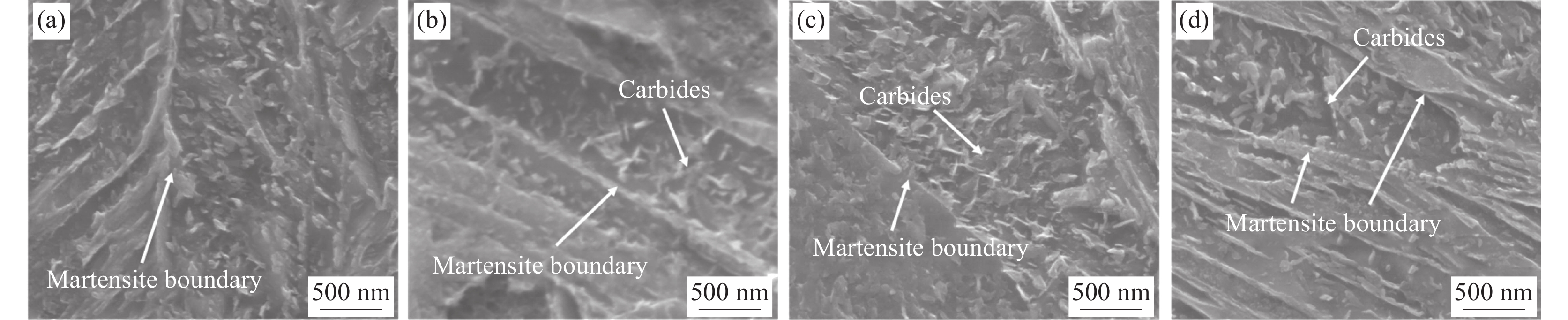
图 9 不同第一段回火时间的试验钢SEM图
Figure 9. SEM images showing microstructure of samples treated by two-step tempering with the different time of the first-step tempering
(a)15 min;(b)30 min;(c)45 min;(d)60 min
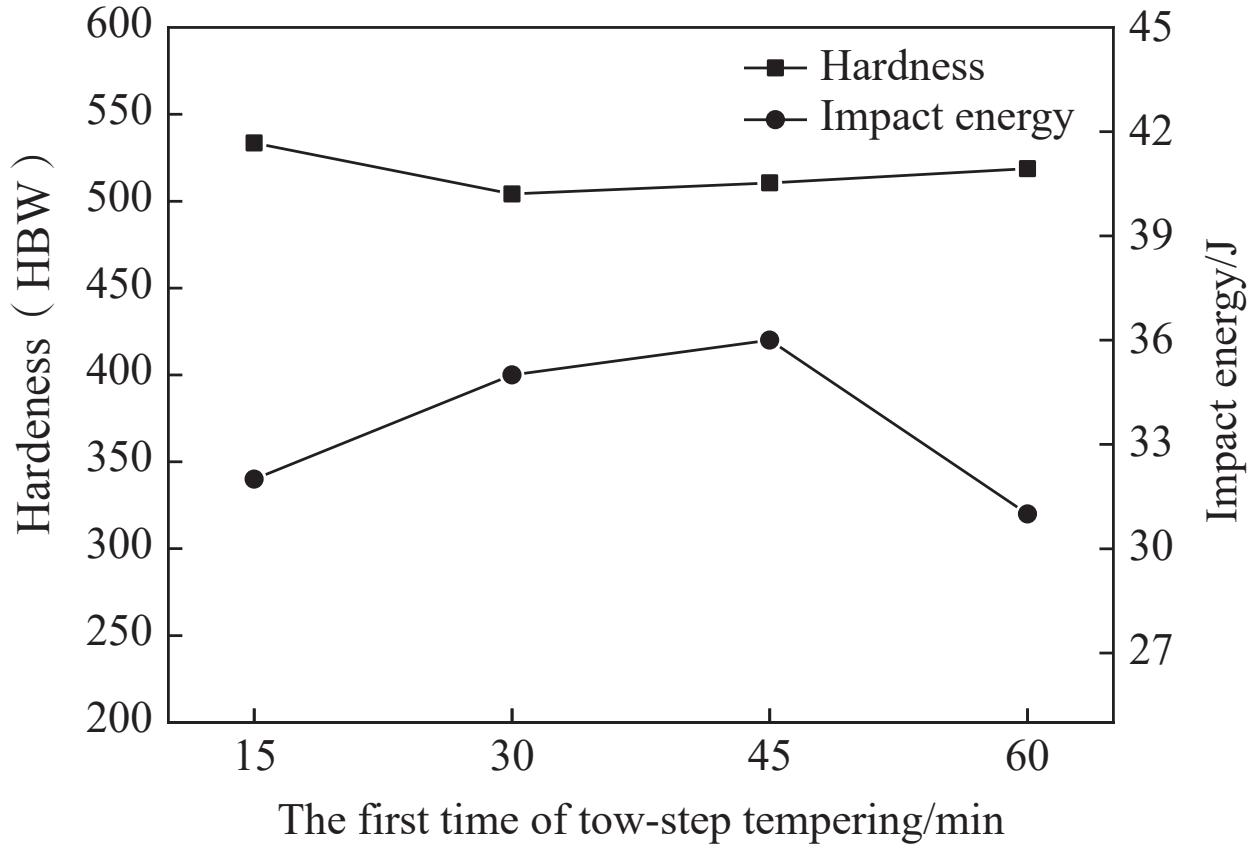
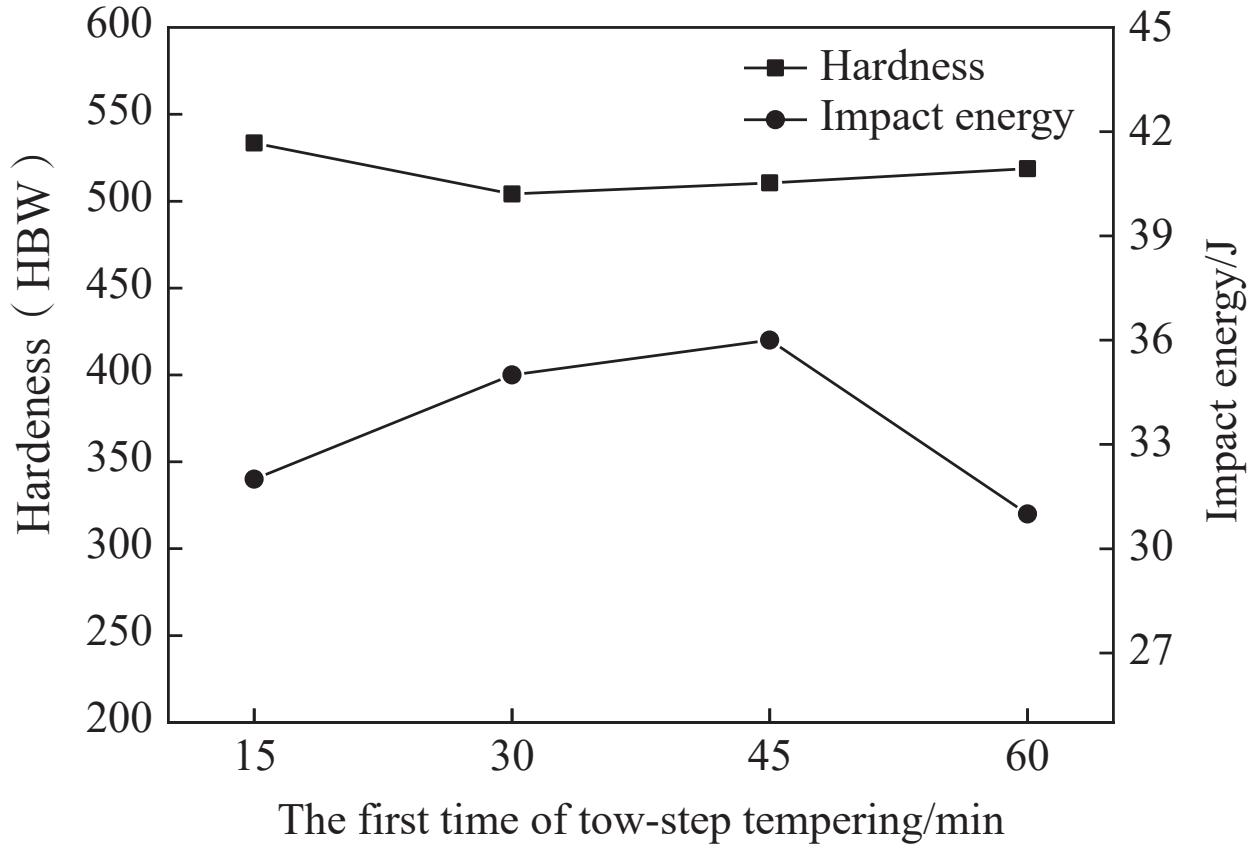
图 10 不同第一段回火时间和常规回火的试验钢力学性能
Figure 10. The impact energy and hardness of the samples treated by two-step tempering with different time of the first-step tempering
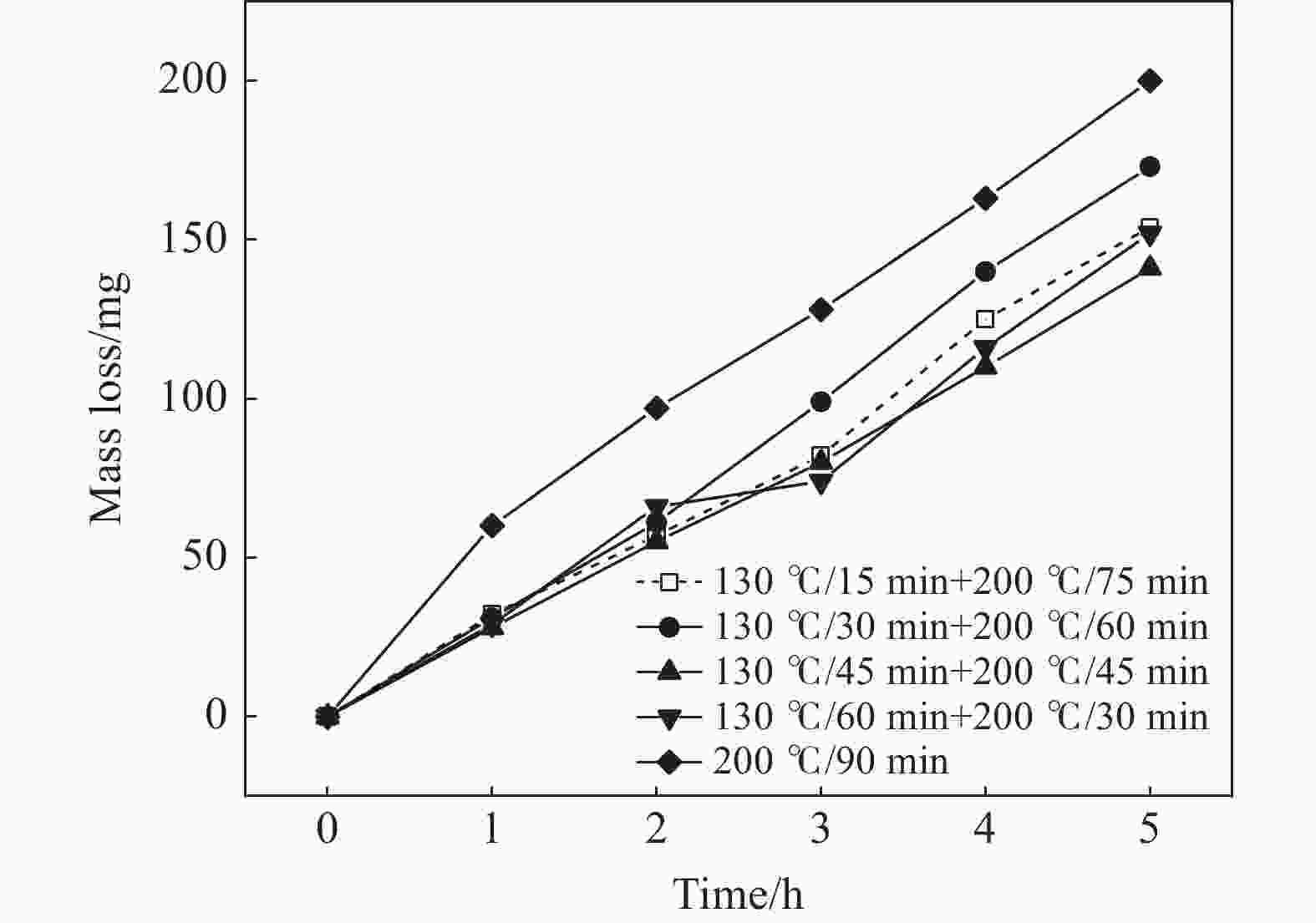
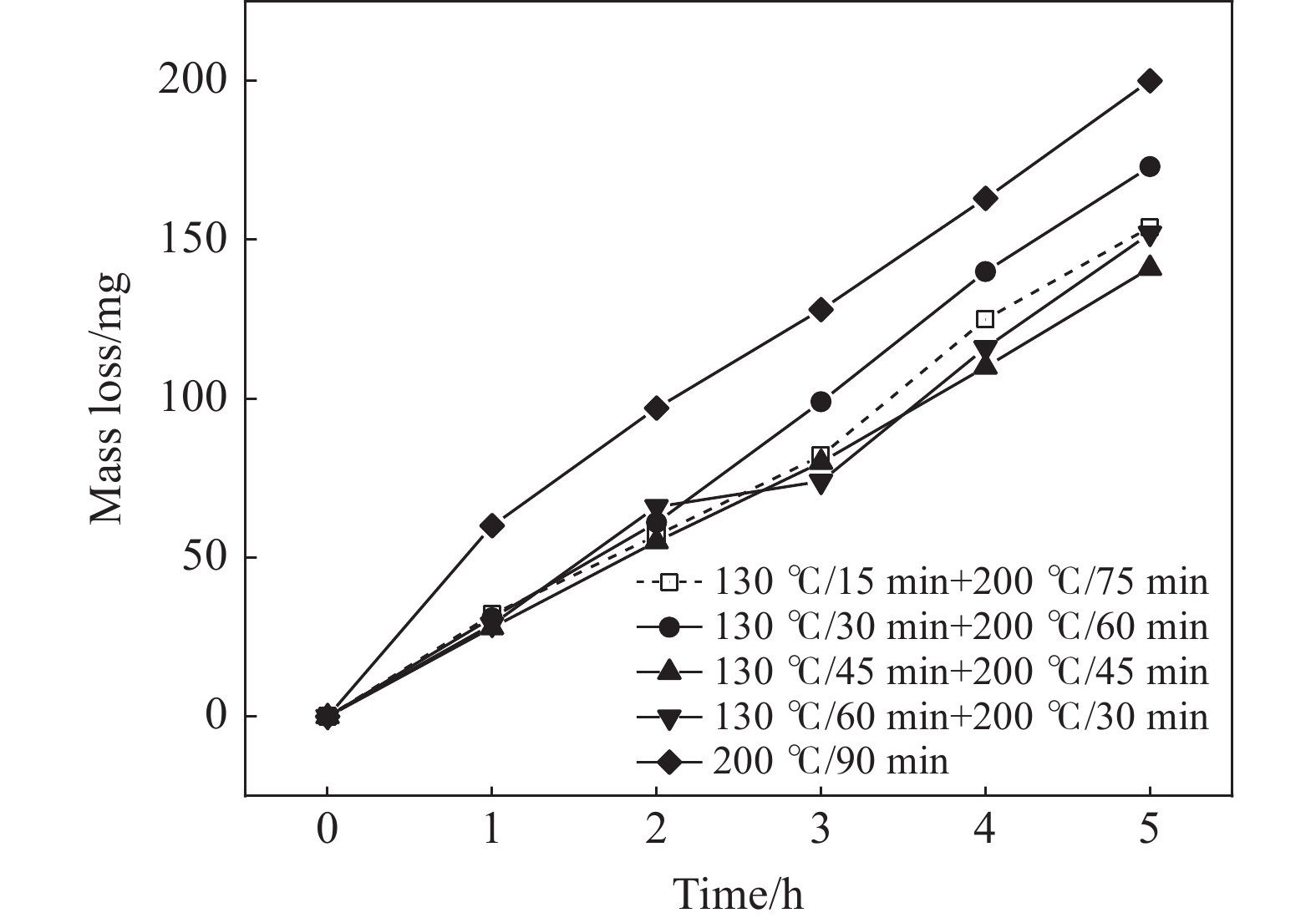
图 11 不同第一段回火时间和常规回火的试验钢磨损失重量
Figure 11. The mass loss due to sliding wear of the samples treated by two-step tempering with different time of the first-step tempering and traditional tempering
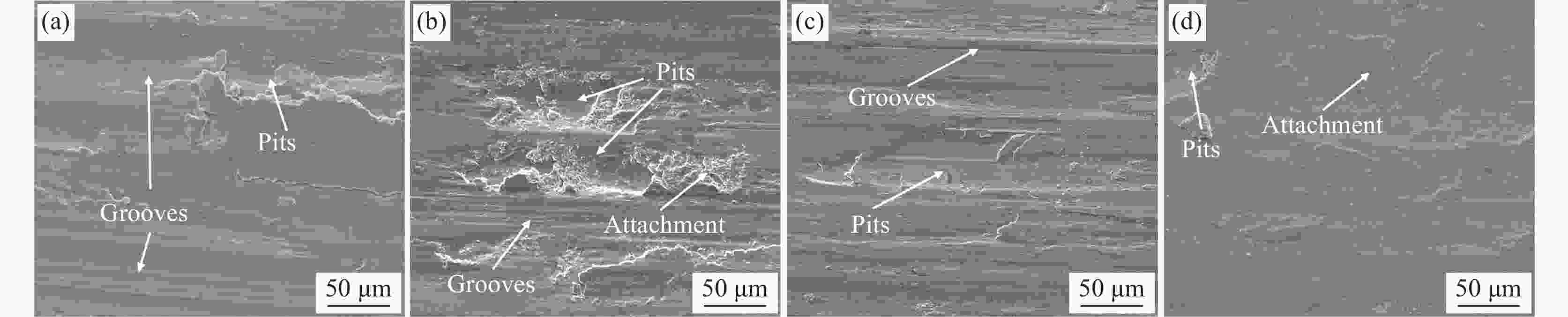
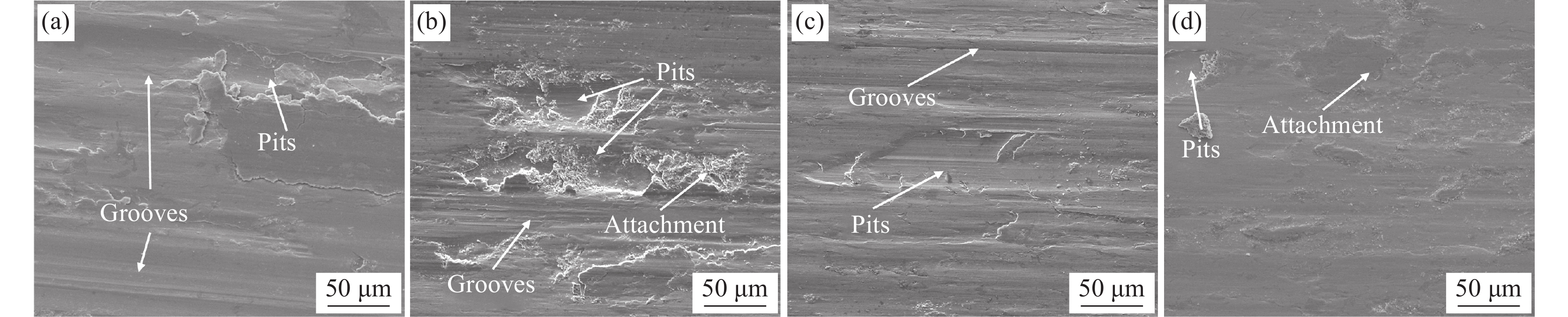
图 12 不同的第一段回火保温时间试验钢的磨损形貌
(a)15 min;(b)30 min;(c)45 min;(d)60 min
Figure 12. The morphologies of the samples treated by two-step tempering with different time of the first-step tempering
表 1 试验材料的化学成分
Table 1. Chemical composition of the experimental steel
% C Si Mn Cr Ni Al P S Fe 0.27 0.28 1.49 1.17 1.25 0.025 0.02 0.02 Bal.  下载: 导出CSV
表 2 分段回火的三因素三水平L9(33)正交试验表
Table 2. Factors and levels of the two-step tempering
Levels A/℃ B/min C/℃ 1 100 15 180 2 130 30 200 3 160 45 220
下载: 导出CSV
表 3 正交试验的设计及结果
Table 3. Design and results of orthogonal experiment
NO. A/℃ B/min C/℃ Impact
toughness of -20 ℃/JHardness
(HBW)Wear
amount/mg1 100 15 180 26 490.4 172 2 100 30 200 29 505.5 176 3 100 45 220 32 528.1 217 4 130 15 200 35 494.9 131 5 130 30 220 33 504.1 181 6 130 45 180 32 525.0 146 7 160 15 220 34 481.2 149 8 160 30 180 30 502 166 9 160 45 200 35 519 162
下载: 导出CSV
表 4 试验钢的极差分析
Table 4. Range analysis table of experimental steel
Factor Impact toughness of -20 ℃/J Hardness(HBW) Wear amount/mg k1 k2 k3 R k1 k2 k3 R k1 k2 k3 R A 29 33.3 33 4.3 508 508 500.3 7.27 188.3 152.7 159 35.7 B 31.7 30.7 33 2.3 488.8 506.5 504.5 35.2 150.7 174.3 175 24.3 C 29.3 33 33 3.7 504.5 503.9 508.3 2 161.3 156.3 182.3 26 Influence degree A>C>B B>A>C A>C>B Optimal combination A2B3C2 or A2B3C3 A1B2C3 or A2B2C3 A2B1C2
下载: 导出CSV
表 5 试验钢的冲击韧性方差分析
Table 5. Analysis of variance of impact toughness of experimental steel
Factors Impact toughness Hardness Wear amount S f MS F S f MS F S f MS F A 34.89 2 17.44 22.4 105.61 2 52.81 3.04 2172.67 2 1086.33 5.16 B 8.22 2 4.11 5.29 1871.77 2 935.87 53.93 1152.67 2 576.33 2.74 C 26.89 2 13.44 17.3 6.22 2 3.11 0.18 1142 2 571 2.71
下载: 导出CSV
-
[1] 李忠波, 胡海江, 何平, 等. 淬火和回火温度对Cr-Mo系耐磨钢组织及力学性能的影响[J]. 金属热处理, 2025, 50(1): 88-97. Li Zhongbo, Hu Haijiang, He Ping, et al. Effects of quenching and tempering temperature on microstructure and mechanical properties of Cr-Mo wear-resistant steel[J]. Heat Treatment of Metals, 2025, 50(1): 88-97. doi: 10.13251/j.issn.0254-6051.2025.01.014Li Zhongbo, Hu Haijiang, He Ping, et al. Effects of quenching and tempering temperature on microstructure and mechanical properties of Cr-Mo wear-resistant steel[J]. Heat Treatment of Metals, 2025, 50(1): 88-97. doi: 10.13251/j.issn.0254-6051.2025.01.014 [2] Galindo-Nava E I, Rivera-Díaz-del-Castillo P E J. Understanding the factors controlling the hardness in martensitic steels[J]. Scripta Materialia, 2016, 96-100. [3] 王凯凯, 马龙腾, 罗平, 等. 回火温度对贝氏体耐磨钢组织和性能的影响[J]. 金属热处理, 2023, 48(3): 84-90. Wang Kaikai, Ma Longteng, Luo Ping, et al. Effect of tempering temperature on microstructure and properties of bainitic wear-resistant steel[J]. Heat Treatment of Metals, 2023, 48(3): 84-90. doi: 10.13251/j.issn.0254-6051.2023.03.014Wang Kaikai, Ma Longteng, Luo Ping, et al. Effect of tempering temperature on microstructure and properties of bainitic wear-resistant steel[J]. Heat Treatment of Metals, 2023, 48(3): 84-90. doi: 10.13251/j.issn.0254-6051.2023.03.014 [4] 黄龙, 邓想涛, 王昭东. 回火温度对颗粒增强型低合金耐磨钢组织和性能的影响[J]. 金属热处理, 2022, 47(3): 1-6. Huang Long, Deng Xiangtao, Wang Zhaodong. Effect of tempering temperature on microstructure and properties of particle reinforced low-alloyed wear resistant steel[J]A. Heat Treatment of Metals, 2022, 47(3): 1-6.Huang Long, Deng Xiangtao, Wang Zhaodong. Effect of tempering temperature on microstructure and properties of particle reinforced low-alloyed wear resistant steel[J]A. Heat Treatment of Metals, 2022, 47(3): 1-6. [5] 马玉喜, 宋新莉, 练容彪, 等. 回火温度与钛含量对低合金耐磨钢组织及性能的影响[J]. 材料热处理学报, 2017, 38(5): 67-72. Ma Yuxi, Song Xinli, Lian Rongbiao, et al. Effect of tempering temperature and titanium on content microstructure and mechanical properties of low alloy wear resistant steels[J]. Transactions of Materials and Heat Treatment, 2017, 38(5): 67-72. doi: 10.13289/j.issn.1009-6264.2016-X247Ma Yuxi, Song Xinli, Lian Rongbiao, et al. Effect of tempering temperature and titanium on content microstructure and mechanical properties of low alloy wear resistant steels[J]. Transactions of Materials and Heat Treatment, 2017, 38(5): 67-72. doi: 10.13289/j.issn.1009-6264.2016-X247 [6] Lindroos M, Ratia V, Apostol M, et al. The effect of impact conditions on the wear and deformation behavior of wear resistant steels[J]. Wear, 2015, 328-329: 197-205. [7] 刘国亮, 唐梦兰, 李栋, 等. 42CrMo钢回火组织演变及屈服强度预测[J]. 材料热处理学报, 2020, 41(7): 144-150. Liu Guoliang, Tang Menglan, Li Dong, et al. Microstructural evolution and yield strength prediction of quench-tempered 42CrMo steel[J]. Transactions of Materials and Heat Treatment, 2017, 38(5): 67-72.Liu Guoliang, Tang Menglan, Li Dong, et al. Microstructural evolution and yield strength prediction of quench-tempered 42CrMo steel[J]. Transactions of Materials and Heat Treatment, 2017, 38(5): 67-72. [8] Speer J, Matlock D K, Cooman B, et al. Carbon partitioning into austenite after martensite transformation[J]. Acta Mater, 2003, 51: 2611-2622. doi: 10.1016/S1359-6454(03)00059-4 [9] Xiao Y, Li W, Zhao H S, et al. Investigation of carbon segregation during low temperature tempering in a medium carbon steel[J]. Materials Characterization, 2016, 117: 84-90. doi: 10.1016/j.matchar.2016.04.021 [10] Saha D C, Biro E, Gerlich A P, et al. Effects of tempering mode on the structural changes of martensite[J]. Materials Science and Engineering: A, 2016, 673: 467-475. doi: 10.1016/j.msea.2016.07.092 [11] Lin H, Chang J Z. An investigation of the role of secondary carbide in martensitic steel during three-body abrasion wear[J]. Wear, 1994, 176: 103-109. doi: 10.1016/0043-1648(94)90203-8 [12] 朱震宇, 吴志方, 吴润. 回火温度对NM500耐磨钢组织和性能的影响[J]. 金属热处理, 2022, 47: 154-159. Zhu Zhenyu, Wu Zhifang, Wu Run. Effect of tempering temperature on microstructure and properties of NM500 wear-resistant steel, 2022, 47: 154-159.Zhu Zhenyu, Wu Zhifang, Wu Run. Effect of tempering temperature on microstructure and properties of NM500 wear-resistant steel, 2022, 47: 154-159. [13] 柳金甫, 张志刚. 概率论与数理统计[M]. 北京市: 北京大学出版社, 2023: 127-137. Liu Jinpu, Zhang Zhigang. Probability and mathematical statistics[M]. Beijing: Peking University Press, 2023: 127-137.Liu Jinpu, Zhang Zhigang. Probability and mathematical statistics[M]. Beijing: Peking University Press, 2023: 127-137. [14] Ruijie Z, Chunlei Z, Bo L, et al. Effect of non-uniform microstructure on rolling contact fatigue performance of bainitic rail steel[J]. International Journal of Fatigue, 2022, 159: 106795. doi: 10.1016/j.ijfatigue.2022.106795 -



计量
- 文章访问数: 0
- HTML全文浏览量: 0
- PDF下载量: 0
- 被引次数: 0