Study on the effects of pouring speed and mold heating temperature on shrinkage cavity of superalloy induction ingot
-
摘要: 高温合金感应锭存在大尺寸缩孔缺陷,会显著影响感应锭成材率、后续重熔工序的运行稳定性,以及产品质量。采用数值仿真模拟分析了浇注速度、锭模加热温度这两种典型工艺参数对感应锭缩孔深度的影响。结果表明:感应锭缩孔深度并未随浇注速度的增加呈现规律性变化。由于调整浇注速度未能改变感应锭凝固过程纵向温度分布规律及凝固顺序,因此无法通过该工艺参数的优化显著减小感应锭缩孔深度。采用锭模加热可以减小锭模与感应锭凝固过程纵向方向上的温差,在一定程度上改善了感应锭纵向凝固向着顺序凝固反方向发展的趋势,采用锭模加热可以显著减小感应锭缩孔深度。Abstract: Large-scale shrinkage cavity defects exist in superalloy induction ingots, which significantly affect the yield of the induction ingots, the operational stability of the subsequent remelting processes and the product quality. This paper analyzes the effects of two typical process parameters, namely pouring speed and mold heating temperature, on the depth of shrinkage cavities in induction ingots through numerical simulation. The results indicate that the depth of shrinkage cavities in induction ingots does not change regularly with increasing pouring speed. Since adjusting the pouring speed fails to alter the longitudinal temperature distribution and solidification sequence of the induction ingot during solidification. It is impossible to significantly reduce the depth of shrinkage cavities through optimization of this process parameter. Using mold heating can reduce the temperature difference of the mold and the induction ingot in the longitudinal direction during solidification, which to some extent improves the trend of longitudinal solidification of the induction ingot towards the opposite direction of sequential solidification. Using mold heating can significantly reduce the depth of shrinkage cavities in induction ingots.
-
Key words:
- superalloy /
- induction ingot /
- pouring speed /
- ingot mold temperature /
- shrinkage cavity
-
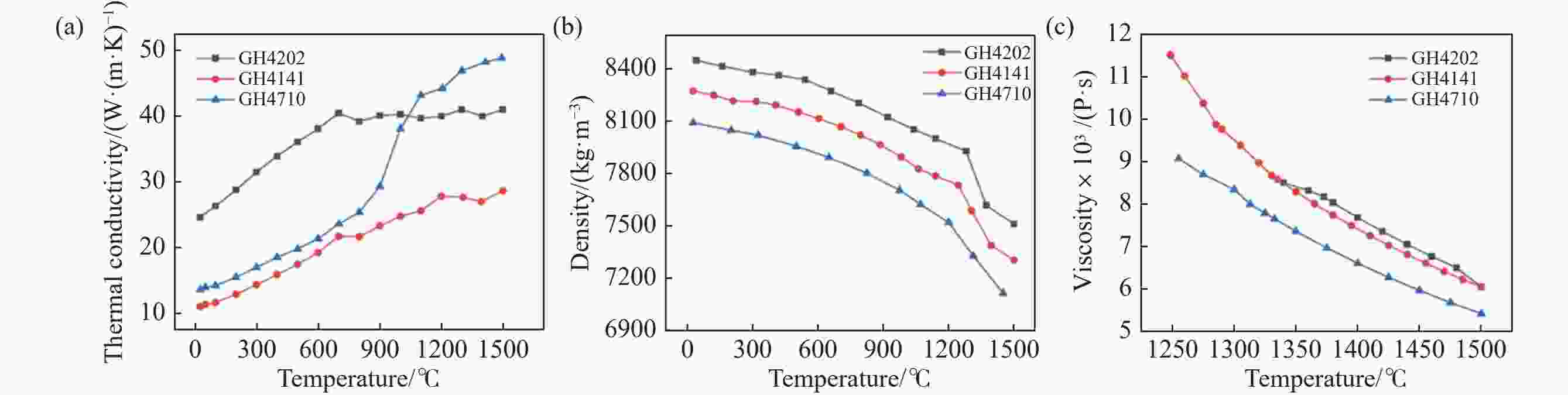
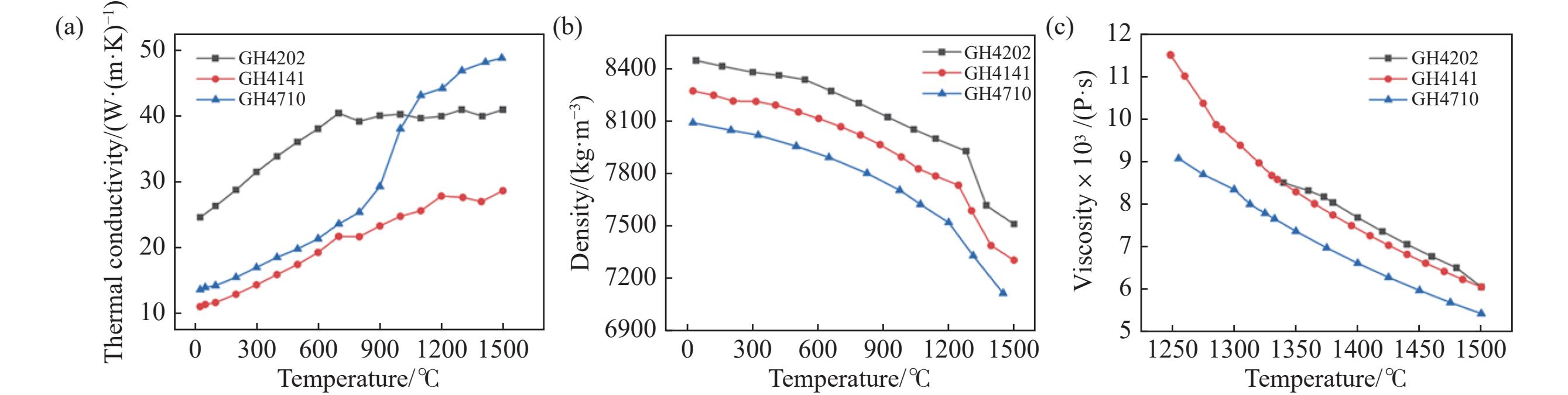
图 2 不同合金典型热物性参数
(a)导热系数;(b)密度;(c)黏度
Figure 2. Typical thermophysical properties of different alloys
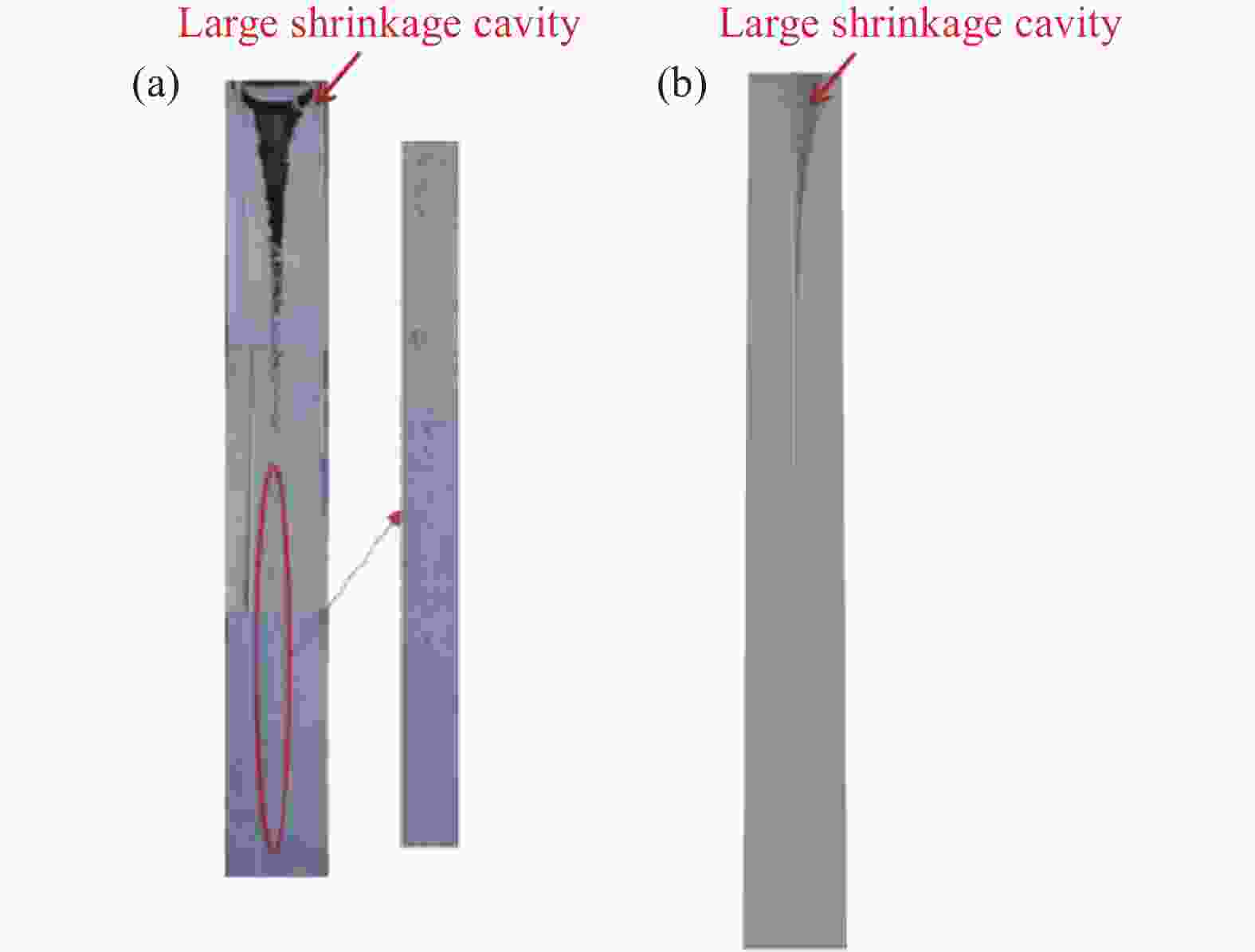
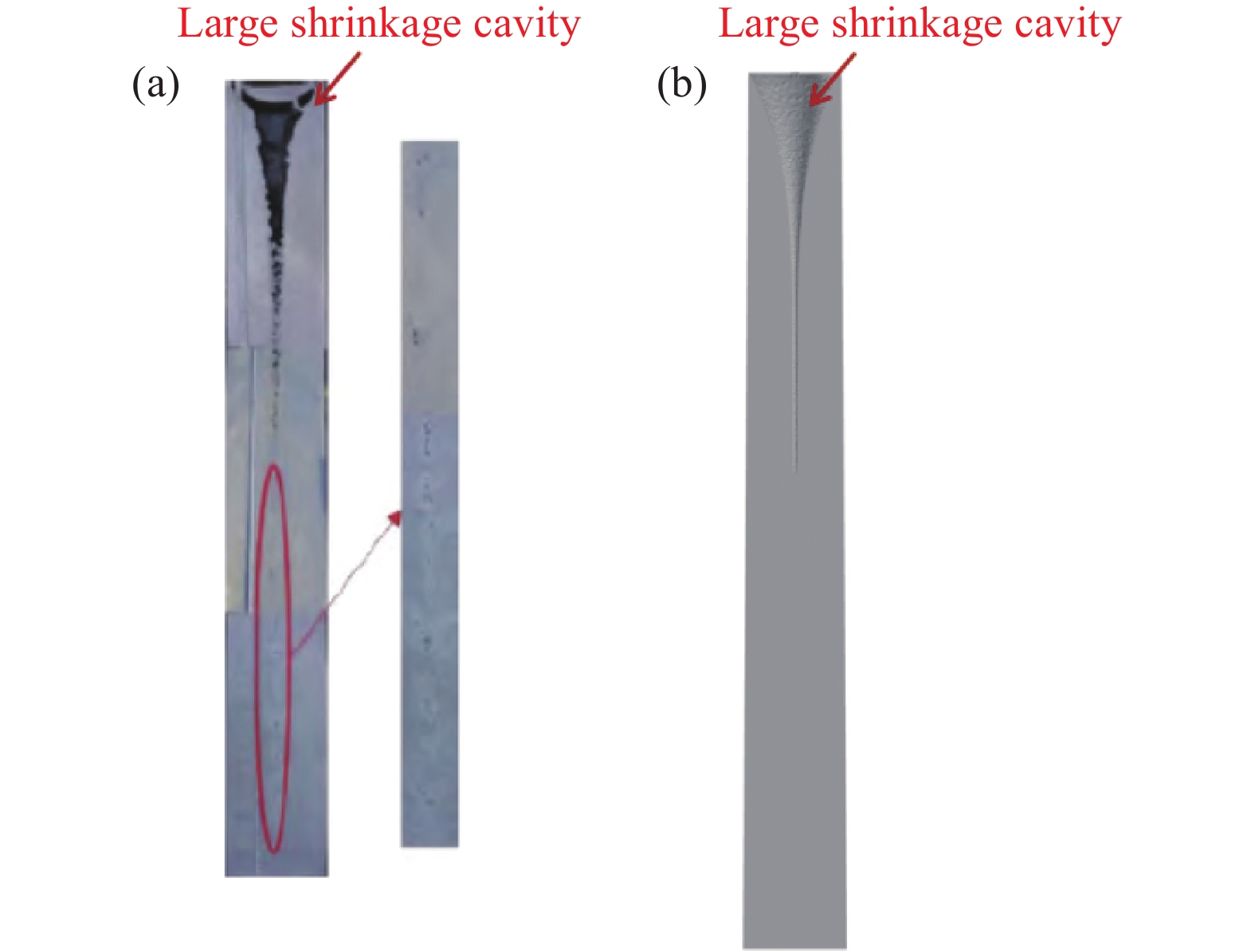
图 3 试验解剖的[12]与模拟预测的缩孔形貌
(a)试验解剖;(b)模拟预测
Figure 3. Shrinkage cavity morphology obtained from experimental dissection and simulated prediction
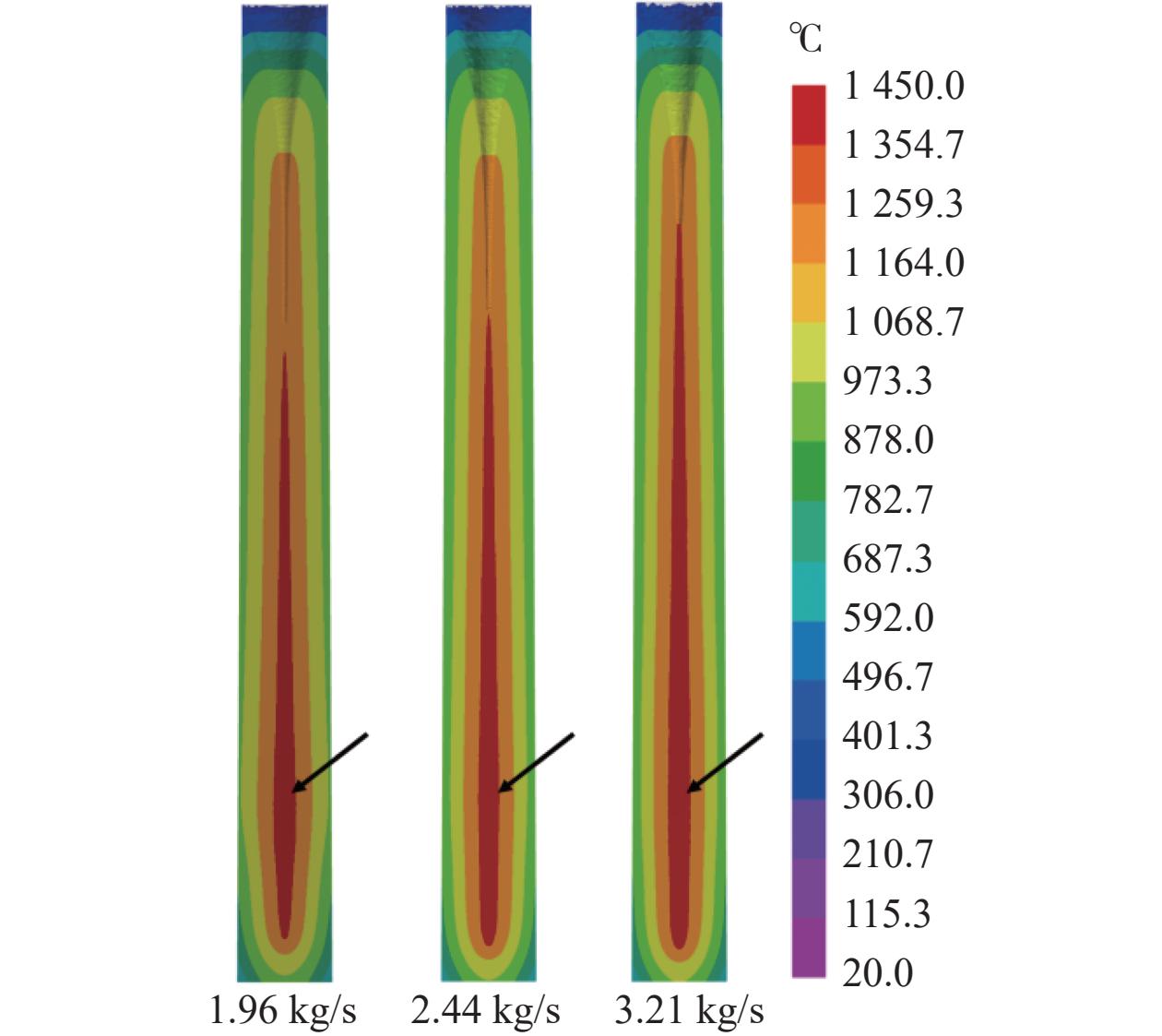
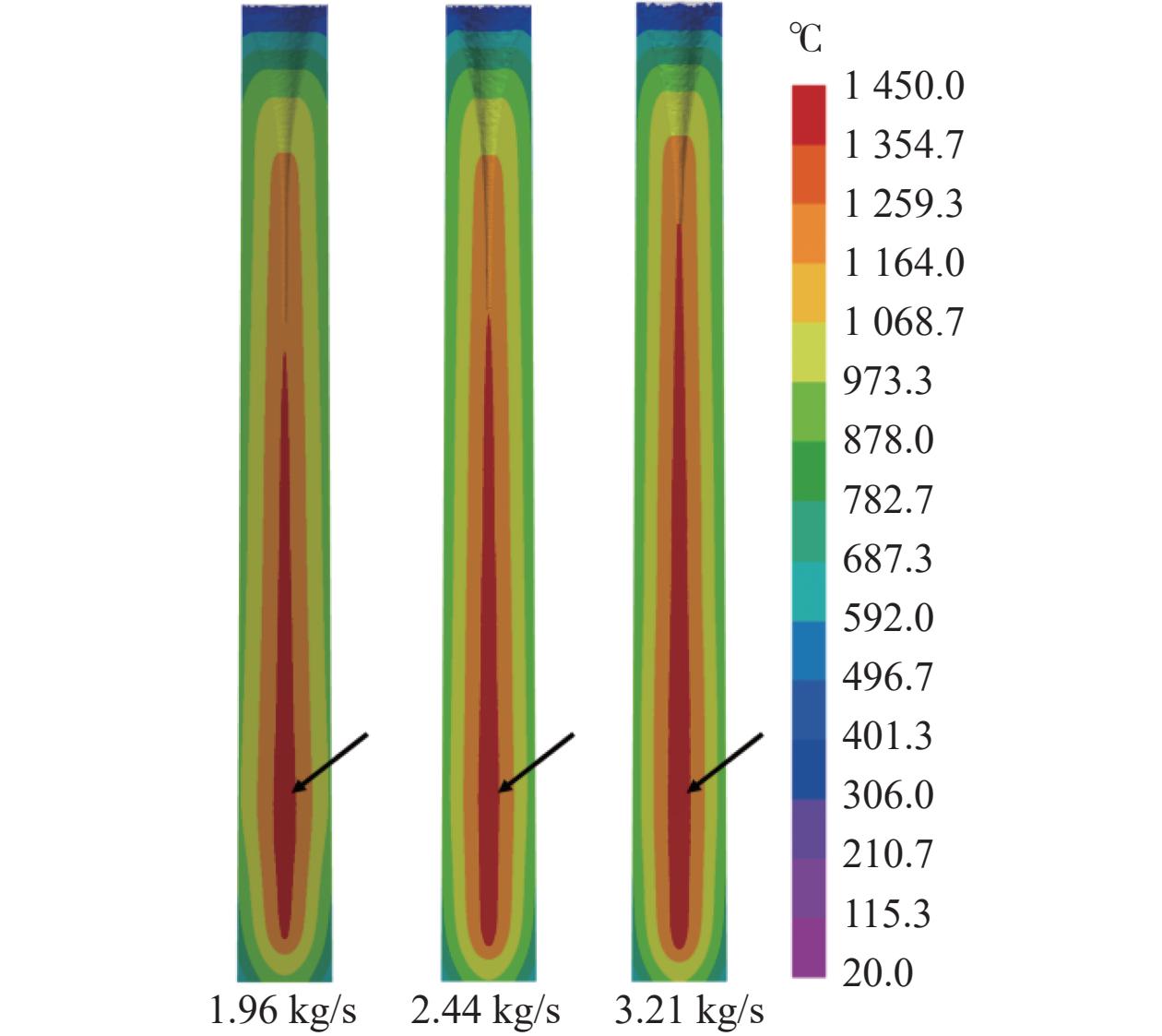
图 4 不同浇注速度下感应锭凝固时的温度分布
Figure 4. Temperature distribution during the solidification of induction ingots under different pouring speeds
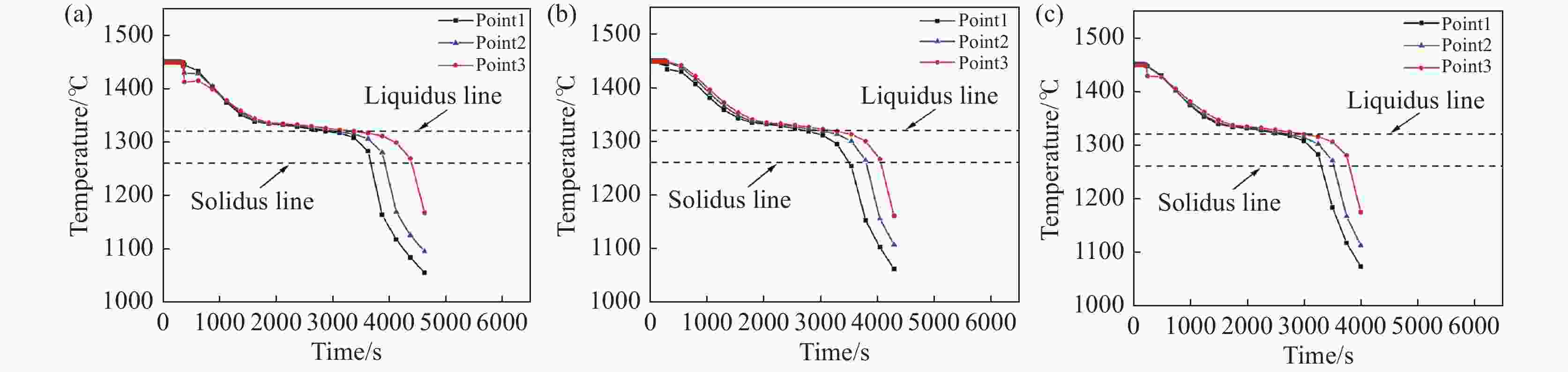
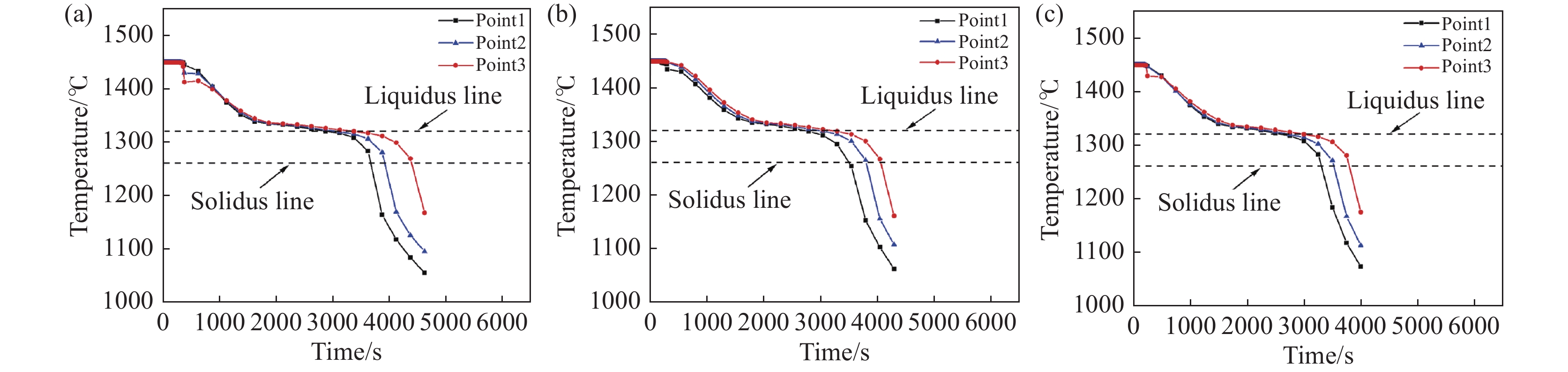
图 6 不同浇注速度下各监测点合金温度随时间变化曲线
Figure 6. The curve of temperature versus time of monitoring points under different pouring speeds
(a)1.96 kg/s;(b) 2.44 kg/s;(c) 3.21 kg/s
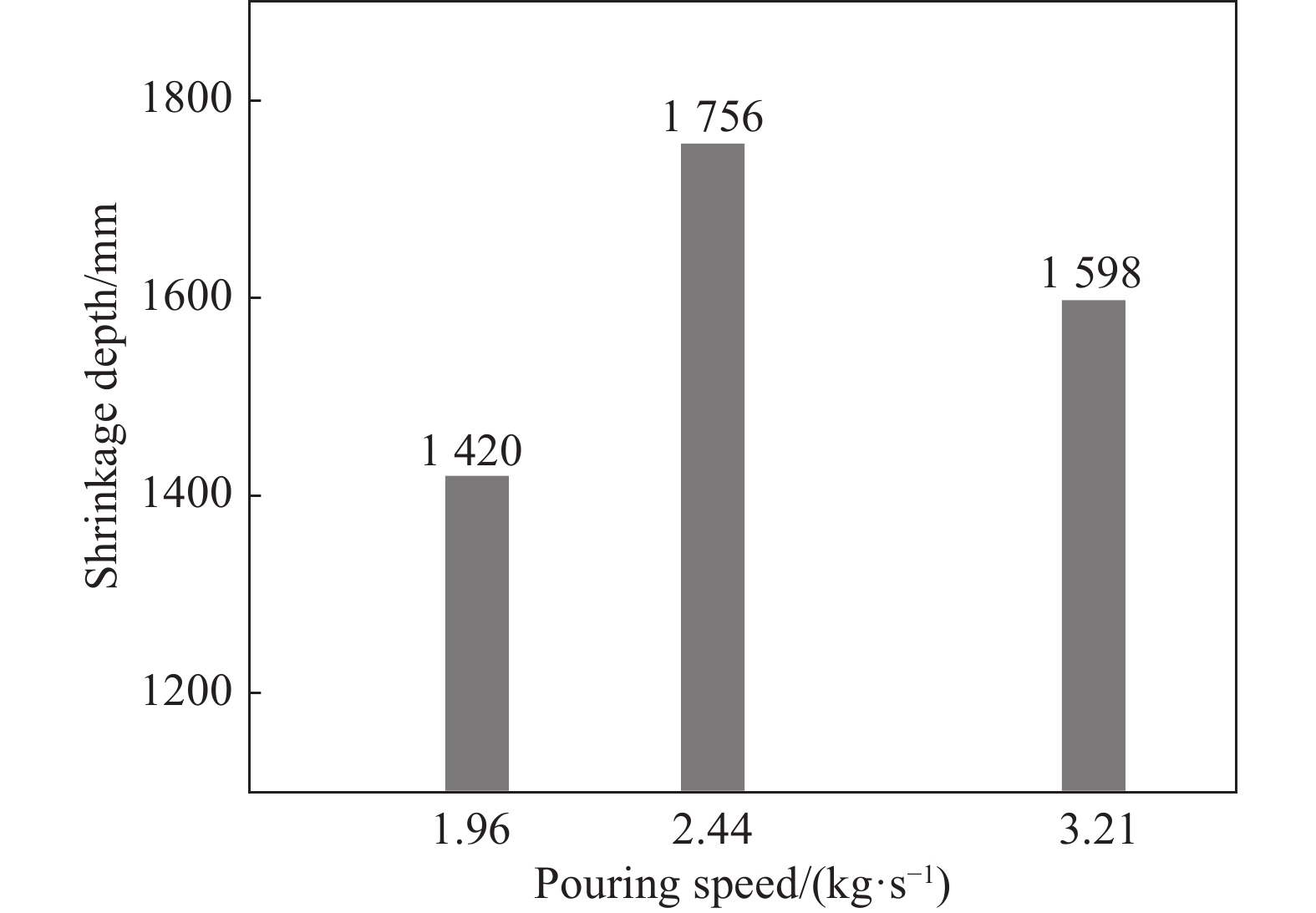
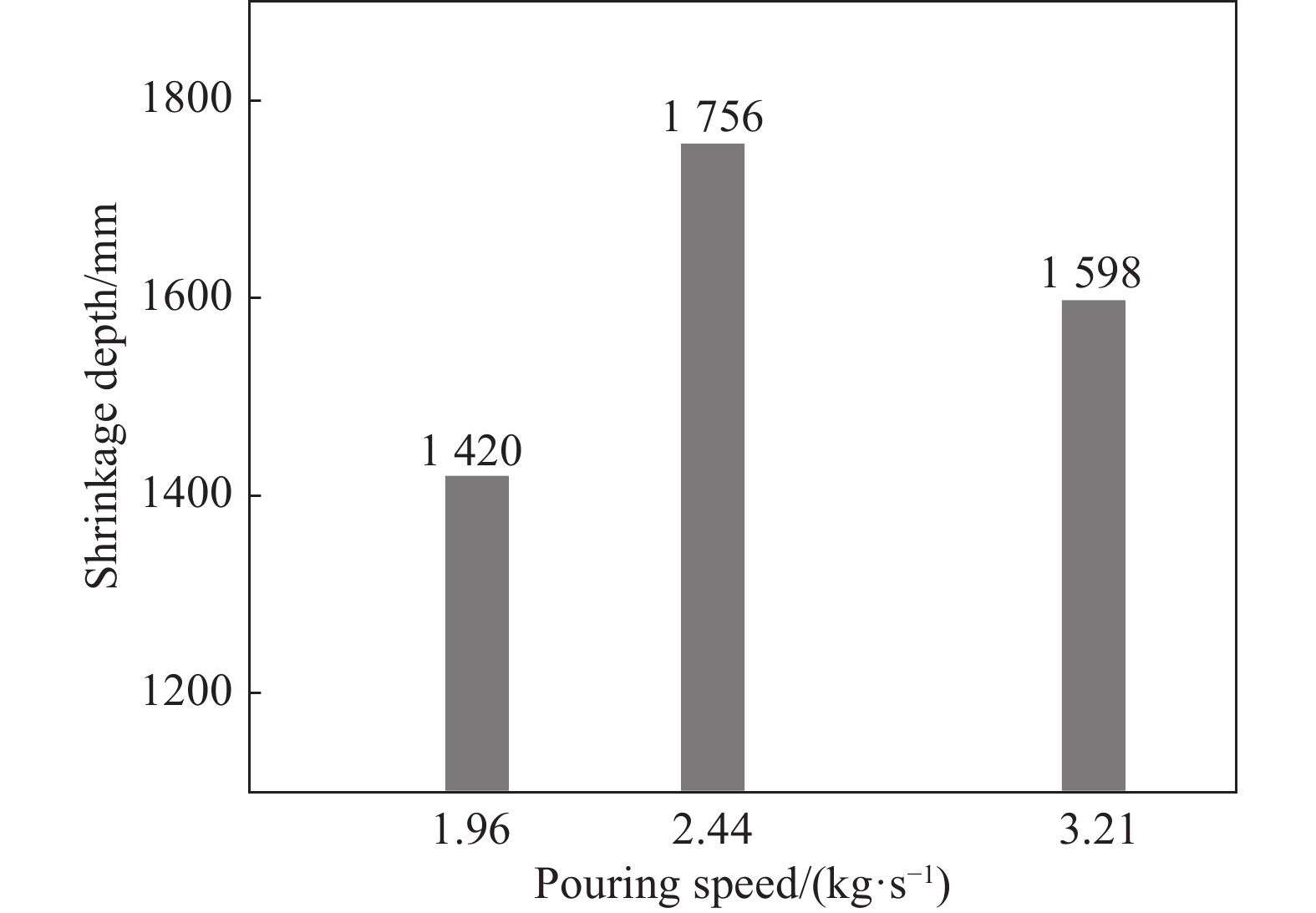
图 7 感应锭端部缩孔深度随浇注速度的变化
Figure 7. Change in shrinkage cavity depth at the end of induction ingot with the pouring speed
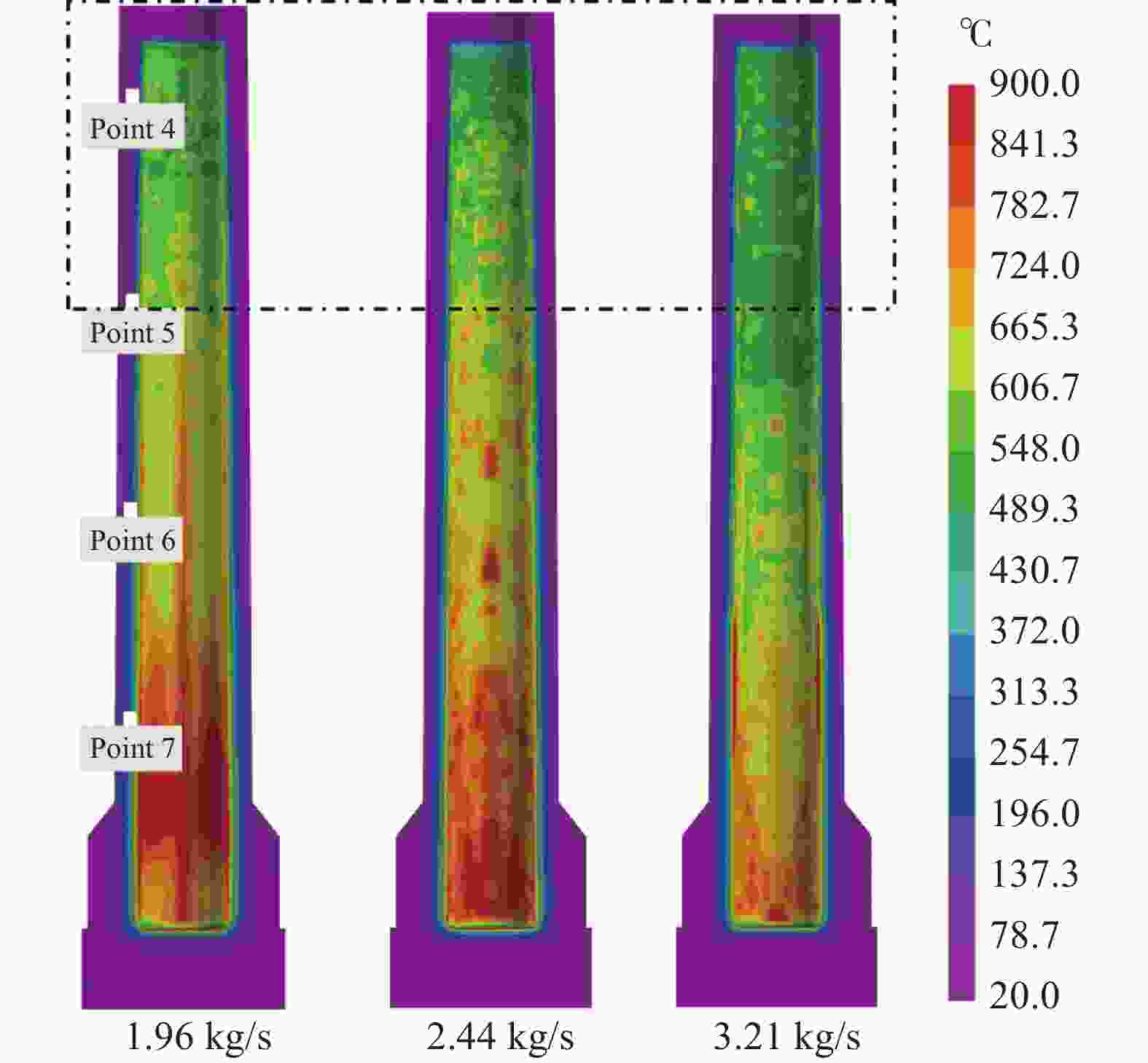
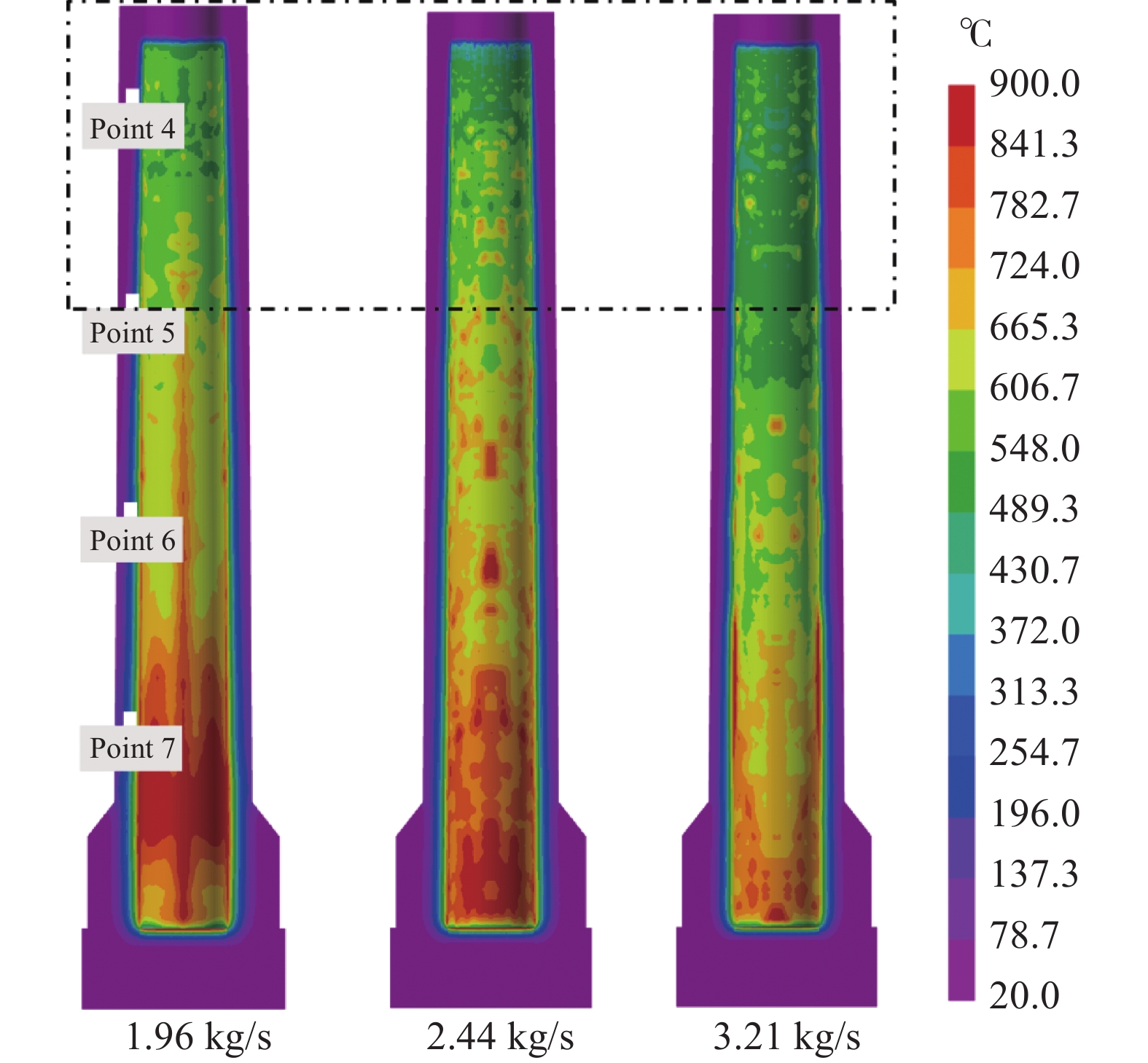
图 8 不同浇注速度下浇注充型结束锭模的温度分布
Figure 8. Temperature distribution of the ingot mold at the end of pouring and filling under different pouring speeds
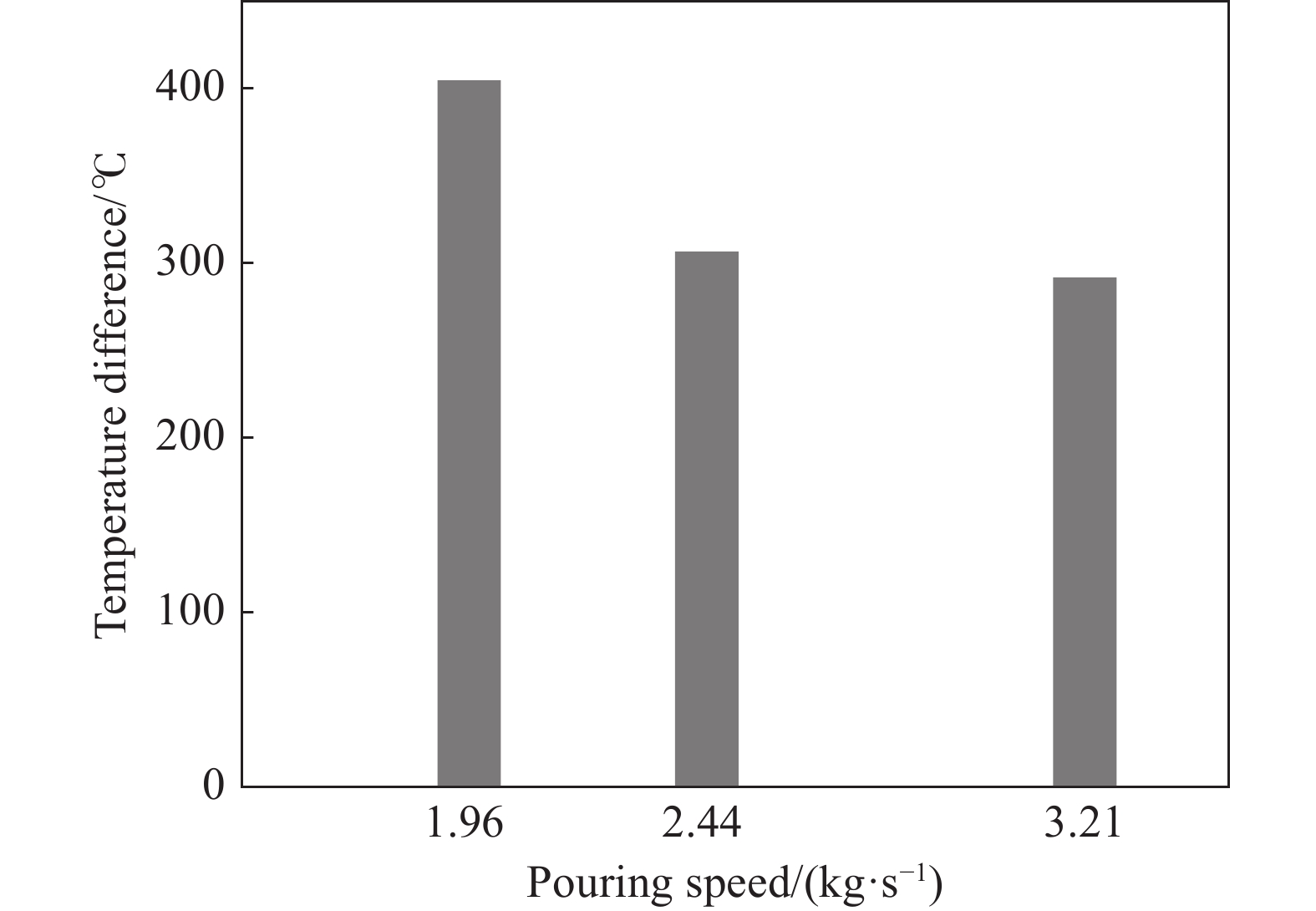
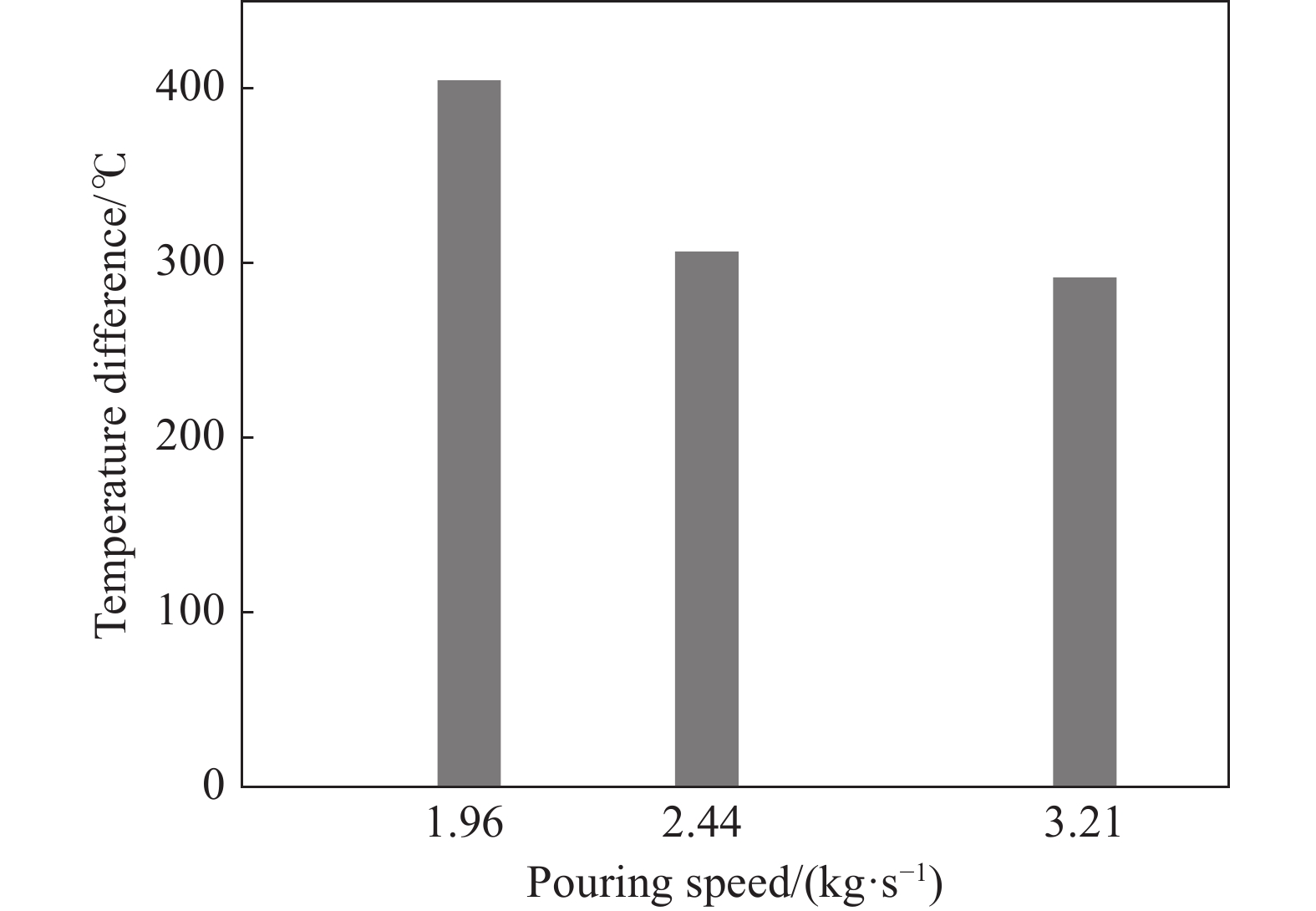
图 9 不同浇注速度下锭模温差
Figure 9. Temperature difference of the ingot mold under different pouring speeds
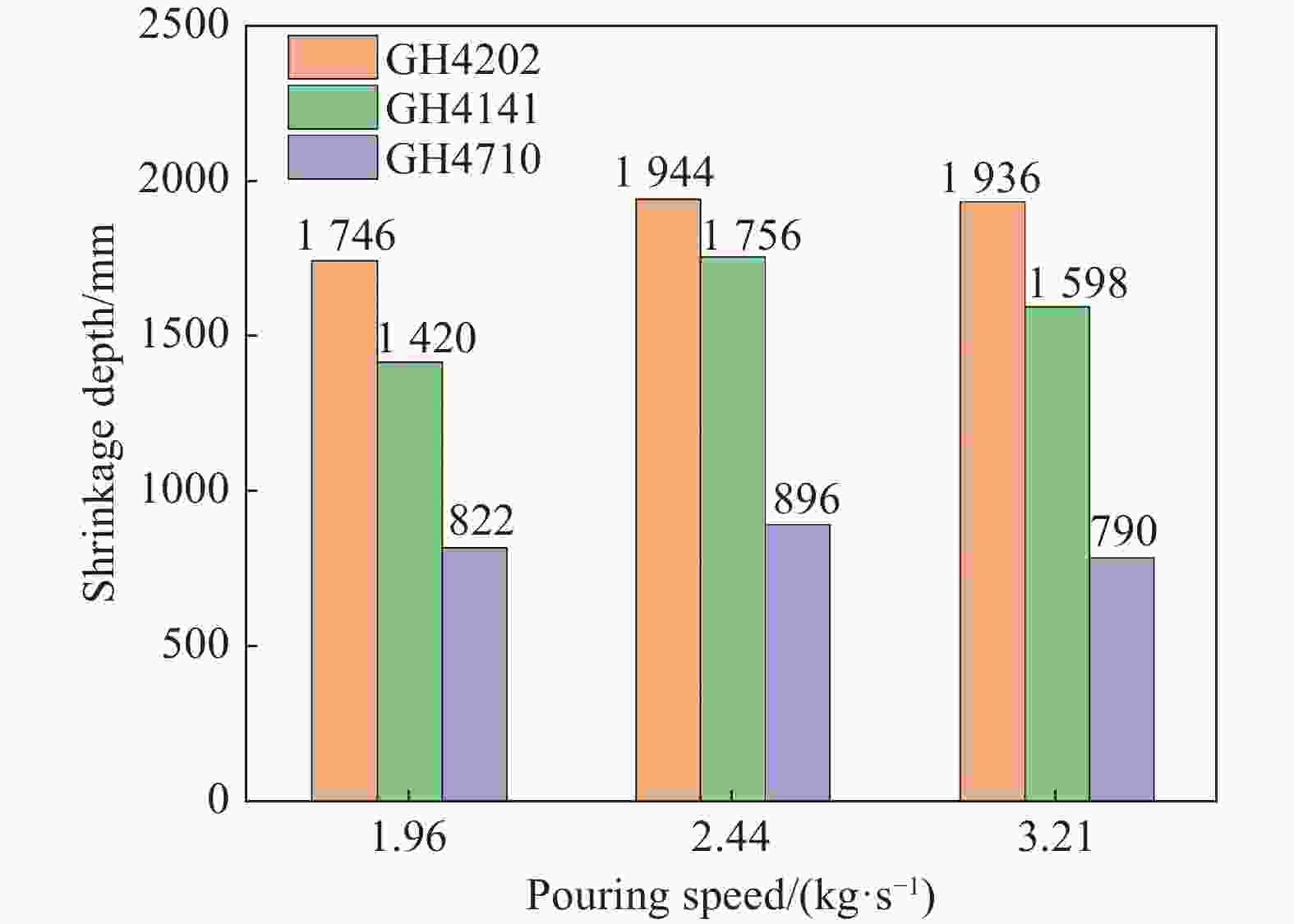
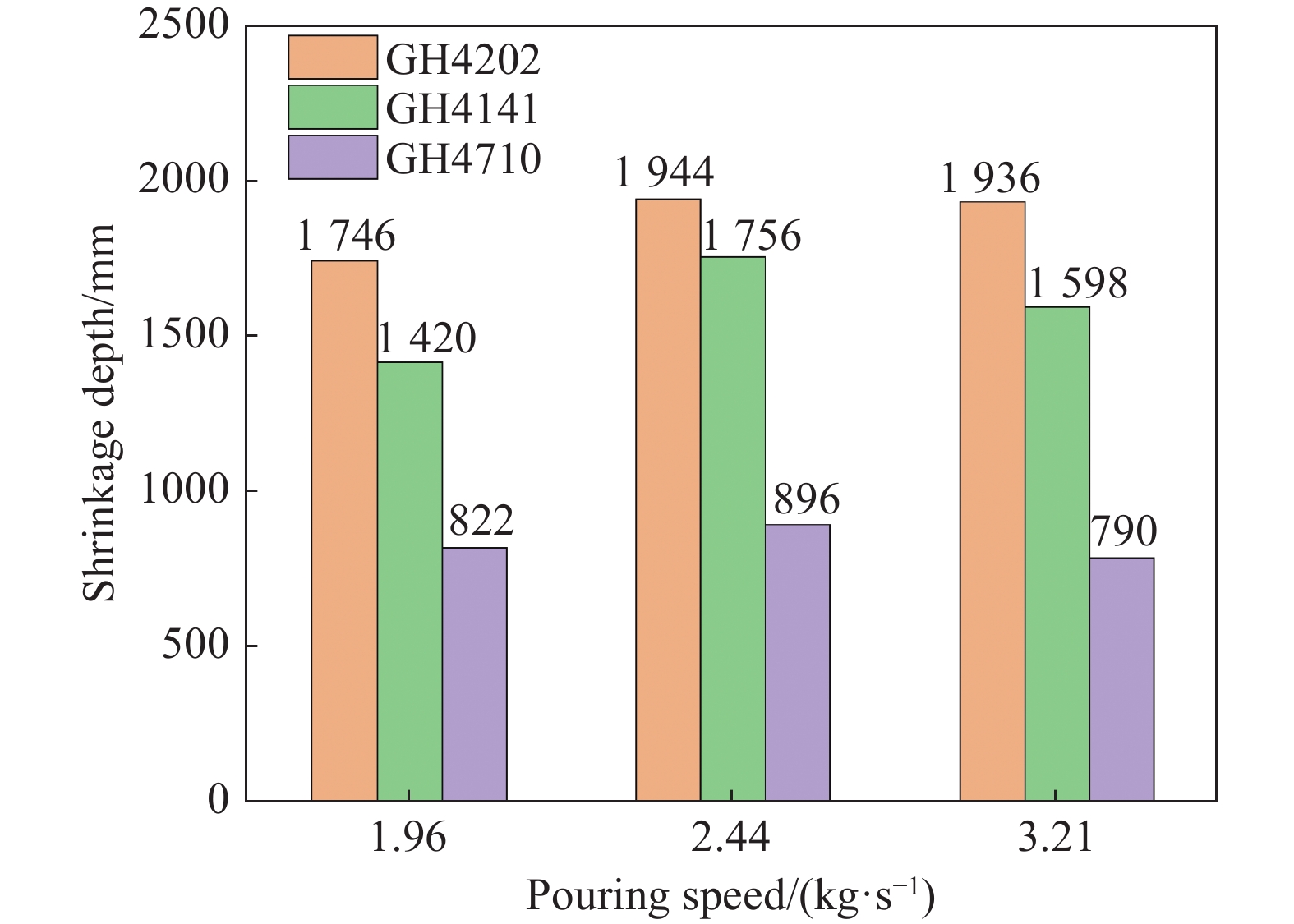
图 10 不同浇注速度下不同牌号高温合金感应锭的缩孔深度
Figure 10. Shrinkage cavity depth of induction ingots of different grades of superalloy under different pouring speeds
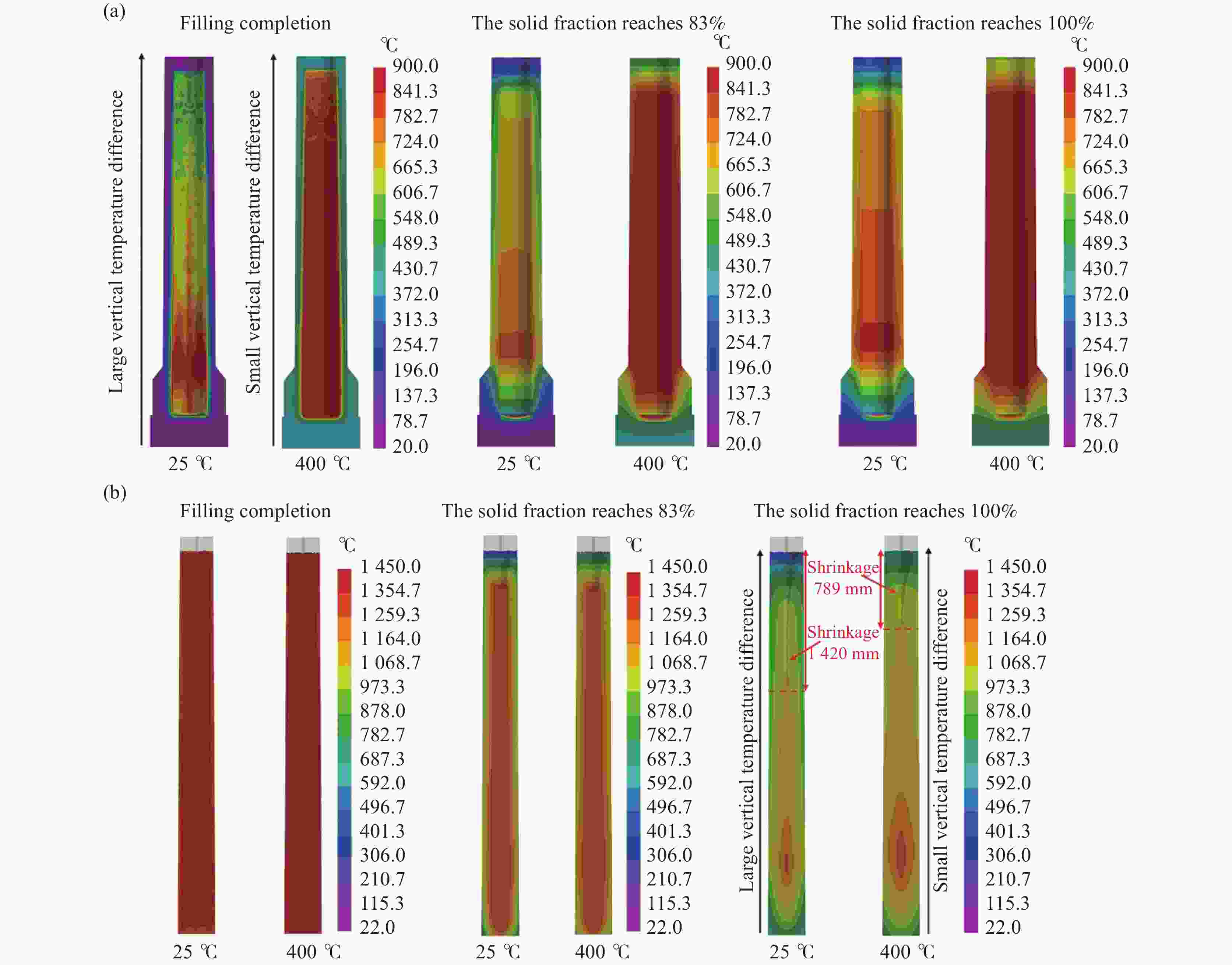
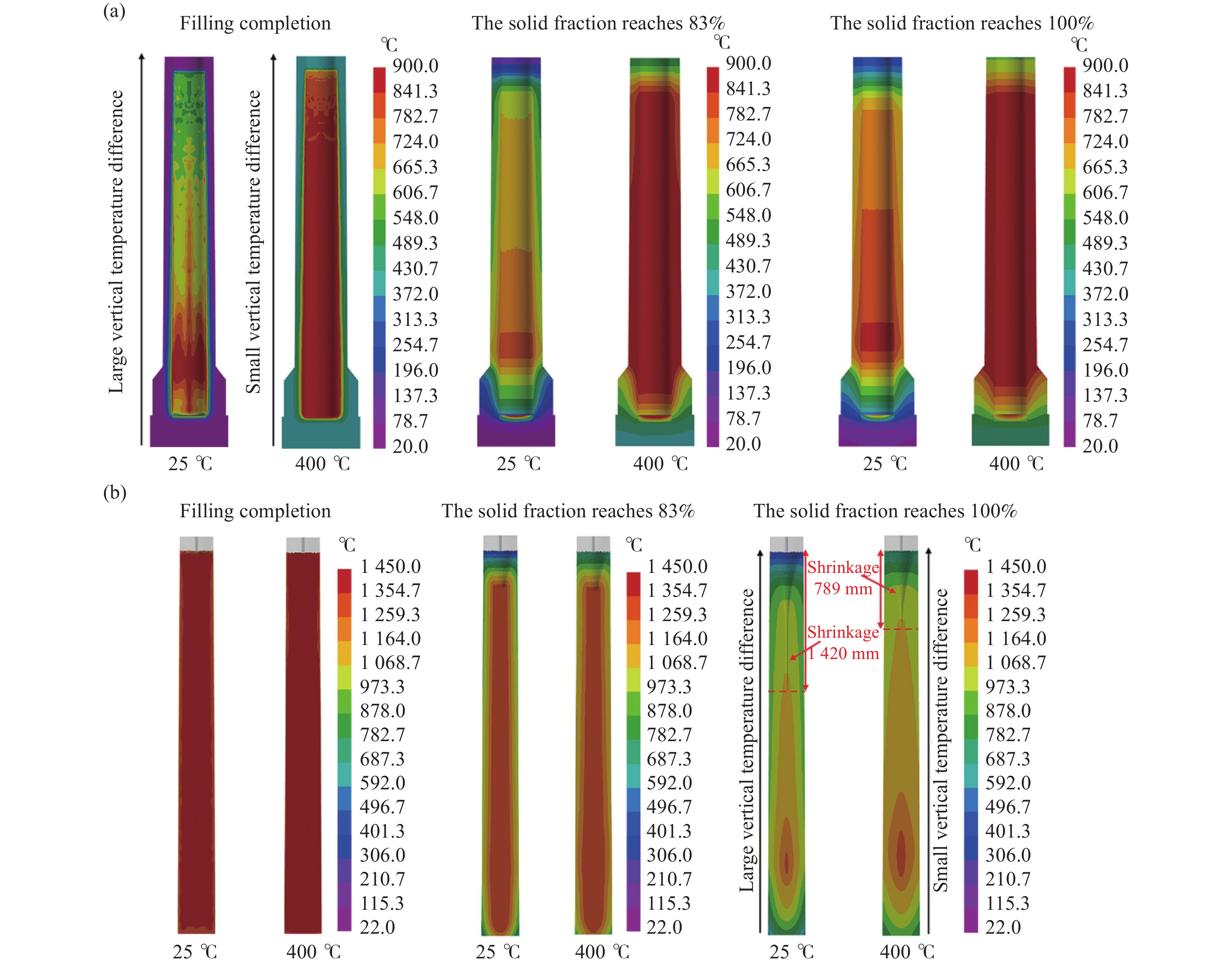
图 11 不同锭模温度下凝固过程锭模及感应锭温度分布
(a) 锭模温度分布;(b)感应锭温度分布
Figure 11. Temperature distribution of the ingot mold and induction ingot during the solidification process at different ingot mold temperatures
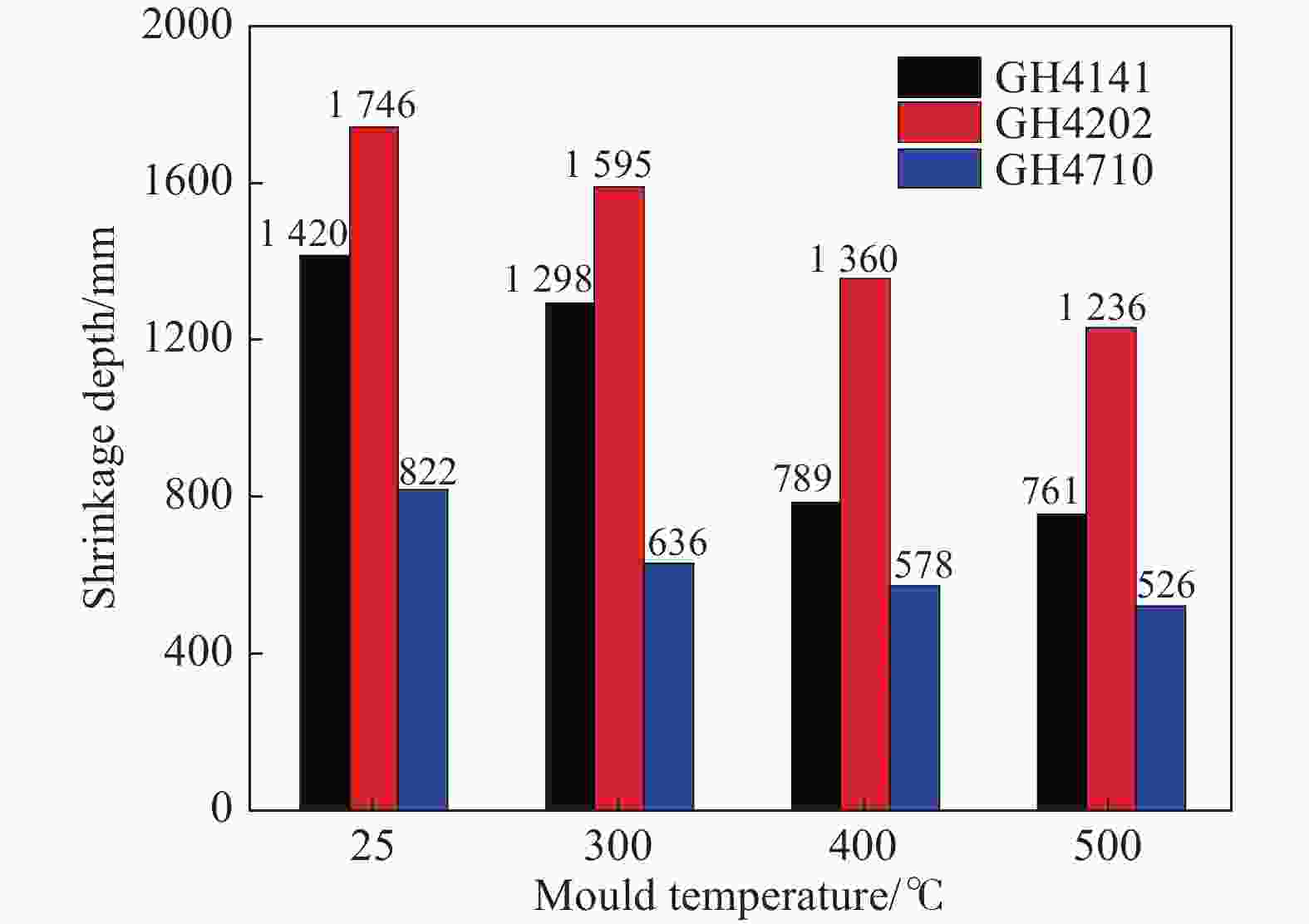
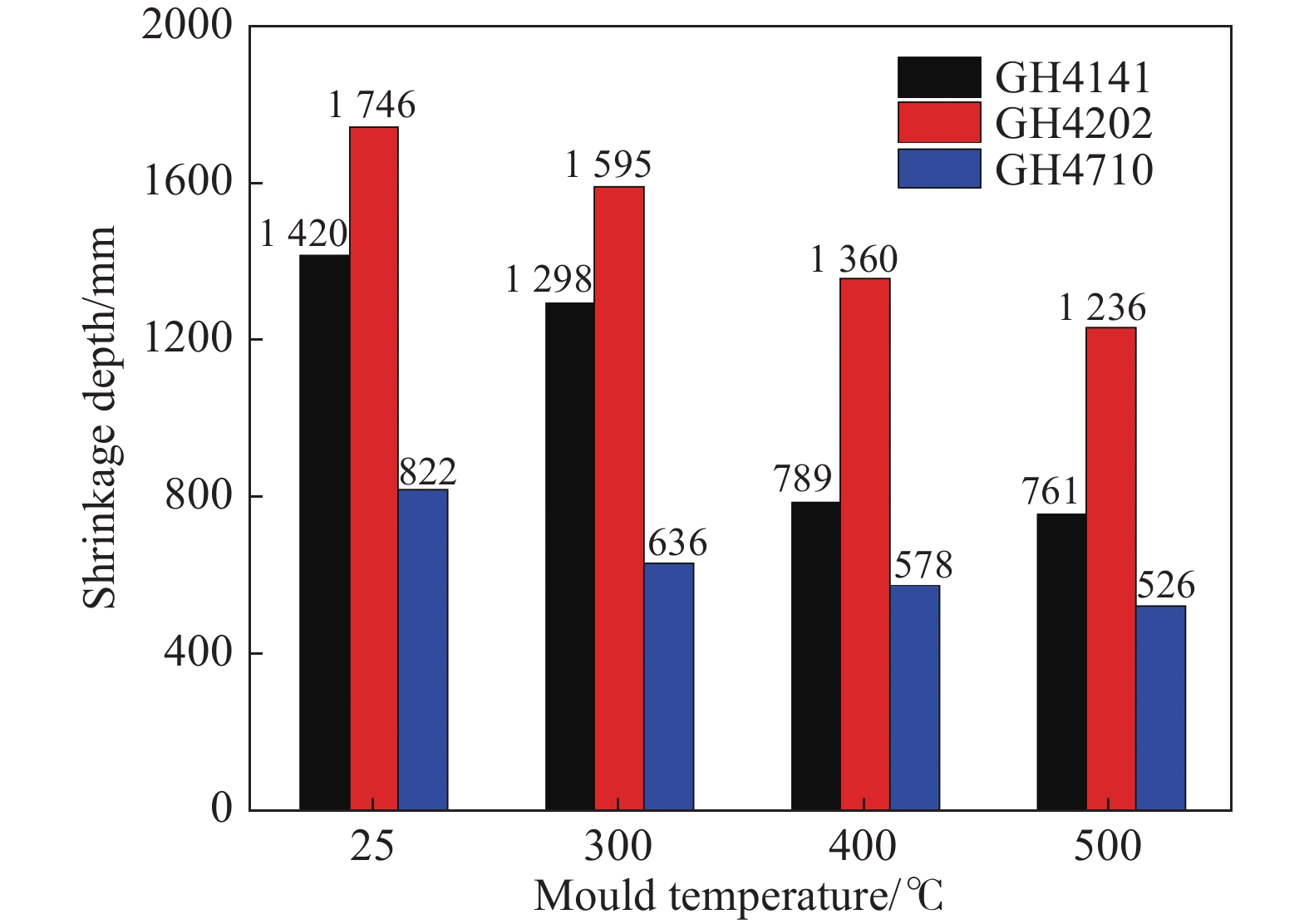
图 12 不同锭模温度下不同牌号合金的感应锭缩孔深度
Figure 12. Induction ingot shrinkage cavity depth of different grades of alloys at different ingot mold temperatures
表 1 模拟采用的主要工艺参数
Table 1. Main process parameters used in the simulation
Pouring temperature/℃ Inlet diameter/mm Ingot mold temperature/℃ 1450 27、32、37 25、300、400、500  下载: 导出CSV
-
[1] Gialanella S, Malandruccolo A. Aerospace alloys[M]. Cham, Switzerland: Springer, 2020. [2] 朱兴, 江河, 董建新, 等. 高合金化难变形高温合金GH4975热裂敏感性研究[J]. 稀有金属材料与工程, 2026, 55(1): 203-212. Zhu Xing, Jiang He, Dong Jianxin, et al. Hot cracking sensitivity of difficult-to-deform superalloy GH4975 with high alloying[J]. Rare Metal Materials and Engineering, 2026, 55(1): 203-212. doi: 10.12442/j.issn.1002-185X.20240603Zhu Xing, Jiang He, Dong Jianxin, et al. Hot cracking sensitivity of difficult-to-deform superalloy GH4975 with high alloying[J]. Rare Metal Materials and Engineering, 2026, 55(1): 203-212. doi: 10.12442/j.issn.1002-185X.20240603 [3] 郭建亭. 高温合金材料学. 下册, 高温合金材料与工程应用[M]. 北京: 科学出版社, 2010. Guo Jianting. Materials science and engineering for superalloy(Volume 2), Superalloy Materials and Engineering Applications[M]. Beijing: Science Press, 2010.Guo Jianting. Materials science and engineering for superalloy(Volume 2), Superalloy Materials and Engineering Applications[M]. Beijing: Science Press, 2010. [4] Akande I G, Oluwole O O, Fayomi O S I, et al. Overview of mechanical, microstructural, oxidation properties and high-temperature applications of superalloys[J]. Materials Today: Proceedings, 2021, 43: 2222-2231. doi: 10.1016/j.matpr.2020.12.523 [5] 任帅, 吕少敏, 谢兴飞, 等. 变形高温合金成分调控与冶金制备技术研究[J]. 铸造, 2025, 74(7): 868-879. Ren Shuai, Lü Shaomin, Xie Xingfei, et al. Research on the regulation of the composition and metallurgical preparation technology of deformed superalloys[J]. Foundry, 2025, 74(7): 868-879. doi: 10.3969/j.issn.1001-4977.2025.07.003Ren Shuai, Lü Shaomin, Xie Xingfei, et al. Research on the regulation of the composition and metallurgical preparation technology of deformed superalloys[J]. Foundry, 2025, 74(7): 868-879. doi: 10.3969/j.issn.1001-4977.2025.07.003 [6] Zhang Hengnian, Li Shu, Li Xin, et al. A simulation method for predicting shrinkage cavity and cracking tendency in waspaloy vacuum induction melting ingot[J]. Journal of Materials Engineering and Performance, 2025, 34(15): 15980-15990. doi: 10.1007/s11665-024-10382-0 [7] 贾雷. 高合金化GH4151合金裂纹形成机理及控制研究[D]. 北京: 北京科技大学, 2024. Jia Lei. Study on the mechanism and control of cracking in highly alloyed GH4151[D]. Beijing: University of Science and Technology Beijing, 2024.Jia Lei. Study on the mechanism and control of cracking in highly alloyed GH4151[D]. Beijing: University of Science and Technology Beijing, 2024. [8] Wang Zixing, Li Qing, Wang Lei. Numerical simulation of the influence of electrode shrinkage cavity on ESR process of IN718 alloy[J]. Rare Metal Materials and Engineering, 2018, 47(12): 3579-3589. doi: 10.1016/S1875-5372(19)30002-5 [9] 石骁. 电渣重熔大型IN718镍基合金感应锭凝固和偏析行为基础研究[D]. 北京: 北京科技大学, 2019. Shi Xiao. Fundamental study on the solidification and segregation behaviors of large-sized as-cast IN718 electroslag remelting ingots[D]. Beijing: University of Science and Technology Beijing, 2019.Shi Xiao. Fundamental study on the solidification and segregation behaviors of large-sized as-cast IN718 electroslag remelting ingots[D]. Beijing: University of Science and Technology Beijing, 2019. [10] 姜彩伟, 刘建民, 胡显军. 真空感应炉冶炼铁铬铝合金铸锭常见缺陷成因分析及改善措施[J]. 真空, 2019, 56(2): 74-77. Jiang Caiwei, Liu Jianmin, Hu Xianjun. Cause analysis and improvement measures of common defects in Fe-Cr-Al alloy ingots smelted by VIM furnace[J]. Vacuum, 2019, 56(2): 74-77. doi: 10.13385/j.cnki.vacuum.2019.02.15Jiang Caiwei, Liu Jianmin, Hu Xianjun. Cause analysis and improvement measures of common defects in Fe-Cr-Al alloy ingots smelted by VIM furnace[J]. Vacuum, 2019, 56(2): 74-77. doi: 10.13385/j.cnki.vacuum.2019.02.15 [11] 唐平梅, 周扬, 姜东滨. 镍基高温合金感应锭浇注过程的数值模拟研究[J]. 钢铁钒钛, 2022, 43(4): 127-133, 141. Tang Pingmei, Zhou Yang, Jiang Dongbin. Numerical simulation on pouring process of nickel base superalloy induction ingot[J]. Iron Steel Vanadium Titanium, 2022, 43(4): 127-133, 141. doi: 10.7513/j.issn.1004-7638.2022.04.020Tang Pingmei, Zhou Yang, Jiang Dongbin. Numerical simulation on pouring process of nickel base superalloy induction ingot[J]. Iron Steel Vanadium Titanium, 2022, 43(4): 127-133, 141. doi: 10.7513/j.issn.1004-7638.2022.04.020 [12] 王建武, 徐志强, 杨树峰. 热顶设计对镍基高温合金铸锭收缩孔隙的影响[J]. 中国冶金, 2022, 32(4): 63-69, 76. Wang Jianwu, Xu Zhiqiang, Yang Shufeng. Effect of hot top design on shrinkage porosity of nickel-based superalloy ingots[J]. China Metallurgy, 2022, 32(4): 63-69, 76. doi: 10.13228/j.boyuan.issn1006-9356.20210876Wang Jianwu, Xu Zhiqiang, Yang Shufeng. Effect of hot top design on shrinkage porosity of nickel-based superalloy ingots[J]. China Metallurgy, 2022, 32(4): 63-69, 76. doi: 10.13228/j.boyuan.issn1006-9356.20210876 [13] 张亨年, 李澍, 江河, 等. 大型GH4738合金真空感应熔炼铸锭凝固与缩孔研究[J]. 兵器材料科学与工程, 2026, 49(1): 1-8. Zhang Hengnian, Li Shu, Jiang He, et al. Study on solidification behavior and shrinkage control of large-scale GH4738 alloy vacuum induction melting ingot[J]. Ordnance Material Science and Engineering, 2026, 49(1): 1-8. doi: 10.14024/j.cnki.1004-244x.20250731.001Zhang Hengnian, Li Shu, Jiang He, et al. Study on solidification behavior and shrinkage control of large-scale GH4738 alloy vacuum induction melting ingot[J]. Ordnance Material Science and Engineering, 2026, 49(1): 1-8. doi: 10.14024/j.cnki.1004-244x.20250731.001 [14] 张亨年, 赵展, 李澍, 等. 大锭型GH4169合金铸锭真空感应熔炼凝固过程及缩孔控制[J]. 中国有色金属学报, 2025, 35(7): 2287-2297. Zhang Hengnian, Zhao Zhan, Li Shu, et al. Solidification process and shrinkage control of large-scale GH4169 alloy vacuum induction melting ingot[J]. The Chinese Journal of Nonferrous Metals, 2025, 35(7): 2287-2297. doi: 10.11817/j.ysxb.1004.0609.2025-45438Zhang Hengnian, Zhao Zhan, Li Shu, et al. Solidification process and shrinkage control of large-scale GH4169 alloy vacuum induction melting ingot[J]. The Chinese Journal of Nonferrous Metals, 2025, 35(7): 2287-2297. doi: 10.11817/j.ysxb.1004.0609.2025-45438 [15] Ghodrati N, Loucif A, Morin J B, et al. Modeling of the influence of hot top design on microporosity and shrinkage cavity in large-size cast steel ingots[C]//8th International Congress on the Science and Technology of Steelmaking, 2022: 239-244. [16] 元俊杰. 大型钢锭凝固过程的数值模拟与实验装置研究[D]. 重庆: 重庆大学, 2010. Yuan Junjie. Numerical simulation in heavy ingot solidification and the study of experimental apparatus[D]. Chongqing: Chongqing University, 2010.Yuan Junjie. Numerical simulation in heavy ingot solidification and the study of experimental apparatus[D]. Chongqing: Chongqing University, 2010. [17] 成建强, 胡显军, 顾晔, 等. 发热保温冒口在高温合金真空浇注中的应用[J]. 铸造技术, 2016, 37(1): 110-113. Cheng Jianqiang, Hu Xianjun, Gu Ye, et al. Application of exothermic insulated riser in superalloy vacuum casting[J]. Foundry Technology, 2016, 37(1): 110-113. doi: 10.16410/j.issn1000-8365.2016.01.030Cheng Jianqiang, Hu Xianjun, Gu Ye, et al. Application of exothermic insulated riser in superalloy vacuum casting[J]. Foundry Technology, 2016, 37(1): 110-113. doi: 10.16410/j.issn1000-8365.2016.01.030 [18] 黄婷, 李京社, 唐海燕, 等. 铸锭凝固过程缩孔缺陷的数值模拟[J]. 铸造, 2013, 62(7): 633-636, 640. Huang Ting, Li Jingshe, Tang Haiyan, et al. Numerical simulation research of the shrinkage defects in ingot casting[J]. Foundry, 2013, 62(7): 633-636, 640. doi: 10.3969/j.issn.1001-4977.2013.07.007Huang Ting, Li Jingshe, Tang Haiyan, et al. Numerical simulation research of the shrinkage defects in ingot casting[J]. Foundry, 2013, 62(7): 633-636, 640. doi: 10.3969/j.issn.1001-4977.2013.07.007 [19] 高晨, 张立峰, 李崇巍, 等. 真空条件下锭模参数对铁镍合金缩孔分布的影响[J]. 北京科技大学学报, 2014, 36(7): 887-894. Gao Chen, Zhang Lifeng, Li Chongwei, et al. Effect of molding parameters on porosity distribution in Fe-Ni alloy ingots under vacuum circumstance[J]. Journal of University of Science and Technology Beijing, 2014, 36(7): 887-894. doi: 10.13374/j.issn1001-053x.2014.07.006Gao Chen, Zhang Lifeng, Li Chongwei, et al. Effect of molding parameters on porosity distribution in Fe-Ni alloy ingots under vacuum circumstance[J]. Journal of University of Science and Technology Beijing, 2014, 36(7): 887-894. doi: 10.13374/j.issn1001-053x.2014.07.006 [20] Kermanpur A, Eskandari M, Purmohamad H, et al. Influence of mould design on the solidification of heavy forging ingots of low alloy steels by numerical simulation[J]. Materials & Design, 2010, 31(3): 1096-1104. doi: 10.1016/j.matdes.2009.09.045 [21] 仇春荔, 陶盼, 廖恒成, 等. 浇注速度对铸件充型过程流场影响的数值模拟[J]. 铸造, 2007(11): 1190-1194. Qiu Chunli, Tao Pan, Liao Hengcheng, et al. Numerical simulation on influence of pouring velocity on flow field of casting during mold-filling[J]. Foundry, 2007(11): 1190-1194.Qiu Chunli, Tao Pan, Liao Hengcheng, et al. Numerical simulation on influence of pouring velocity on flow field of casting during mold-filling[J]. Foundry, 2007(11): 1190-1194. [22] 刘国军, 赵俊学, 唐雯聃, 等. 钢锭模表面温度与内部质量对应关系研究[J]. 铸造技术, 2017, 38(7): 1692-1696, 1700. Liu Guojun, Zhao Junxue, Tang Wendan, et al. Relationship between ingot mould surface temperature and internal quality[J]. Foundry Technology, 2017, 38(7): 1692-1696, 1700. doi: 10.16410/j.issn1000-8365.2017.07.044Liu Guojun, Zhao Junxue, Tang Wendan, et al. Relationship between ingot mould surface temperature and internal quality[J]. Foundry Technology, 2017, 38(7): 1692-1696, 1700. doi: 10.16410/j.issn1000-8365.2017.07.044 [23] Wang J Q, Fu P X, Liu H W, et al. Shrinkage porosity criteria and optimized design of a 100-ton 30Cr2Ni4MoV forging ingot[J]. Materials & Design, 2012, 35: 446-456. [24] 李庆春. 铸件形成理论基础[M]. 北京: 机械工业出版社, 1982. Li Qingchun. Theoretical basis of casting formation[M]. Beijing: China Machine Press, 1982.Li Qingchun. Theoretical basis of casting formation[M]. Beijing: China Machine Press, 1982. -


计量
- 文章访问数: 0
- HTML全文浏览量: 0
- PDF下载量: 0
- 被引次数: 0