Simulation analysis and process optimization of residual stress and machining deformation in the manufacturing of thin-walled titanium alloy rings
-
摘要: 钛合金薄壁环件是航空航天等领域的关键构件,其机加工变形严重制约精度与可靠性。以钛合金矩形薄壁环件为对象,建立了轧制、冷却、加热、胀形及热处理全流程有限元模型,系统研究了成形过程残余应力演变规律及其对机加工变形的影响。通过分析不同胀形量与胀形温度下的应力分布特征,揭示了胀形工艺对应力场的调控机制,在此基础上,构建了残余应力与加工变形之间的理论分析模型,并进行了仿真与试验验证。结果表明,环件残余应力主要产生于首次冷却阶段,后续胀形及热处理工序可显著降低应力幅值并改善分布均匀性;合理的胀形工艺可有效改善残余应力分布,其中胀形量约4%、胀形温度800 ℃时应力水平最低且分布最为均匀;机加工仿真结果与理论模型计算结果吻合良好,最大误差为20.37%。进一步将优化工艺与理论模型应用于异形环件,并通过试验验证其有效性与工程适用性。研究结果可为钛合金薄壁环件残余应力调控及加工变形控制提供理论依据和工艺指导。Abstract: Thin-walled titanium alloy rings are critical aerospace components, whose machining deformation severely restricts their dimensional accuracy and service reliability. A full-process finite element model covering rolling, cooling, heating, bulging and heat treatment was established for rectangular thin-walled titanium alloy rings, to systematically investigate residual stress evolution during forming and its effect on machining deformation. The regulation mechanism of bulging on the stress field was revealed by analyzing stress distribution under different bulging parameters, and a theoretical model correlating residual stress and machining deformation was constructed and verified via simulation and experiments. Results show that residual stress mainly originates from the initial cooling stage, and subsequent bulging and heat treatment can significantly reduce stress amplitude and improve distribution uniformity. The optimal residual stress state is achieved at a bulging ratio of 4% and a bulging temperature of 800 °C. Simulation results are in good agreement with theoretical calculations, with a maximum error of 20.37%. The optimized process and model were validated effective for special-shaped rings, providing a theoretical basis and process guidance for residual stress regulation and deformation control of titanium alloy thin-walled rings.
-
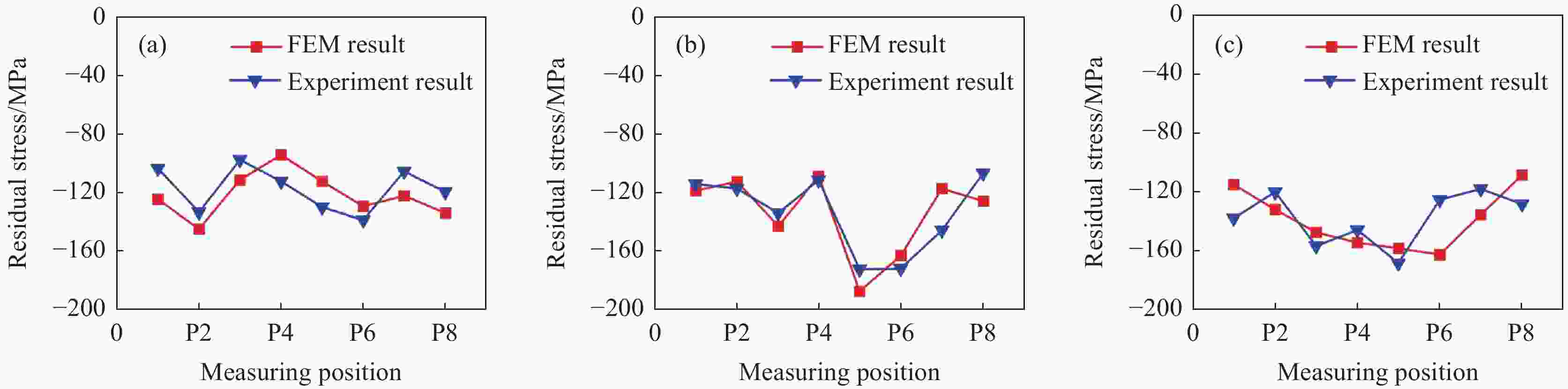
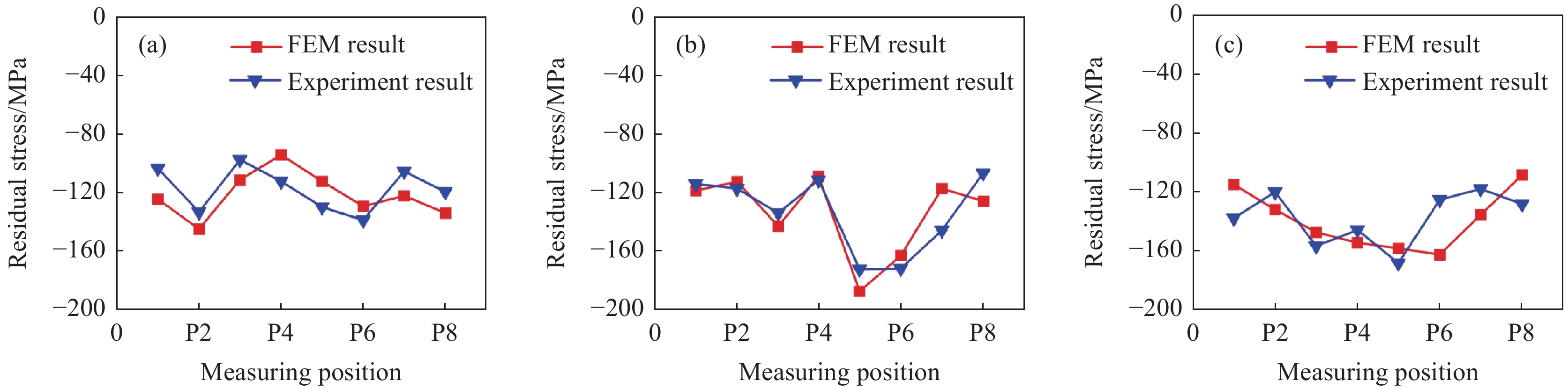
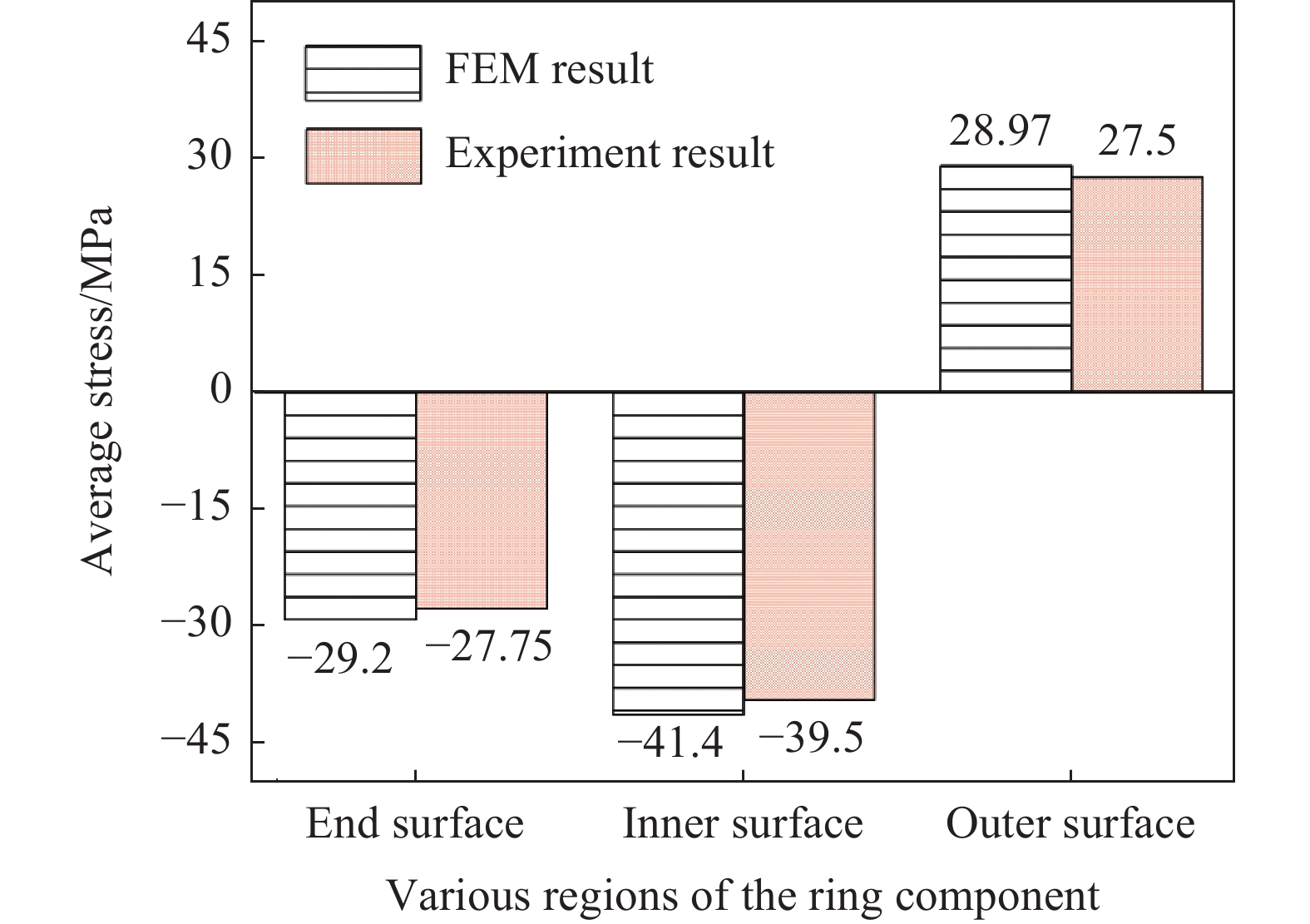
图 3 机加工模拟与试验结果对比
(a)上端面; (b)内壁; (c)外壁
Figure 3. Comparison of machining simulation and experimental results
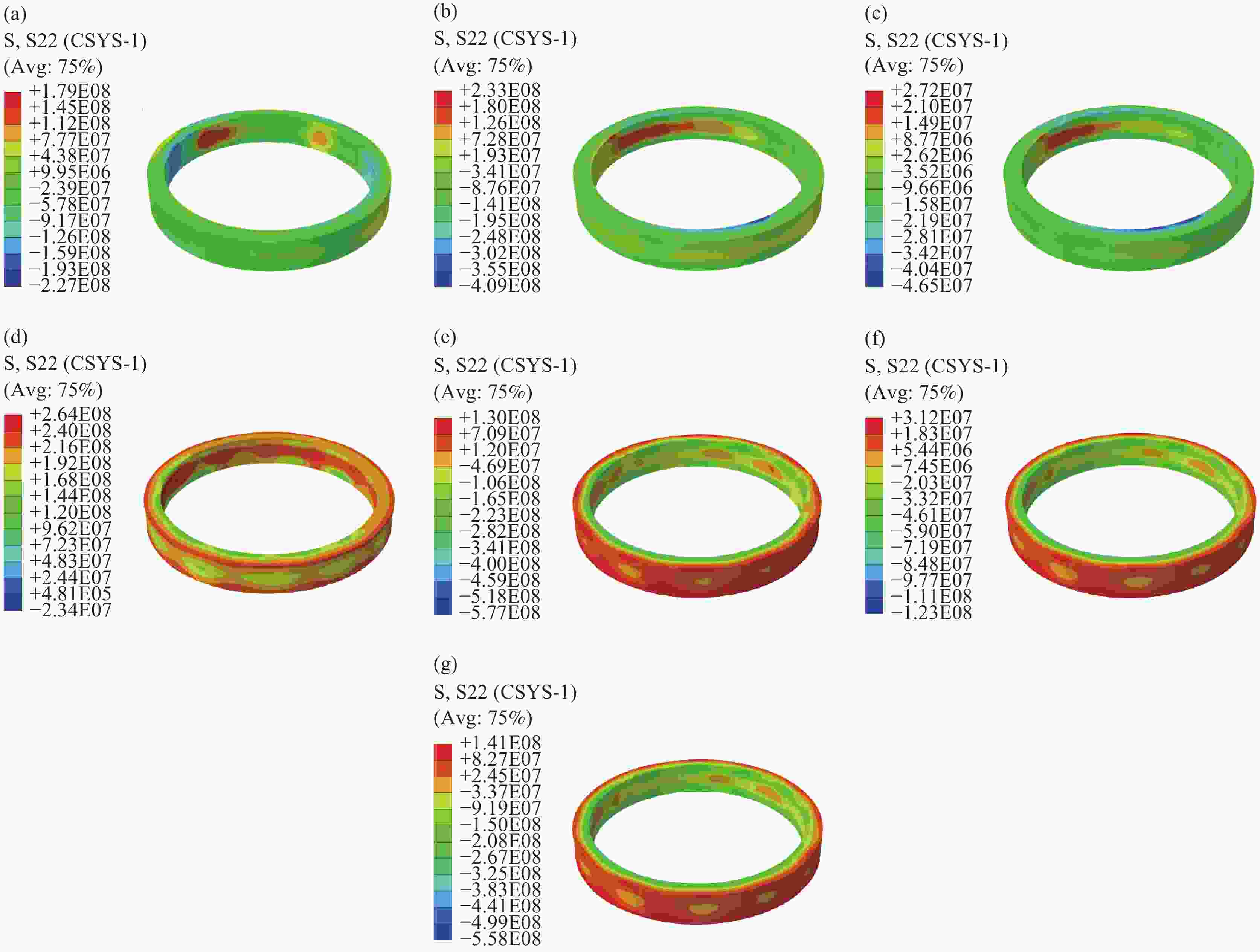
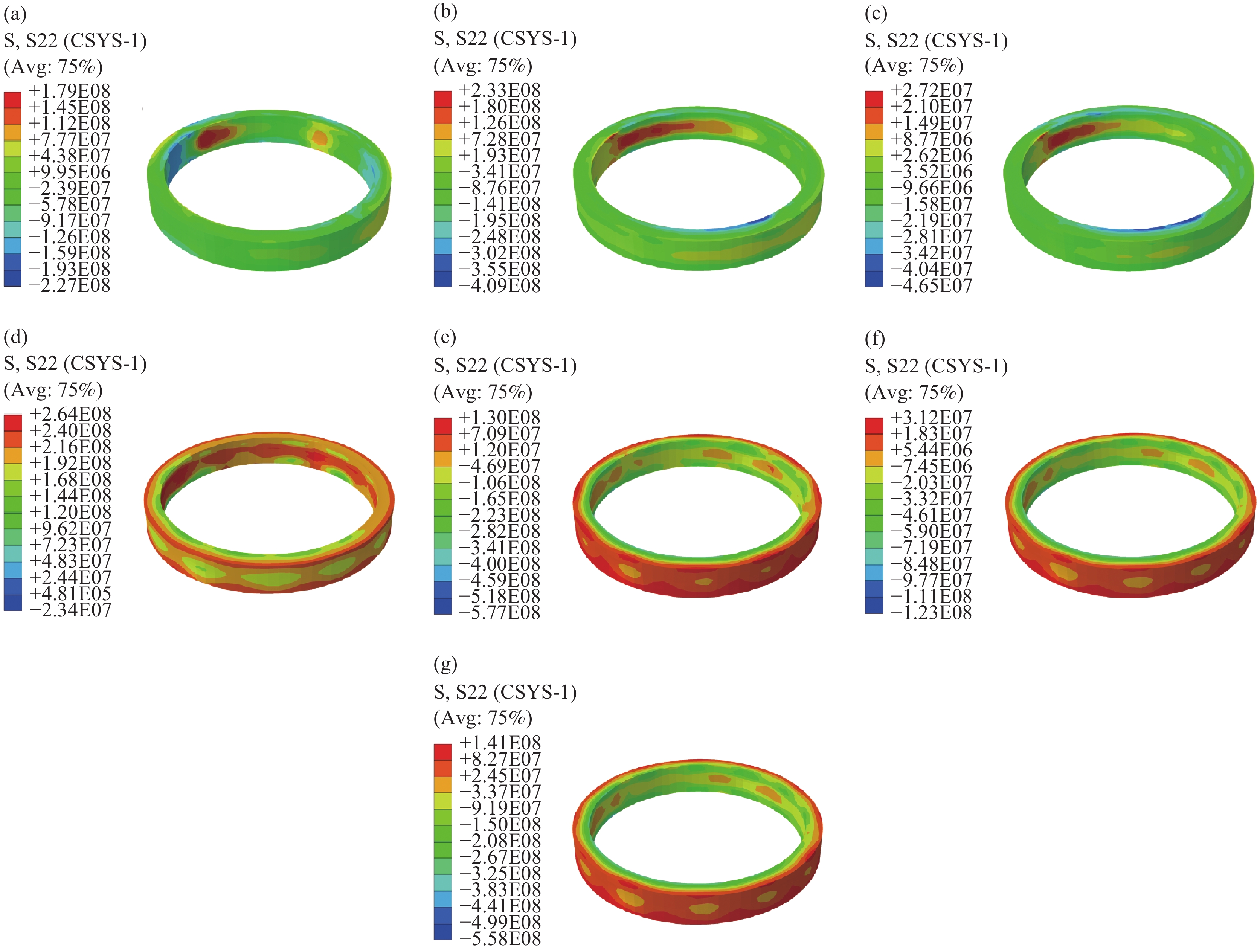
图 4 制造关键工序中环件应力演化规律
(a)轧制; (b)冷却; (c)加热; (d)胀形; (e)卸载冷却; (f)热处理; (g)冷却
Figure 4. Stress evolution law of ring-shaped components in key manufacturing processes
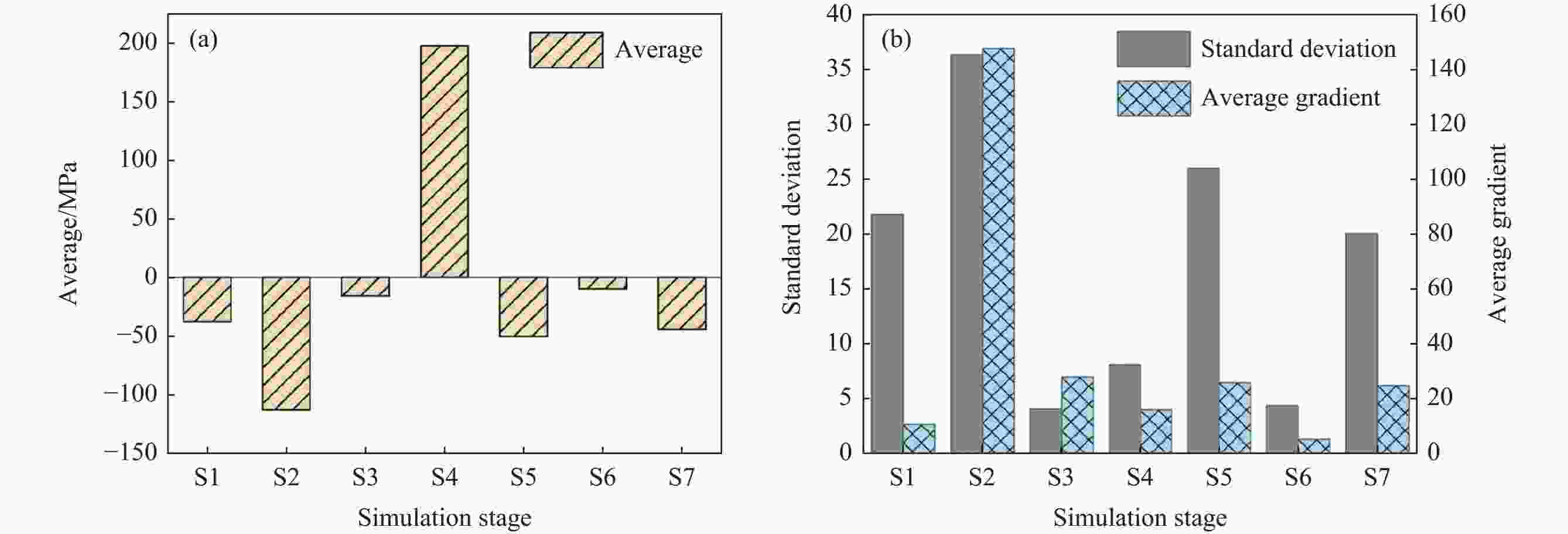
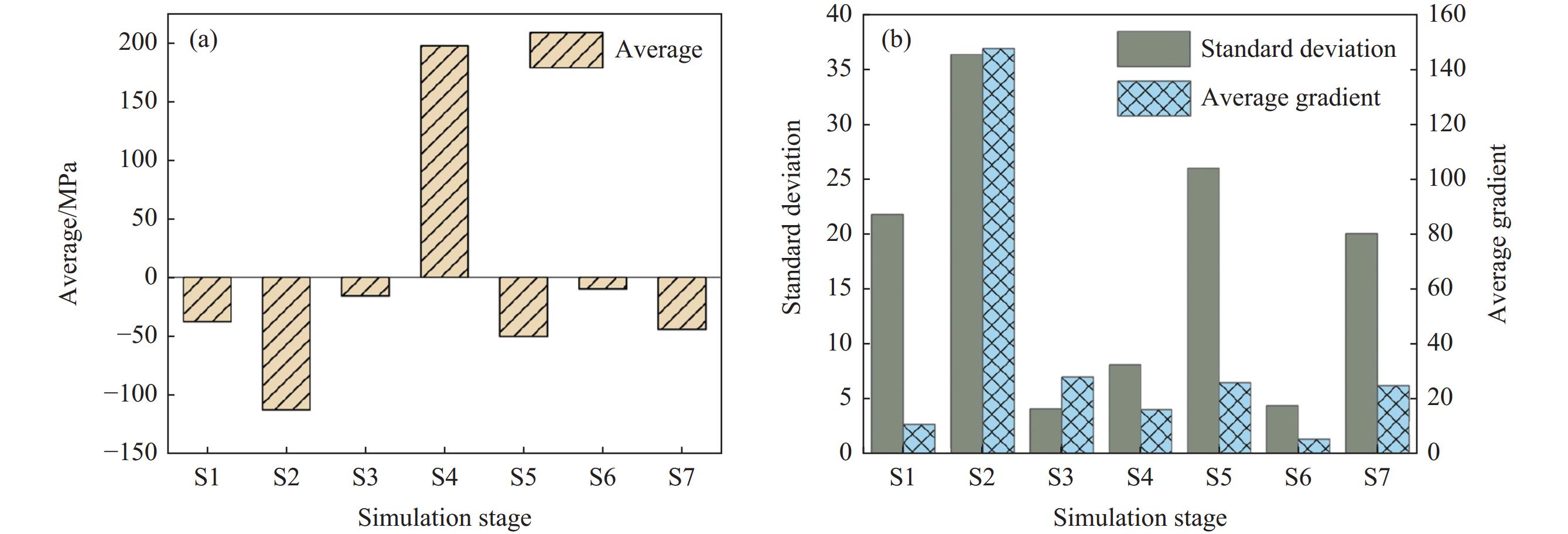
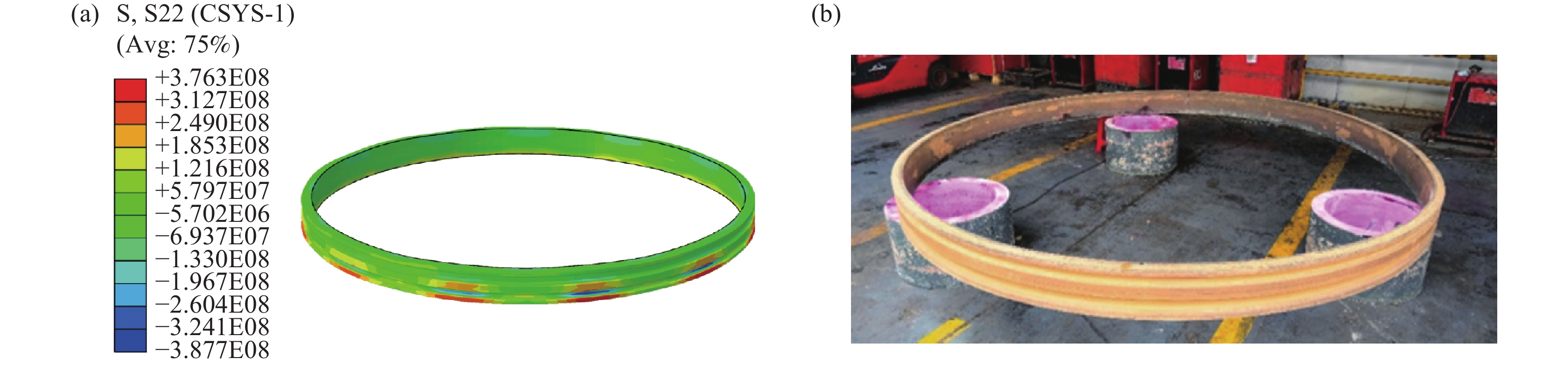
图 5 环件各工序周向残余应力评价指标
(a)均值; (b)标准差和梯度
Figure 5. Evaluation indices of circumferential residual stress
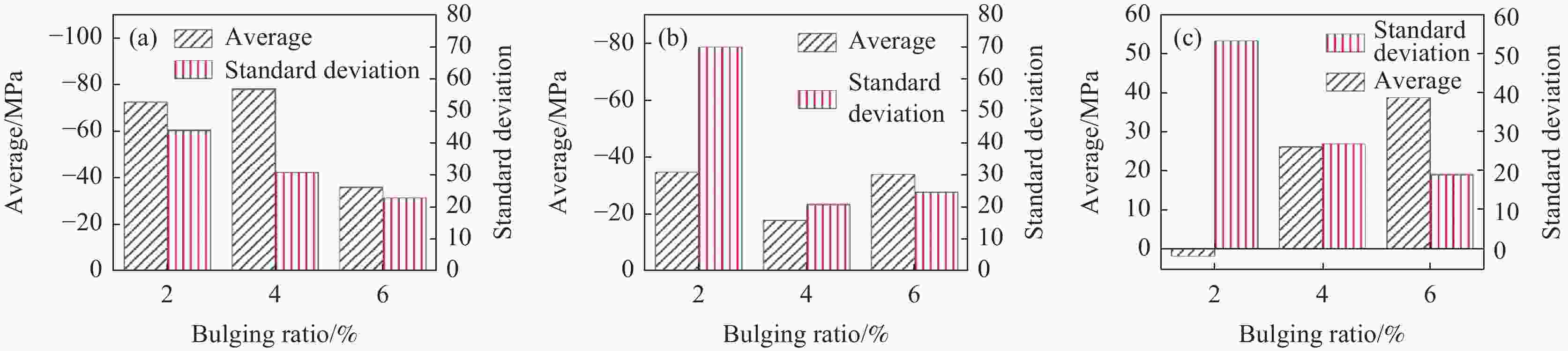
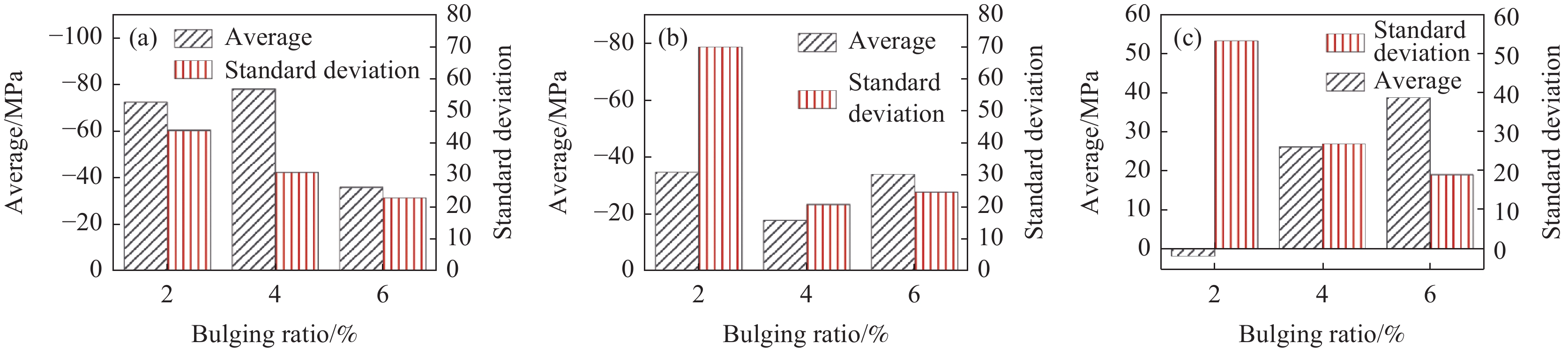
图 6 不同胀形量下胀形后环件各位置的应力评价指标
(a)上端面; (b)内壁; (c)外壁
Figure 6. Stress indices of bulged ring at different bulging ratio
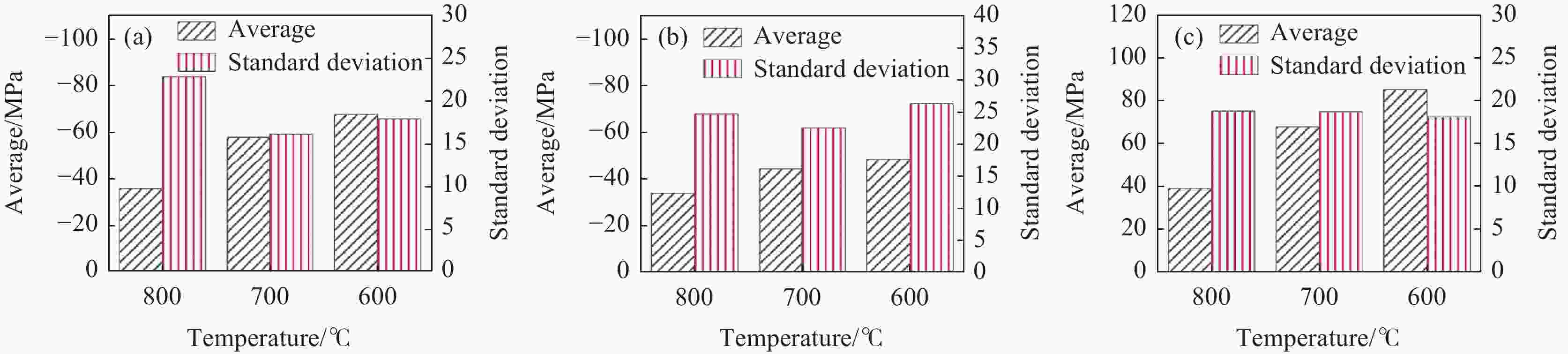
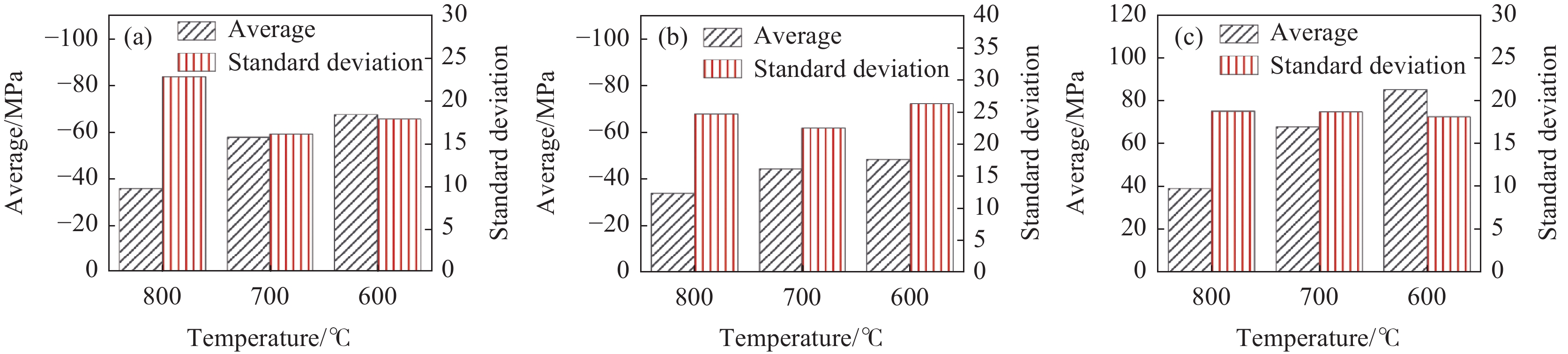
图 7 不同胀形温度下胀形后环件各位置的应力评价指标
(a)上端面; (b)内壁; (c)外壁
Figure 7. Stress indices of bulged ring at different bulging temperatures
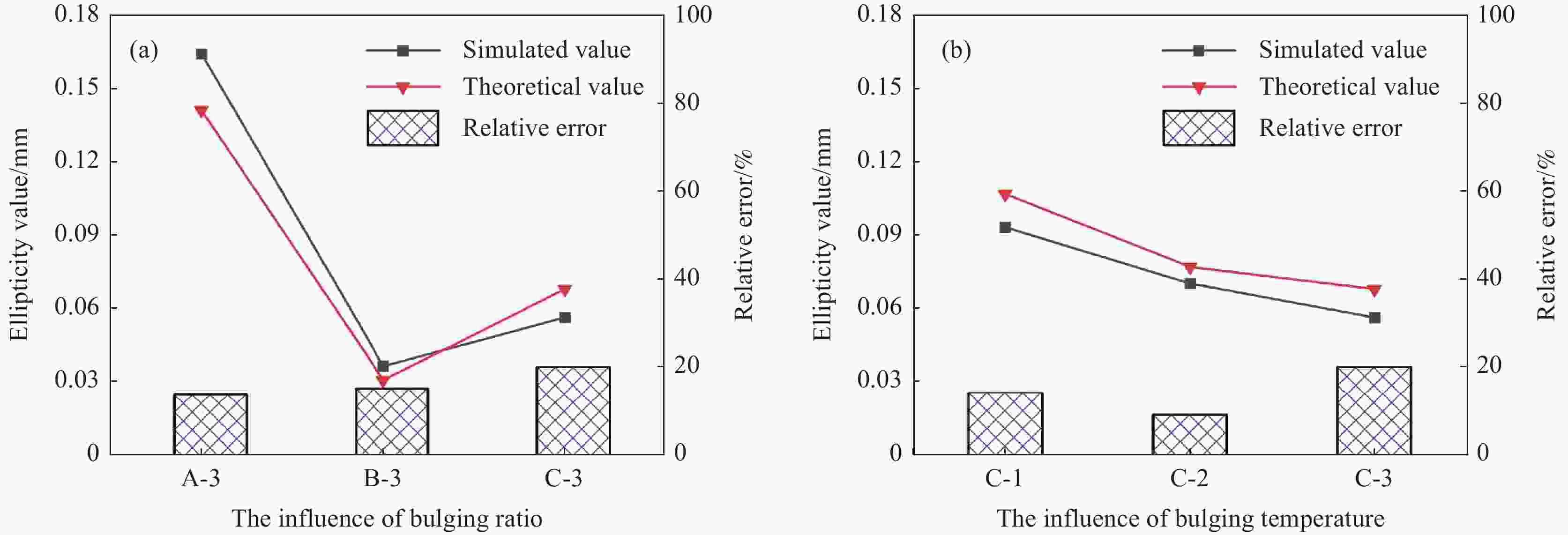
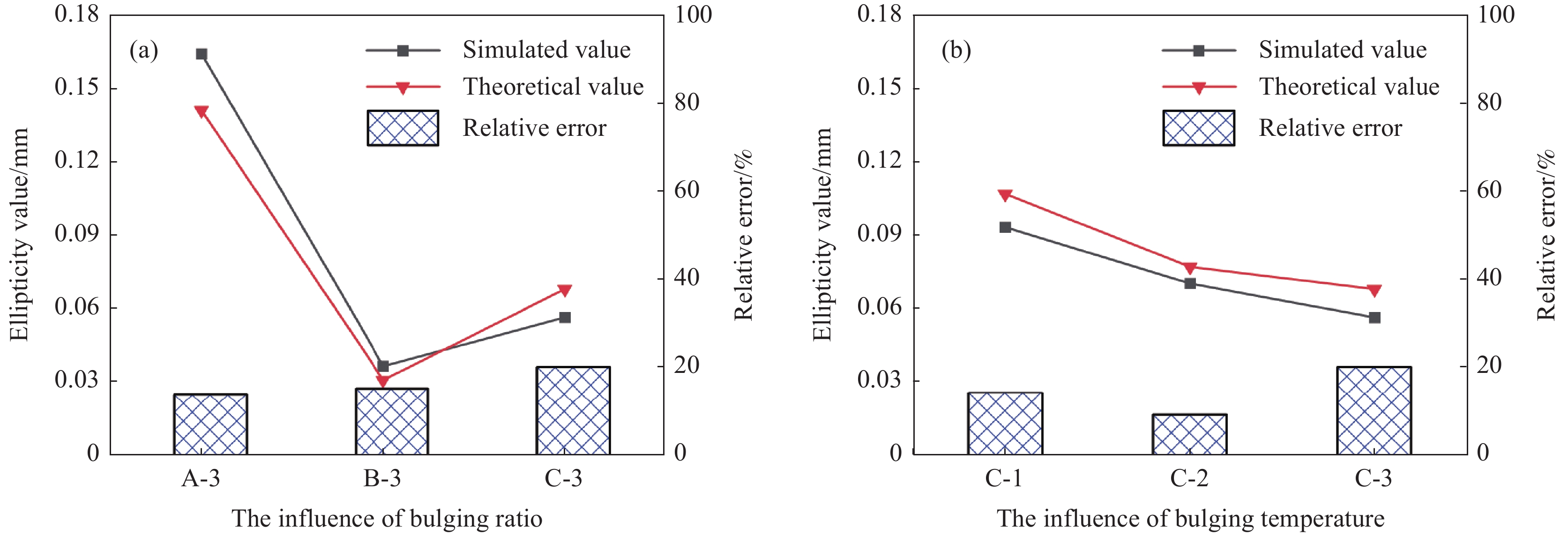
图 8 胀形工艺参数对仿真和理论计算的椭圆度影响
(a)胀形量; (b) 胀形温度
Figure 8. Simulation and theoretical calculation of machining deformation
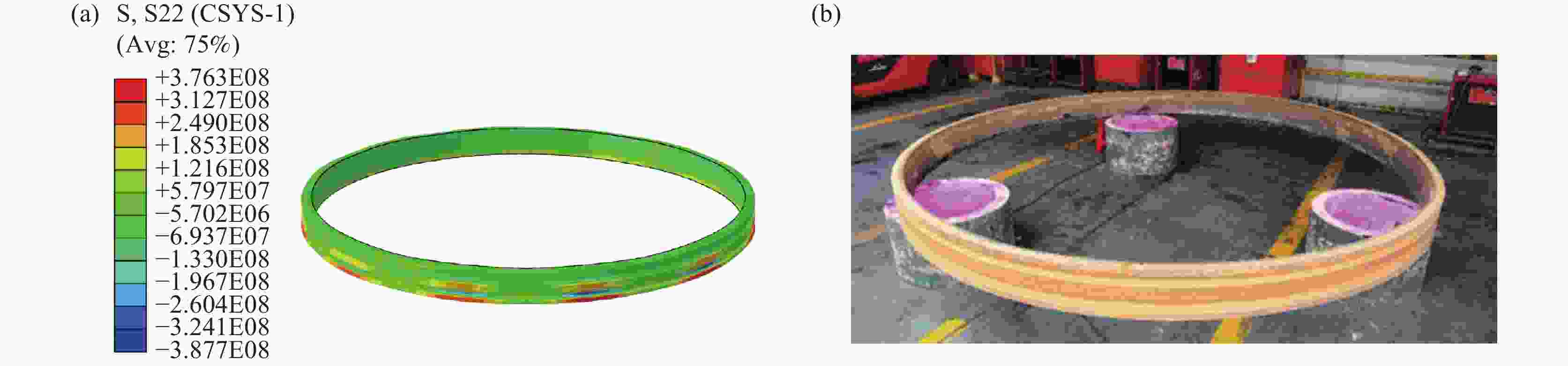
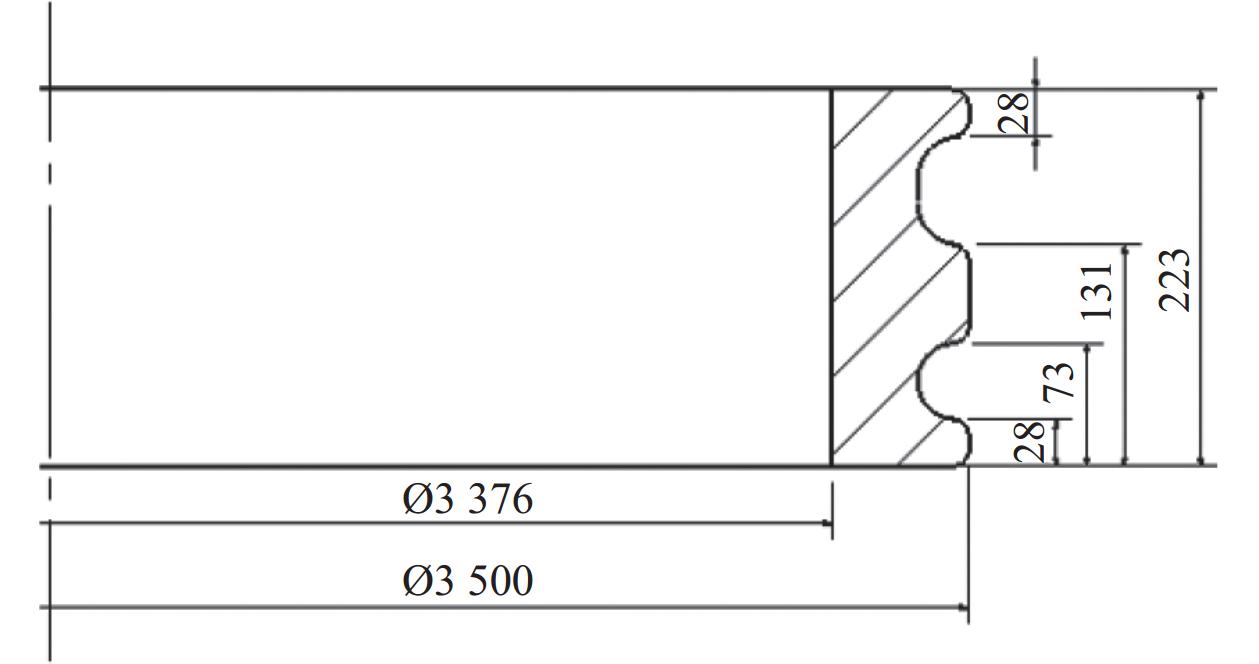
图 10 异形环件胀形后模拟和试验结果
(a)仿真; (b)试验
Figure 10. Simulation and experimental results of special-shaped ring components
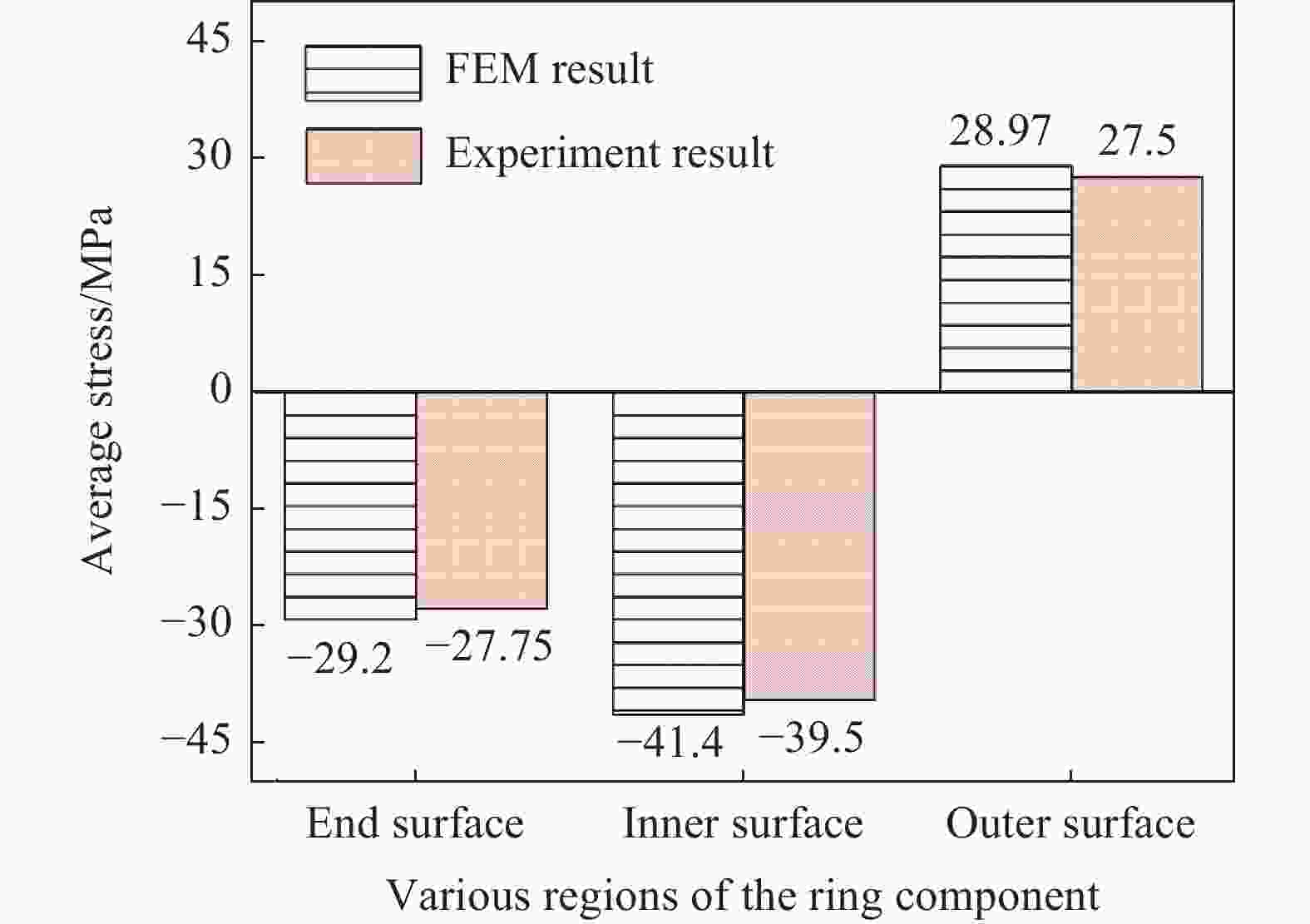
图 11 胀形后环件不同部位残余应力结果
Figure 11. Post-bulging residual stress results at different positions of ring components
表 1 TC4钛合金环件轧制工艺参数
Table 1. Process parameters of TC4 titanium alloy ring component
Size of ring
blank/mmSize of rolled
ring/mmSpeed of driving
roll/(rad·s−1)Speed of the
mandrel/
(mm·s−1)Initial
temperature
of roll/℃Bulging
speed/
(mm·s−1)Coulomb
friction
factorAmbient
temperature/℃Initial
temperature
of blank/℃Ø72×Ø45×15 Ø106×Ø90×15 0.8 0.5 300 1 0.6 25 950  下载: 导出CSV
表 2 TC4钛合金环件胀形参数
Table 2. Expansion parameters of TC4 titanium alloy ring component
Number Bulging ratio/% Temperature/℃ A-3 2 800 B-3 4 800 C-3 6 800 C-2 6 700 C-1 6 600
下载: 导出CSV
-
[1] WEI S, YIN Z W, GAO P, et al. Direct-reverse SPF process for TC4 semi-annular part[J]. Rare Metal Materials and Engineering, 2017, 46(S1): 139-144. (微石, 阴中炜, 高鹏, 等. TC4半环超塑正反胀形工艺研究[J]. 稀有金属材料与工程, 2017, 46(S1): 139-144.WEI S, YIN Z W, GAO P, et al. Direct-reverse SPF process for TC4 semi-annular part[J]. Rare Metal Materials and Engineering, 2017, 46(S1): 139-144. [2] WEI Z J, LI J S, LÜ N, et al. Effect of bulging process on residual stress and its distribution of TC4 alloy ring forgings[J]. Rare Metal Materials and Engineering, 2019, 48(8): 2537-2543. (魏志坚, 李金山, 吕楠, 等. 胀形对TC4合金辗轧环锻件残余应力及分布的影响[J]. 稀有金属材料与工程, 2019, 48(8): 2537-2543.WEI Z J, LI J S, LÜ N, et al. Effect of bulging process on residual stress and its distribution of TC4 alloy ring forgings[J]. Rare Metal Materials and Engineering, 2019, 48(8): 2537-2543. [3] CAO Q S. Research on residual stress elimination method of aluminum alloy ring based on electromagnetic forming technology[D]. Wuhan: Huazhong University of Science and Technology, 2021. (曹青山. 基于电磁胀形技术的铝合金环件残余应力消除方法研究[D]. 武汉: 华中科技大学, 2021.CAO Q S. Research on residual stress elimination method of aluminum alloy ring based on electromagnetic forming technology[D]. Wuhan: Huazhong University of Science and Technology, 2021. [4] YANG Y H, XIONG S C, DENG Y F, et al. Reducing quenching residual stress of 2219 aluminum alloy ring by cold bulging process[J]. Rare Metal Materials and Engineering, 2023, 52(10): 3355-3362. (杨艳慧, 熊思灿, 邓云飞, 等. 采用冷胀形工艺降低2219铝合金环的淬火残余应力[J]. 稀有金属材料与工程, 2023, 52(10): 3355-3362.YANG Y H, XIONG S C, DENG Y F, et al. Reducing quenching residual stress of 2219 aluminum alloy ring by cold bulging process[J]. Rare Metal Materials and Engineering, 2023, 52(10): 3355-3362. [5] HE L Y. Research on forging forming and quenching residual stress reduction process of large 7085 aluminum alloy cylindrical part[D]. Chongqing: Chongqing University, 2023. (何珞玉. 大型7085铝合金筒形件锻造成形及淬火残余应力消减工艺研究[D]. 重庆: 重庆大学, 2023.HE L Y. Research on forging forming and quenching residual stress reduction process of large 7085 aluminum alloy cylindrical part[D]. Chongqing: Chongqing University, 2023. [6] LÜ N, LIU D, HU Y, et al. Research on the evolution of residual stresses in the manufacturing process of TC4 alloy profile rolled ring[J]. Engineering Failure Analysis, 2022, 137: 106269. doi: 10.1016/j.engfailanal.2022.106269 [7] LÜ N, LIU D, WANG J G, et al. Residual stresses evolution and process route optimization of TC4 profiled rolled rings incorporating thermal bulging[J]. Archives of Civil and Mechanical Engineering, 2023, 23(3): 200. doi: 10.1007/s43452-023-00737-0 [8] ZHANG Z, ZHANG D, WU B, et al. Milling distortion prediction for thin-walled component based on the average MIRS in specimen machining[J]. The International Journal of Advanced Manufacturing Technology, 2020, 107(1): 1-18. doi: 10.1007/s00170-020-06281-y [9] FUH K H, WU C F. A residual-stress model for the milling of aluminum-alloy[J]. Journal of Materials Processing Technology, 1995, 51(1): 87-105. [10] LIAO K, ZHANG X D, CHE X F, et al. Construction and analysis of mechanical model for machining deformation of aluminum alloy thin-walled components[J]. Journal of Harbin Institute of Technology, 2018, 50(5): 166-172. (廖凯, 张萧笛, 车兴飞, 等. 铝合金薄壁件加工变形的力学模型构建与分析[J]. 哈尔滨工业大学学报, 2018, 50(5): 166-172. doi: 10.11918/j.issn.0367-6234.201709069LIAO K, ZHANG X D, CHE X F, et al. Construction and analysis of mechanical model for machining deformation of aluminum alloy thin-walled components[J]. Journal of Harbin Institute of Technology, 2018, 50(5): 166-172. doi: 10.11918/j.issn.0367-6234.201709069 [11] BAI Q, ZHANG J H, LI M Z, et al. A novel method to control stress distribution and machining-induced deformation for thin-walled metallic parts[J]. High Temperature Materials and Processes, 2022, 41(1): 702-712. doi: 10.1515/htmp-2022-0254 [12] XUE N P, WU Q, YANG R S, et al. Research on machining deformation of aluminum alloy rolled ring induced by residual stress[J]. The International Journal of Advanced Manufacturing Technology, 2023, 125(11): 5669-5680. [13] SONG J L, DOWSON A L, JACOBS M H, et al. Coupled thermo-mechanical finite-element modelling of hot ring rolling process[J]. Journal of Materials Processing Technology, 2002, 121(2-3): 332-340. doi: 10.1016/S0924-0136(01)01179-7 [14] JONES A B, MILLER C D, CHEN E F, et al. High-velocity fragmentation of titanium alloy rings and cylinders produced using field-assisted sintering technology[J]. International Journal of Impact Engineering, 2026, 150: 104892-104905. doi: 10.1007/s10704-024-00829-9 [15] SONG H C, GAO H J, ZHANG Q D, et al. Long-term stress relaxation behaviors and mechanisms of 2219 Al–Cu alloy under various temperatures and initial stresses[J]. Journal of Materials Science & Technology, 2024, 180: 174-192. doi: 10.1016/j.jmst.2023.06.061 [16] GUO W F, YI Y P, HUANG S Q, et al. Effects of deformation temperature on the evolution of second-phase and mechanical properties of large 2219 Al-Cu alloy rings[J]. Materials Characterization, 2020, 160: 110094. doi: 10.1016/j.matchar.2019.110094 [17] WU Q, WU J, ZHANG Y D, et al. Analysis and homogenization of residual stress in aerospace ring rolling process of 2219 aluminum alloy using thermal stress relief method[J]. International Journal of Mechanical Sciences, 2019, 157-158: 111-118. [18] HE H L, YI Y P, HUANG S Q, et al. Effects of deformation temperature on second-phase particles and mechanical properties of 2219 Al-Cu alloy[J]. Materials Science & Engineering A, 2018, 712: 414-423. doi: 10.1016/j.msea.2017.11.124 [19] WU L Y. Theory of Plates and Shells[M]. Shanghai: Shanghai Jiao Tong University Press, 1989: 199-206. (吴连元. 板壳理论[M]. 上海: 上海交通大学出版社, 1989: 199-206.WU L Y. Theory of Plates and Shells[M]. Shanghai: Shanghai Jiao Tong University Press, 1989: 199-206. -

计量
- 文章访问数: 4
- HTML全文浏览量: 0
- PDF下载量: 1
- 被引次数: 0