Study on melting simulation of Ti551 alloy ingots with spatial coordinate transformation based on MeltFlow-VAR
-
摘要: 真空自耗电弧熔炼(VAR)是制备钛合金铸锭的关键技术,但传统工艺难以精准把控多物理场耦合作用,易引发铸锭成分偏析问题。对Ti551合金目标成分取Ti-5.3Al-1.5Mo-1.0V-1.0Sn-1.0Zr-1.0Cr-0.1O-0.15Fe进行熔炼模拟研究,采用MeltFlow-VAR软件开展Ti551钛合金凝固偏析模拟,对Ti551合金铸锭设计4种空间坐标变换的熔炼方案,通过对一次锭和二次锭的熔炼过程仿真,分析不同方案下Al、Mo、V等合金元素的分布规律,研究表明,Ti551合金一次锭存在显著元素偏析,Al、Mo、O呈负偏析,V、Sn、Zr等元素为正偏析,偏析集中于锭头冒口与锭尾区域;对比四种熔炼方案,分切焊接类方案改善铸锭中部成分均匀性效果最优,其中方案2元素含量更贴近标准值,方案4可平缓长尺寸铸锭成分波动;传统头尾倒置法无法根治偏析问题,而空间坐标变换重组熔炼能够打破原有偏析分布格局。同时,高熔点高密度的Mo元素负偏析效应突出,分切焊接重组方式可调控其熔池传输与再分布机制,有效优化铸锭中部成分均匀性,为钛合金高熔点元素偏析控制及提升铸锭成材率提供技术参考。
-
关键词:
- Ti551钛合金 /
- MeltFlow-VAR /
- 偏析 /
- 数值模拟
Abstract: Vacuum arc remelting (VAR) is the key technology for the preparation of titanium alloy ingots. However, traditional processes struggle to precisely control the coupling effect of multi-physical fields, which easily leads to compositional segregation of ingots. In this paper, melting simulation research was carried out on Ti551 alloy with a target composition of Ti-5.3Al-1.5Mo-1.0V-1.0Sn-1.0Zr-1.0Cr-0.1O-0.15Fe. The MeltFlow-VAR software was adopted to simulate the solidification segregation of Ti551 titanium alloy, and four melting cases with spatial coordinate transformation were designed for Ti551 alloy ingots. By simulating the melting processes of primary and secondary ingots, the distribution characteristics of alloying elements such as Al, Mo and V under different cases were analyzed. The results show that obvious elemental segregation exists in the primary Ti551 ingot. Al, Mo and O exhibit negative segregation, while V, Sn, Zr and other elements present positive segregation, and the segregation is mainly concentrated in the riser of the ingot head and the ingot tail. Among the four cases, the cutting and welding cases have the optimal effect on improving the compositional uniformity in the middle of the ingot. Case 2 enables the elemental content in the middle region to be closer to the standard values, and case 4 effectively weakens the element concentration fluctuation of large-size long ingots. The traditional head-to-tail inversion method cannot fundamentally eliminate segregation defects, whereas the restructured melting based on spatial coordinate transformation can break the original segregation distribution pattern. In addition, Mo features a high melting point and high density with prominent negative segregation during VAR processing. The reconstruction methods including cutting and welding can regulate the transport and redistribution mechanism of Mo in the molten pool, which effectively optimizes the compositional uniformity in the middle of ingots. This study provides a technical reference for the segregation control of high-melting-point elements and the improvement of finished product rate of titanium alloy ingots.-
Key words:
- Ti551 titanium alloy /
- MeltFlow-VAR /
- segregation /
- numerical simulation
-

图 5 Ti551钛合金的一次锭中Al, Mo, V, Sn, Zr, Cr, O和Fe元素分布云图
Figure 5. Distribution contours of Al, Mo, V, Sn, Zr, Cr, O and Fe elements in Ti551 titanium alloy primary ingots

图 6 方案1的Ti551钛合金二次锭中Al, Mo, V, Sn, Zr, Cr, O和Fe元素分布云图
Figure 6. Distribution contours of Al, Mo, V, Sn, Zr, Cr, O and Fe elements in Ti551 titanium alloy secondary ingots under case 1

图 7 方案2的Ti551钛合金二次锭中Al, Mo, V, Sn, Zr, Cr,O和Fe元素分布云图
Figure 7. Distribution contours of Al, Mo, V, Sn, Zr and Cr elements in Ti551 titanium alloy secondary ingots under case 2
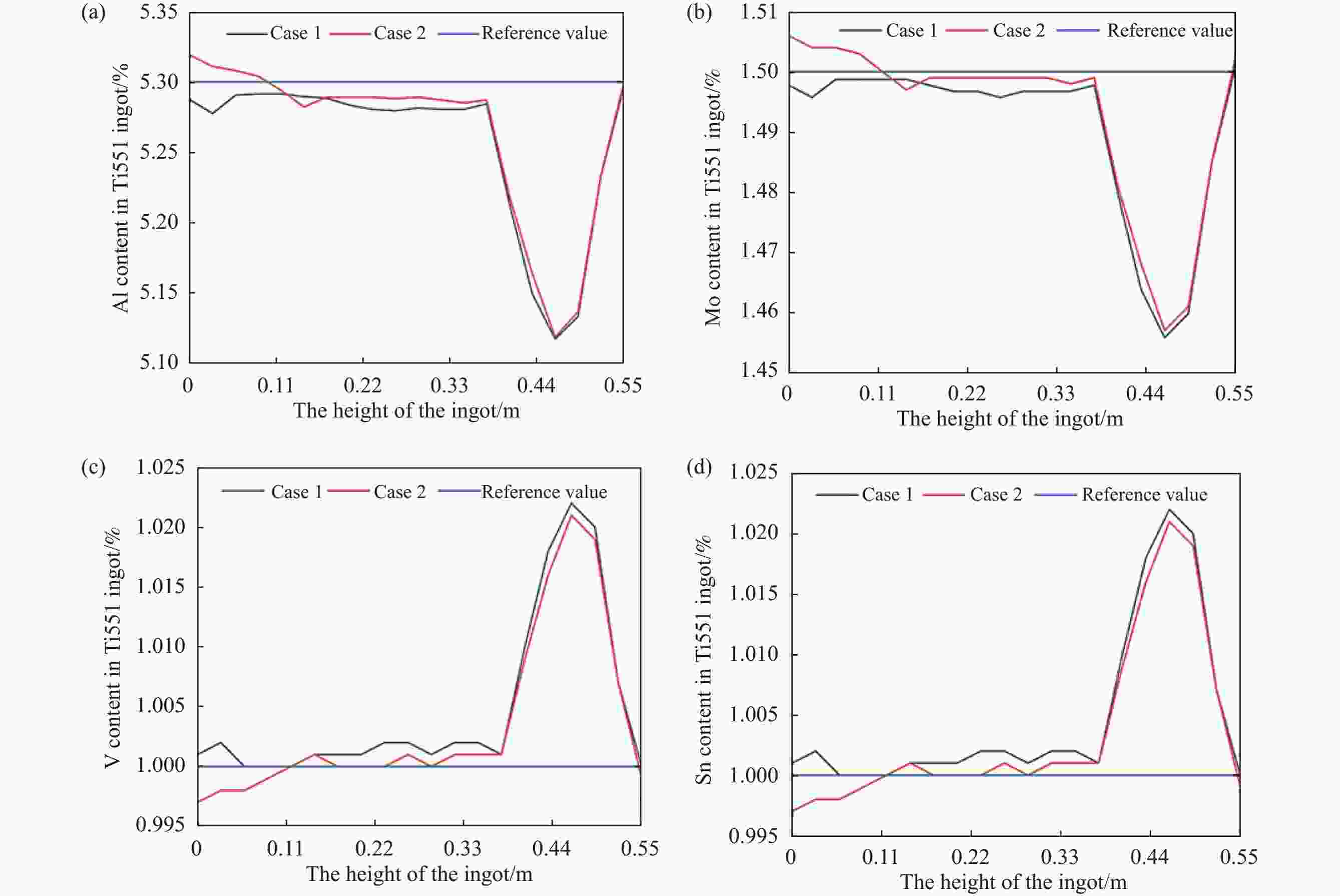
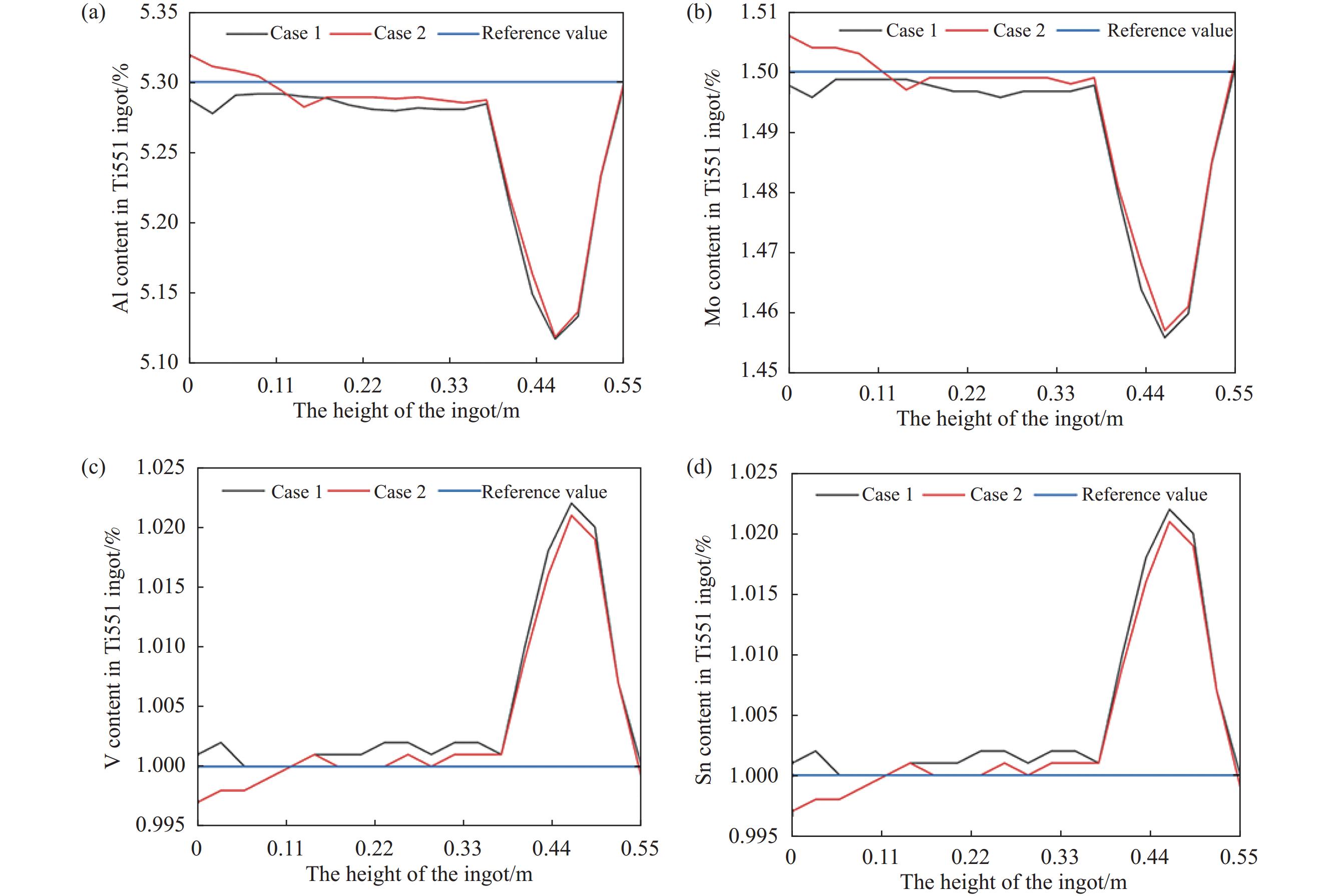
图 8 方案1和方案2的Ti551钛合金二次锭中轴线上Al, Mo, V 和Sn元素分布
(a) Al;(b) Mo;(c) V;(d) Sn
Figure 8. Distribution curves of Al, Mo, V and Sn elements in Ti551 titanium alloy secondary ingots at axial direction under case 1 and case 2
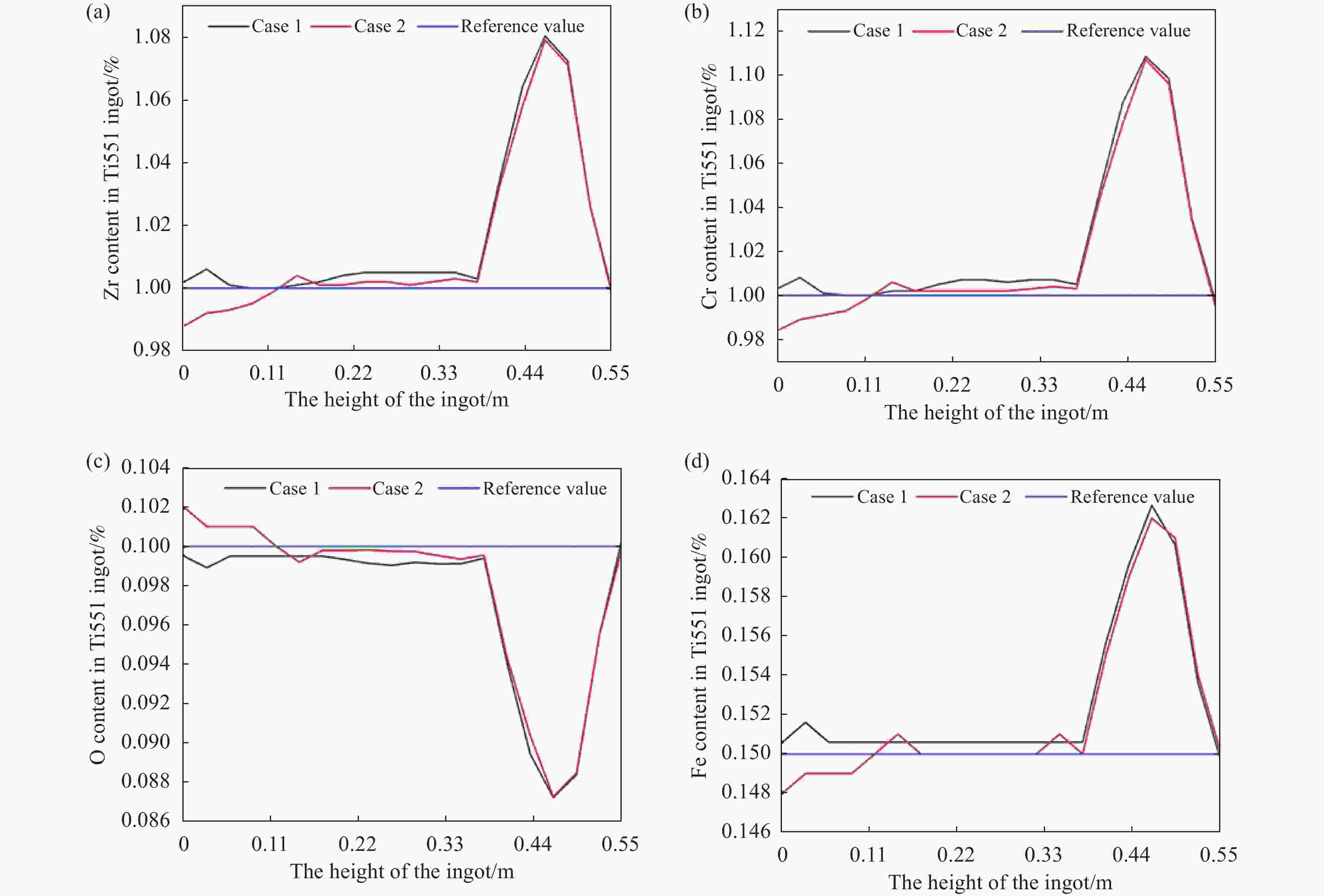
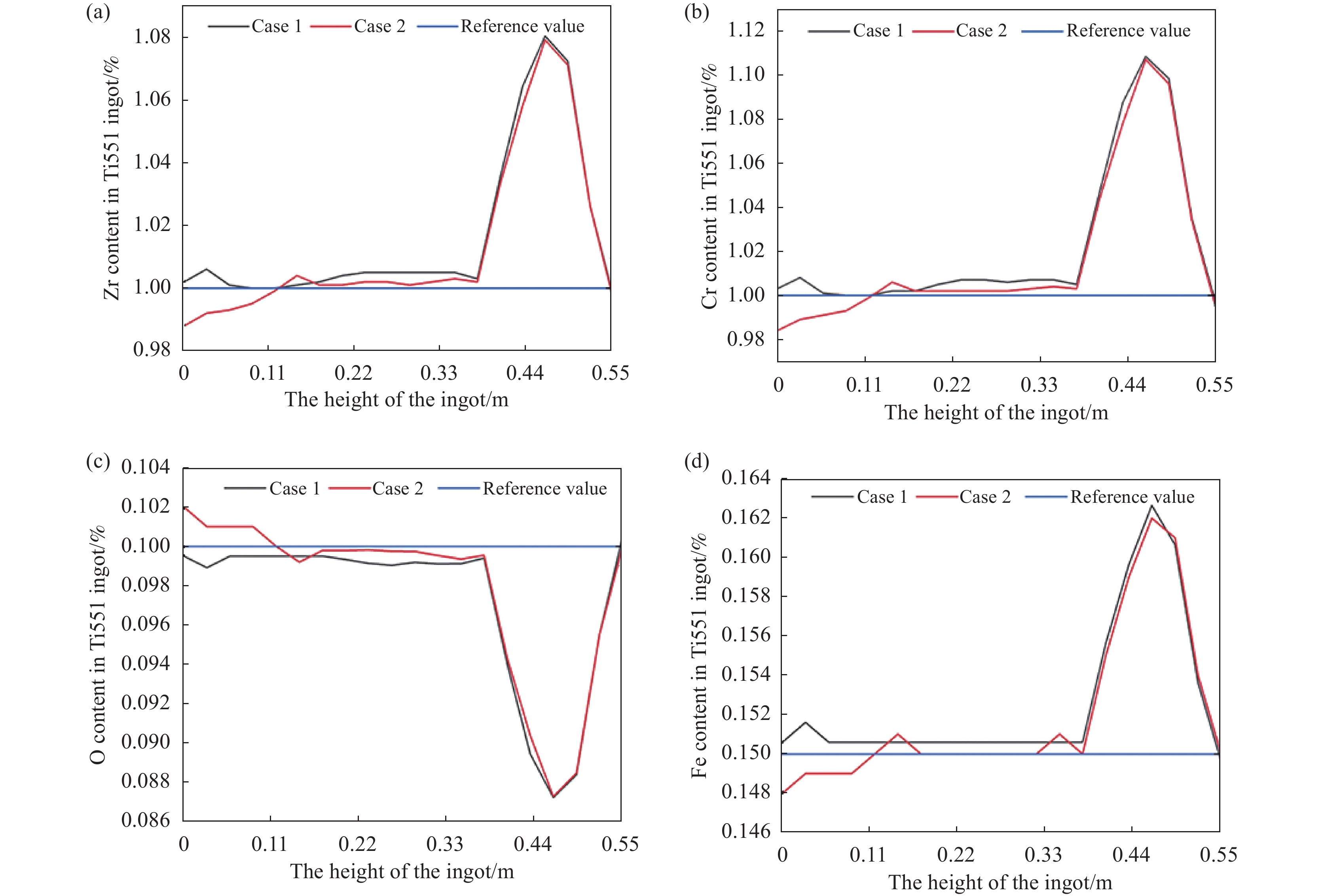
图 9 方案1和方案2的Ti551钛合金二次锭中轴线上Zr, Cr, O和Fe元素分布
(a) Zr;(b) Cr;(c) o;(d) Fe
Figure 9. Distribution curves of Zr, Cr, O and Fe elements in Ti551 titanium alloy secondary ingots at axial direction under case 1 and case 2

图 10 方案3的Ti551钛合金二次锭中Al, Mo, V, Sn, Zr, Cr, O和Fe 元素分布云图
Figure 10. Distribution contours of Al, Mo, V, Sn, Zr, Cr, O and Fe elements in Ti551 titanium alloy secondary ingots under case 3

图 11 方案4的Ti551钛合金二次锭中Al, Mo, V, Sn, Zr, Cr, O和Fe 元素分布云图
Figure 11. Distribution contours of Al, Mo, V, Sn, Zr, Cr, O and Fe elements in Ti551 titanium alloy secondary ingots under case 4
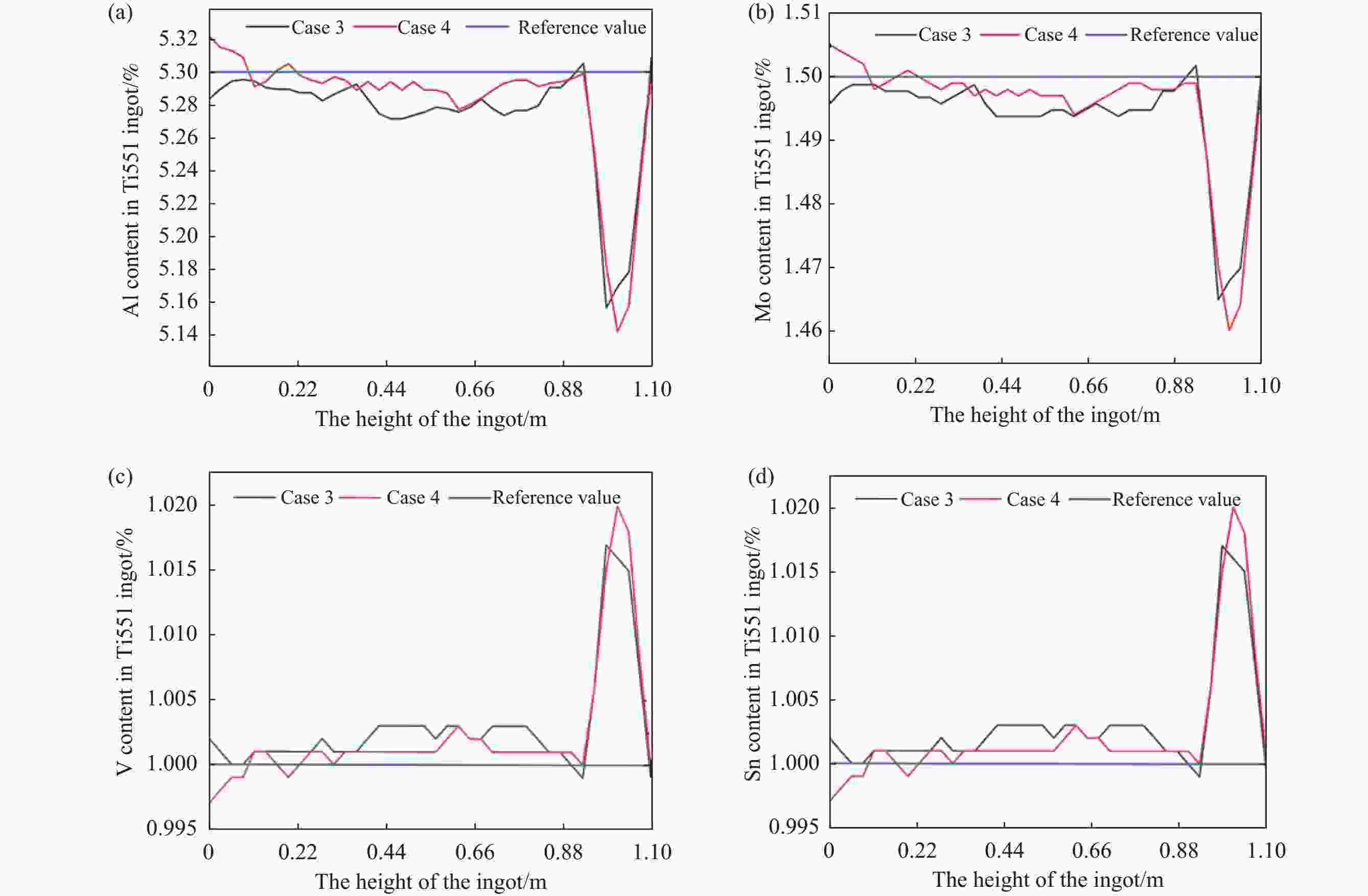
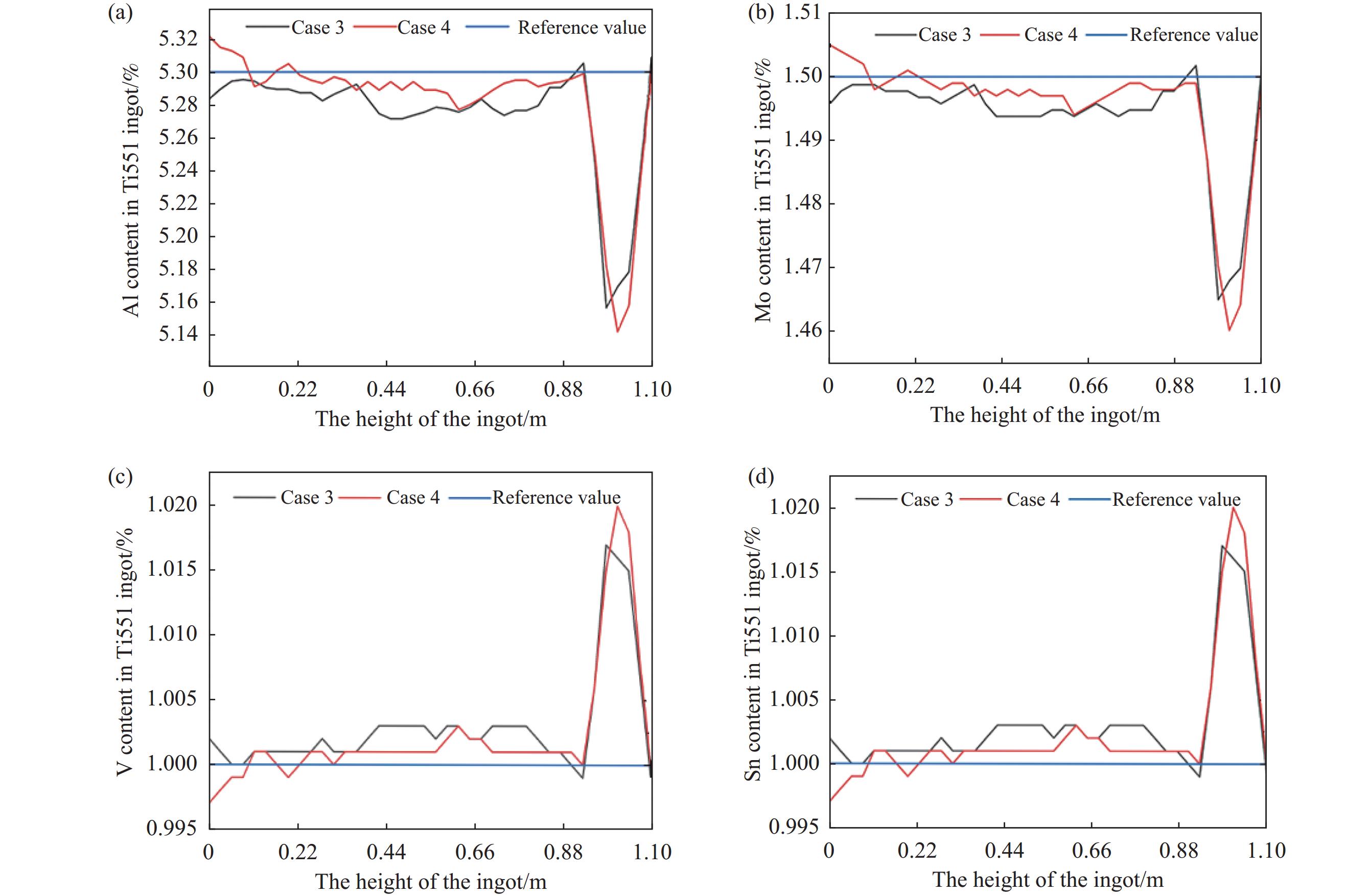
图 12 方案3和方案4的Ti551钛合金二次锭中轴线上Al, Mo, V 和Sn元素分布
(a) Al;(b) Mo;(c) V;(d) Sn
Figure 12. Distribution curves of Al, Mo, V and Sn elements in Ti551 titanium alloy secondary ingots at axial direction under case 3 and case 4
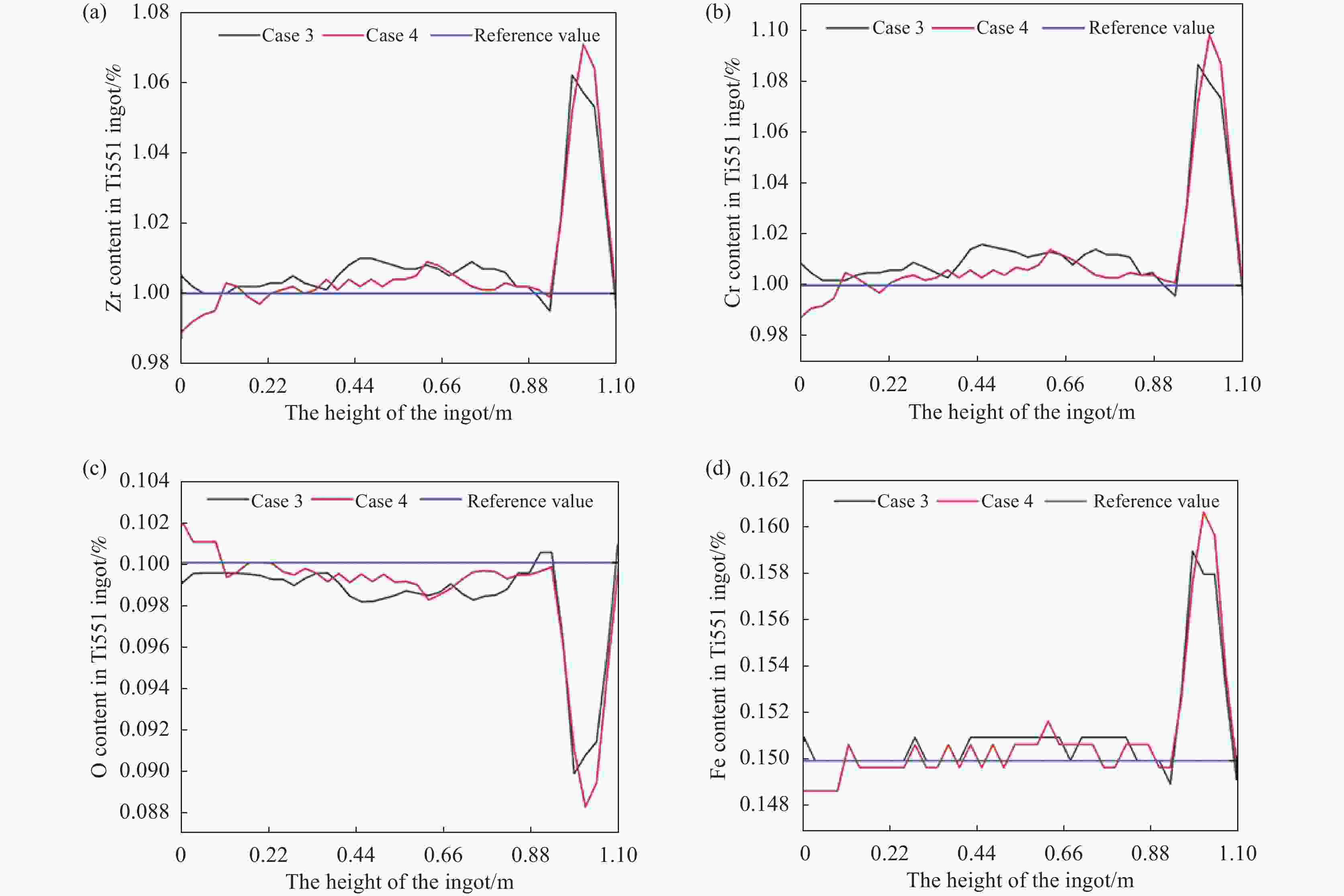
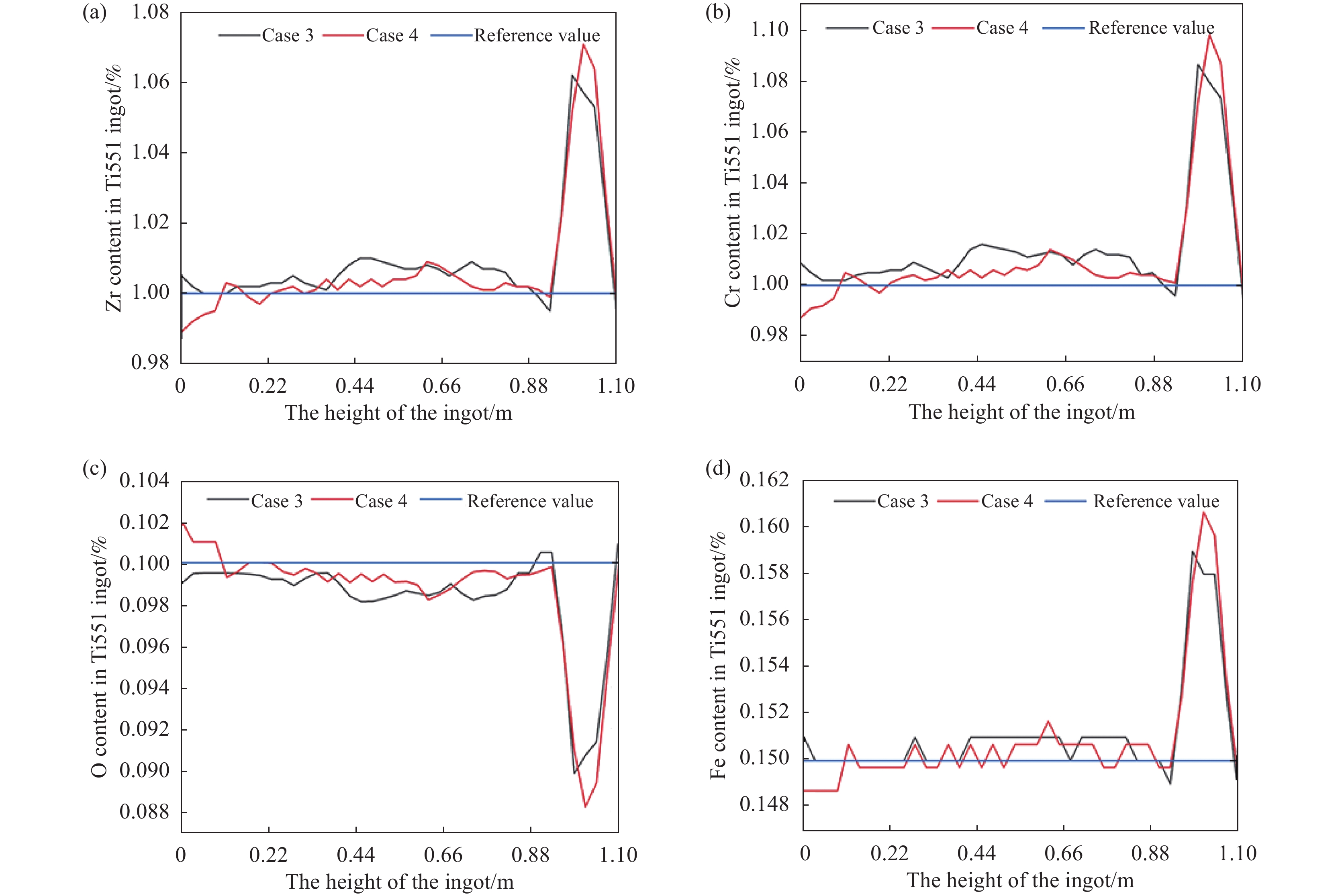
图 13 方案3和方案4的Ti551钛合金二次锭中轴线上Zr, Cr, O和Fe元素分布
Figure 13. Distribution curves of Zr, Cr, O and Fe elements in Ti551 titanium alloy secondary ingots at axial direction under case 3 and case 4
表 1 计算采用的Ti551钛合金物性参数
Table 1. Physical property parameters of Ti551 titanium alloy used in calculation
Liquid
density
(kg/m3)Solid
density
(kg/m3)Volume
expansion
coefficient/KTemperature/K Latent
heat (J·kg−1)Electrical
conductivity
/(A·V−1·m−1)Thermal conductivity
/(W·m−1·K−1,1873 K)Specific heat
/(J·kg−1·K−1,1873 K)Dynamic viscosity
(Pa·S,1873 K)Solidus Liquidus 4060 4510 9.35×10⁻⁵ 1947 2000 3.20×10⁵ 8.5×10⁵ 0.3172 ×1020.947×103 3.35×10⁻³  下载: 导出CSV
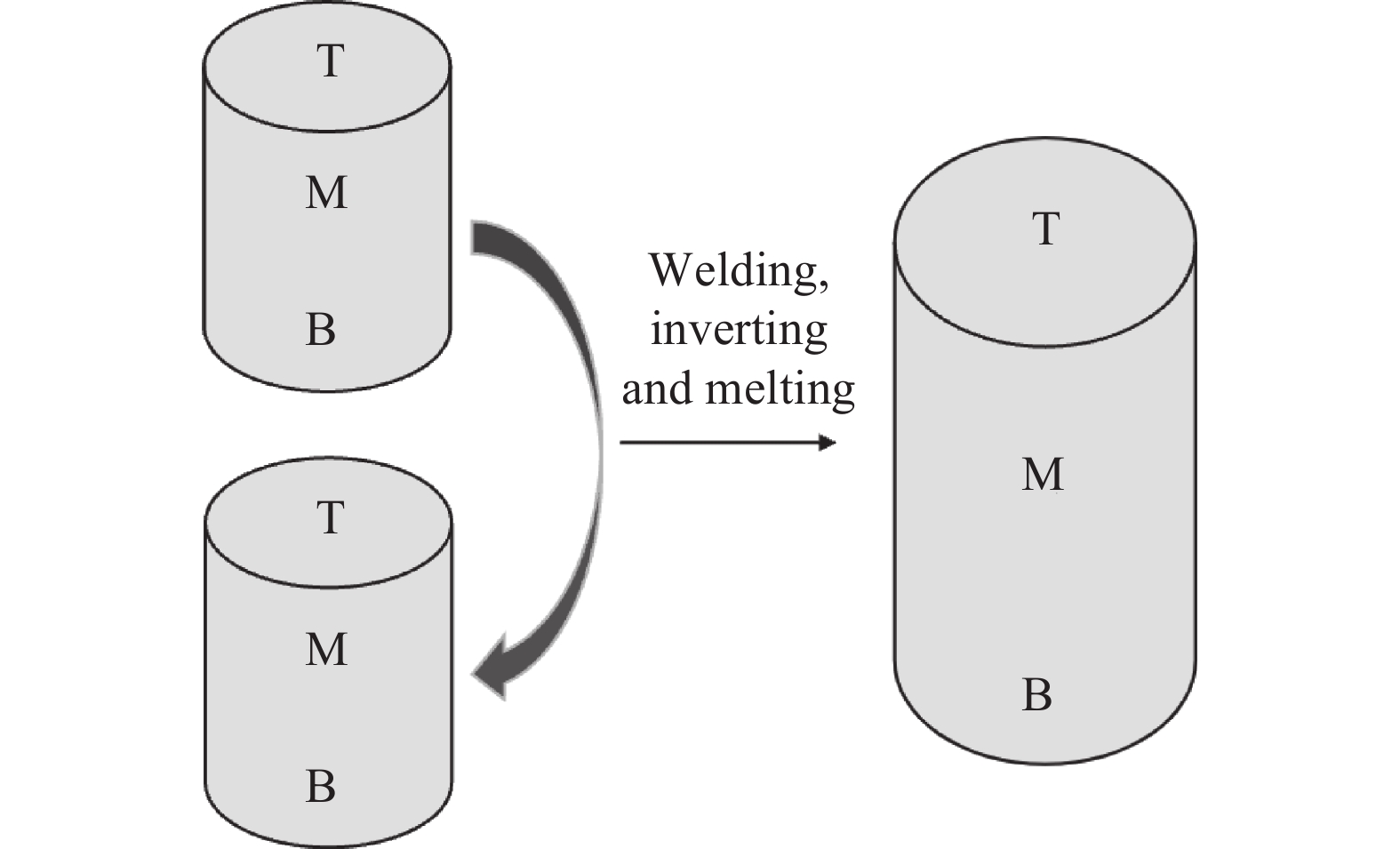
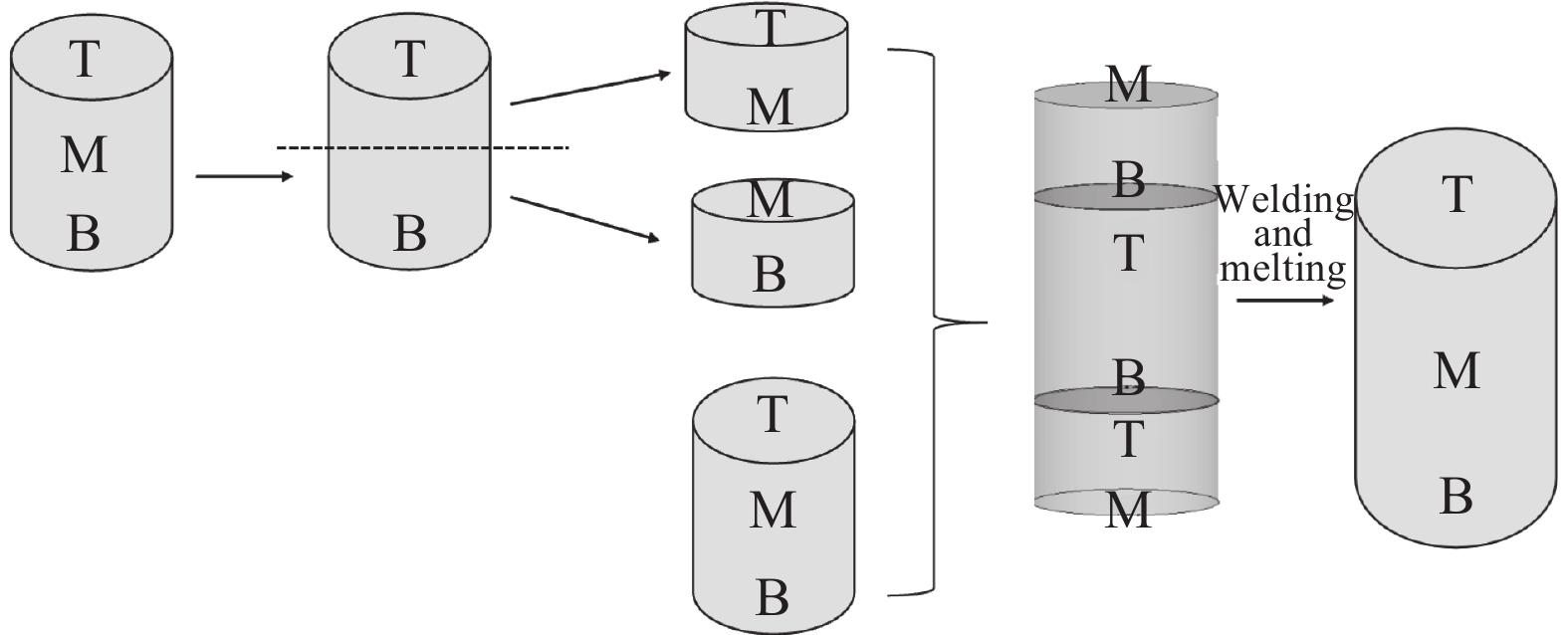
表 2 Ti551合金的空间坐标变换的熔炼方案
Table 2. Melting cases for spatial coordinate transformation of Ti551 alloy
Melting
casesMelting batch Ingot
quantityMatching method Product dimensions/mm 1 First VAR 1 Ø200×930 Second VAR 1 Ø260×550 2 Fist VAR 1 Cutting and welding Ø200×930 Second VAR 1 Ø260×550 3 Fist VAR 2 Welding head and tail Ø200×930 Second VAR 1 Ø260× 1100 4 Fist VAR 2 Cut one ingot into sections, match it with another one, and then weld them together Ø200×930 Second VAR 1 Ø260× 1100
下载: 导出CSV
-
[1] ZHAO Y Q, CHANG H, LI Z C, et al. Ship-use titanium alloys innovatively developed by northwest institute for nonferrous metal research[J]. Titanium Industry Progress, 2003(6): 12-16. (赵永庆, 常辉, 李佐臣, 等. 西北有色院创新研制的船用钛合金[J]. 钛工业进展, 2003(6): 12-16.ZHAO Y Q, CHANG H, LI Z C, et al. Ship-use titanium alloys innovatively developed by northwest institute for nonferrous metal research[J]. Titanium Industry Progress, 2003(6): 12-16. [2] YANG P B. Application of titanium alloys in ships[J]. Guangdong Shipbuilding, 2005(3): 30-32. (杨蓬勃. 钛合金在船舶上的应用[J]. 广东造船, 2005(3): 30-32.YANG P B. Application of titanium alloys in ships[J]. Guangdong Shipbuilding, 2005(3): 30-32. [3] ZHAO Y Q.The new main titanium alloys used for ship building developed in China and their applicationss[J]. Materials China, 2014, 33(7): 398-404. (赵永庆. 我国创新研制的主要路用钛合金及其应用[J]. 中国材料进展, 2014, 33(7): 398-404.ZHAO Y Q.The new main titanium alloys used for ship building developed in China and their applicationss[J]. Materials China, 2014, 33(7): 398-404. [4] LIU X H, WU C, HE W P, et al. Study on strengthening mechanism of Ti80 alloy based on microstructure regulation[J]. Development and Application of Materials, 2024, 39(4): 28-37. (刘向宏, 吴聪, 和卫平, 等. 基于显微组织调控的Ti80合金强韧化机理研究[J]. 材料开发与应用, 2024, 39(4): 28-37.LIU X H, WU C, HE W P, et al. Study on strengthening mechanism of Ti80 alloy based on microstructure regulation[J]. Development and Application of Materials, 2024, 39(4): 28-37. [5] LI X J. Vacuum consumable arc furnace melting technology and ingot quality issues[J]. Titanium Industry Progress, 2001(3): 16-22. (李献军. 真空自耗电弧炉熔炼技术和铸锭质量问题[J]. 钛工业进展, 2001(3): 16-22.LI X J. Vacuum consumable arc furnace melting technology and ingot quality issues[J]. Titanium Industry Progress, 2001(3): 16-22. [6] ZHAO X H, LI J S, YANG Z J, et al. Numerical simulation of temperature field during vacuum consumable arc melting of titanium alloys[J]. Special Casting & Nonferrous Alloys, 2010, 30(11): 1001-1004. (赵小花, 李金山, 杨治军, 等. 钛合金真空自耗电弧熔炼过程中温度场的数值模拟[J]. 特种铸造及有色合金, 2010, 30(11): 1001-1004.ZHAO X H, LI J S, YANG Z J, et al. Numerical simulation of temperature field during vacuum consumable arc melting of titanium alloys[J]. Special Casting & Nonferrous Alloys, 2010, 30(11): 1001-1004. [7] LEI W G, ZHAO Y Q, HAN D, et al. Development status of titanium and titanium alloy melting technology[J]. Materials Review, 2016, 30(5): 101-106. (雷文光, 赵永庆, 韩栋, 等. 钛及钛合金熔炼技术发展现状[J]. 材料导报, 2016, 30(5): 101-106.LEI W G, ZHAO Y Q, HAN D, et al. Development status of titanium and titanium alloy melting technology[J]. Materials Review, 2016, 30(5): 101-106. [8] YANG H, YANG X K, DU C, et al. Research progress of vacuum melting technology for titanium and titanium alloys[J]. World Nonferrous Metals, 2019(8): 1-4. (杨欢, 杨晓康, 杜晨, 等. 钛及钛合金真空熔炼技术研究进展[J]. 世界有色金属, 2019(8): 1-4.YANG H, YANG X K, DU C, et al. Research progress of vacuum melting technology for titanium and titanium alloys[J]. World Nonferrous Metals, 2019(8): 1-4. [9] PATEL A D, MINISANDRAM R S, EVANS D G. Modeling of vacuum arc remelting of alloy 718 ingots[J]. Superalloys, 2004: 917-924. [10] LIU Z, ZHOU B B, MAO L L, et al. Numerical simulation of VAR melting of TC18 titanium alloy ingots based on MeltFlow-VAR[J]. World Nonferrous Metals, 2024(10): 32-36. (刘钊, 周兵兵, 毛玲玲, 等. 基于MeltFlow-VAR的TC18钛合金铸锭VAR熔炼的数值模拟[J]. 世界有色金属, 2024(10): 32-36.LIU Z, ZHOU B B, MAO L L, et al. Numerical simulation of VAR melting of TC18 titanium alloy ingots based on MeltFlow-VAR[J]. World Nonferrous Metals, 2024(10): 32-36. [11] YU J Y, LUO K, GENG N T, et al. Exploring the relationship between Al55 intermediate alloy and composition uniformity of TC4 titanium alloy ingots via MeltFlow-VAR simulation process[J]. Titanium Industry Progress, 2025(2): 9-15. (于继洋, 罗坤, 耿乃涛, 等. 基于MeltFlow-VAR模拟工艺探讨Al55中间合金与TC4钛合金铸锭成分均匀性的关系[J]. 钛工业进展, 2025(2): 9-15.YU J Y, LUO K, GENG N T, et al. Exploring the relationship between Al55 intermediate alloy and composition uniformity of TC4 titanium alloy ingots via MeltFlow-VAR simulation process[J]. Titanium Industry Progress, 2025(2): 9-15. [12] LI T, HUA Q, LIU H, et al. Study on melting process of TC17 titanium alloy ingots based on MeltFlow-VAR[J]. Special Steel Technology, 2024, 30(2): 12-16. (李彤, 华倩, 刘华, 等. 基于MeltFlow-VAR的TC17钛合金铸锭熔炼工艺研究[J]. 特钢技术, 2024, 30(2): 12-16.LI T, HUA Q, LIU H, et al. Study on melting process of TC17 titanium alloy ingots based on MeltFlow-VAR[J]. Special Steel Technology, 2024, 30(2): 12-16. [13] LUO K, GENG N T, YOU Y J, et al. Optimization of VAR melting process for TB9 titanium alloy based on numerical simulation[J]. Iron Steel Vanadium Titanium, 2024, 45(3): 25-32. (罗坤, 耿乃涛, 游彦军, 等. 基于数值模拟的TB9钛合金VAR熔炼工艺优化[J]. Iron Steel Vanadium Titanium, 2024, 45(3): 25-32.LUO K, GENG N T, YOU Y J, et al. Optimization of VAR melting process for TB9 titanium alloy based on numerical simulation[J]. Iron Steel Vanadium Titanium, 2024, 45(3): 25-32. [14] HUA Q, LI T, WANG C N, et al. Study on melting process of Ti2AlNb alloy ingots based on MeltFlow-VAR[J]. Special Steel Technology, 2024, 30(3): 33-35. (华倩, 李彤, 王超南, 等. 基于MeltFlow-VAR 的 Ti2AlNb 合金铸锭熔炼工艺研究[J]. 特钢技术, 2024, 30(3): 33-35.HUA Q, LI T, WANG C N, et al. Study on melting process of Ti2AlNb alloy ingots based on MeltFlow-VAR[J]. Special Steel Technology, 2024, 30(3): 33-35. [15] Innovative Research Inc. COMPACT-AR Reference Manual[EB/OL]. [2026-02-01]. http://www.inres.com. [16] Kelkar K M, Patankar S V, Mitchell A, et al. Computational Modeling of the Vacuum Arc Remelting (VAR) Process Used for the Production of Ingots of Titanium Alloys [C]//The 11th World Conference on Titanium (Ti-2007) Organizing Committee. Ti-2007 Science and Technology. Kyoto: The Japan Institute of Metals, 2007. -







计量
- 文章访问数: 2
- HTML全文浏览量: 0
- PDF下载量: 2
- 被引次数: 0