Effects of build direction on mechanical properties and fatigue behavior of additively manufactured TC4 titanium alloy
-
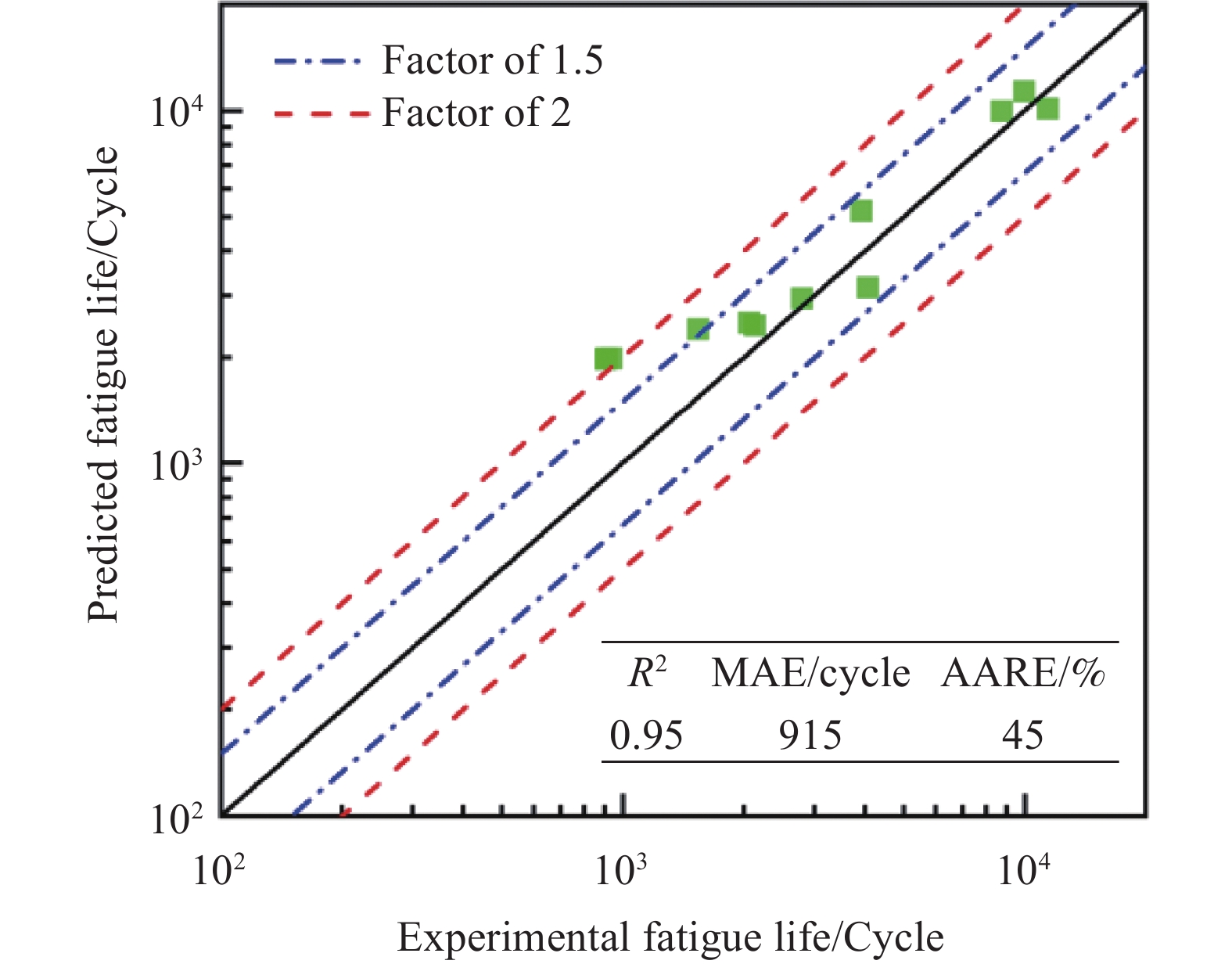
摘要: 基于激光粉末床熔融(L-PBF)制备的TC4钛合金试样,系统开展了0°、12°和16°三种构建方向下的室温拉伸与单轴疲劳试验。拉伸试验结果表明:沿16°方向构建的L-PBF TC4钛合金在高应变速率下表现出最佳的塑性,小范围内变化的构建角度会显著影响L-PBF TC4钛合金的力学性能。通过提出修正后Hollomon模型,整合了不同构建方向及应变速率对拉伸行为的影响,且整体预测性能优于Johnson-Cook(JC)模型,准确地描述了L-PBF TC4钛合金的拉伸力学行为。疲劳试验结果表明:在较高应变幅(0.8%,1.0%)作用下,试样在循环初期出现了短暂的初始硬化,随后表现为典型的软化特征。而在较低应变幅(0.4%,0.6%)作用下,试样的初始硬化阶段消失,直接进入循环稳定阶段,直至快速断裂。最后建立了基于混合物理与数据驱动的VAE-ANN模型,得到的疲劳寿命预测结果均位于2倍误差带内,准确地预测了不同构建方向下L-PBF TC4钛合金的疲劳寿命。Abstract: This paper systematically investigates the tensile and uniaxial fatigue behaviors of TC4 titanium alloy, by laser powder bed fusion (L-PBF), with three building directions (0°, 12°, 16°) under room temperature. Tensile test results indicate that specimens built along 16° direction exhibit the best ductility at high strain rates. Small building direction variations significantly influence the mechanical properties of L-PBF TC4. A modified Hollomon model is proposed, to effectively integrate the effects of different building directions and strain rates on tensile behavior. This model demonstrates superior predictive capability compared to the Johnson-Cook (JC) model, accurately characterizing the tensile mechanical response of L-PBF TC4. Fatigue test results reveal that under higher applied strain amplitudes (0.8%, 1.0%), the specimens experience transient initial cyclic hardening followed by typical softening characteristics. In contrast, under lower applied strain amplitudes (0.4%, 0.6%), the initial hardening stage is absent, and the specimens directly enter a stable cyclic stage before rapid failure. Finally, a hybrid physics and data-driven VAE-ANN model is developed. All fatigue life predictions fall within the 2 times error band, accurately predicting the fatigue life of L-PBF TC4 under different building directions.
-
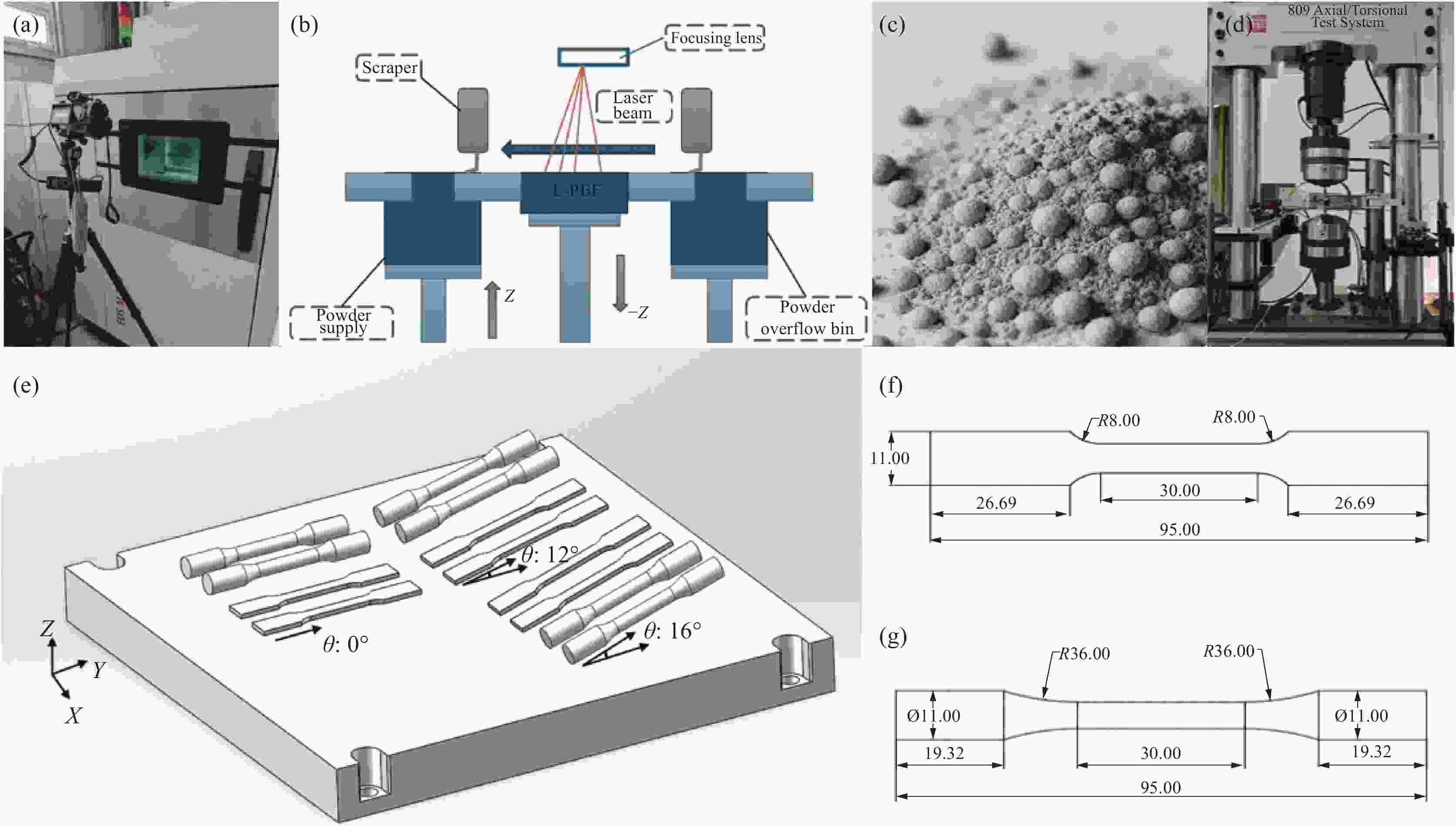
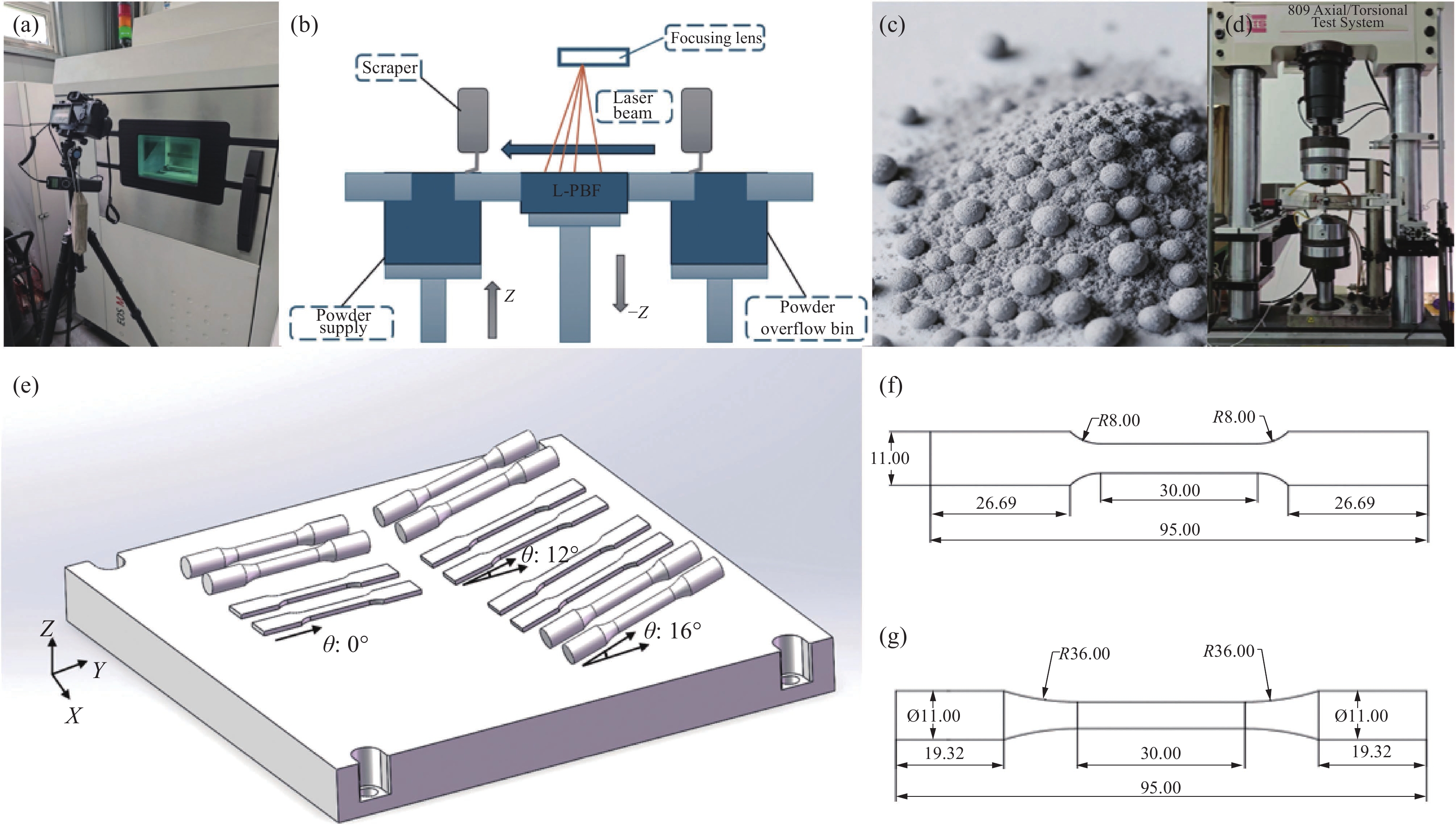
图 1 试样制备与试验(单位:mm)
(a)EOS M290 L-PBF设备;(b)L-PBF工艺流程;(c)TC4粉末;(d)MTS 809 试验机;(e)构建方向示意;(f)拉伸试样尺寸;(g)单轴试样尺寸
Figure 1. Specimen preparation and testing
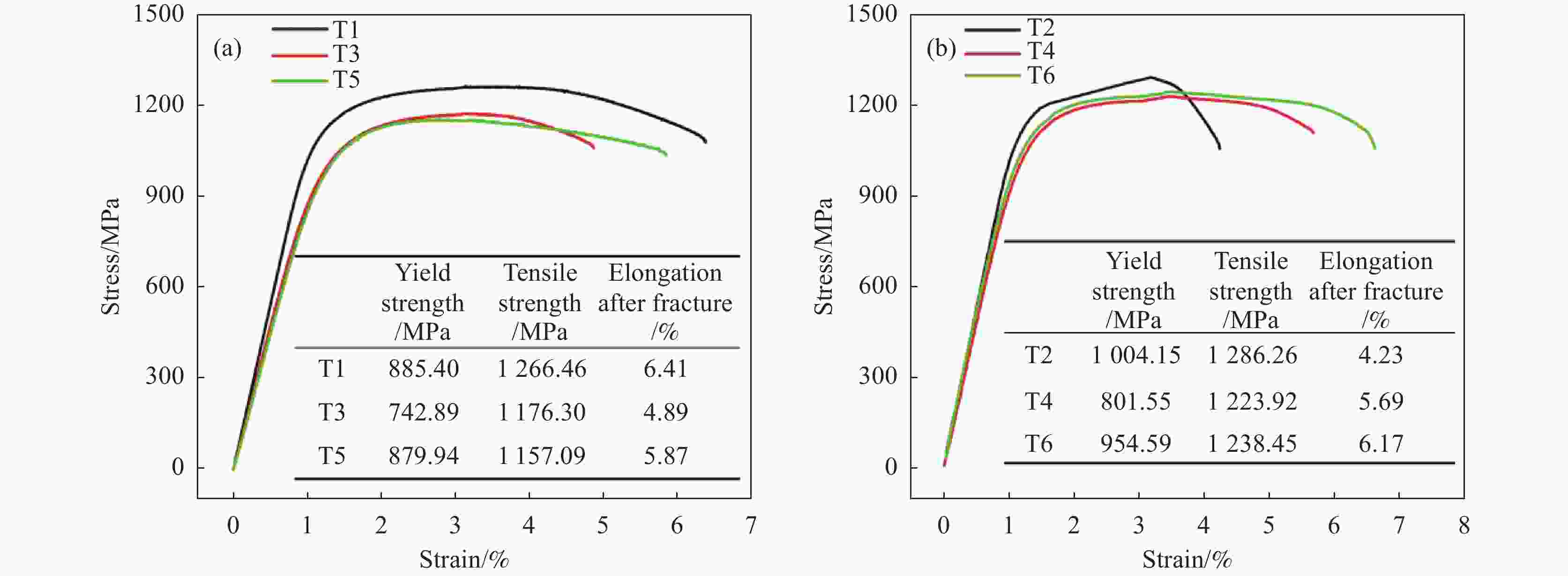
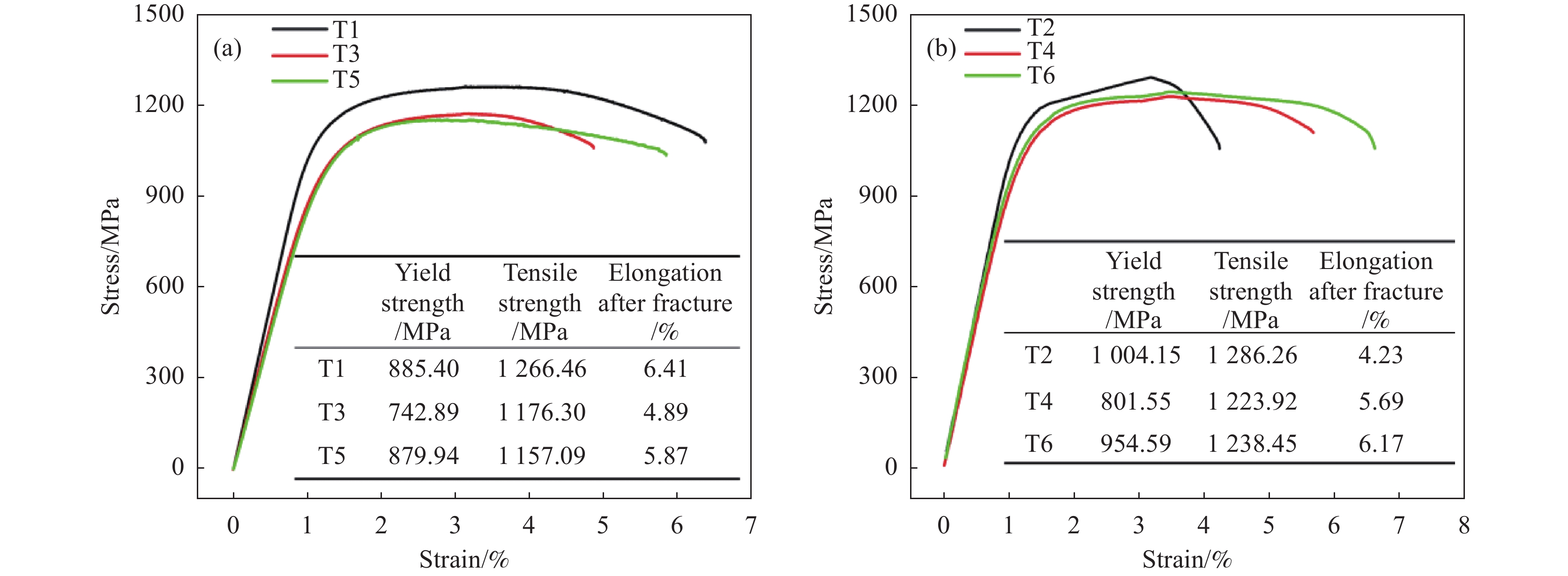
图 2 L-PBF TC4钛合金的工程应力-应变曲线
(a)应变速率5×10⁻⁵/s;(b)应变速率5×10−3/s
Figure 2. Engineering stress-strain curves of L-PBF TC4 titanium alloy
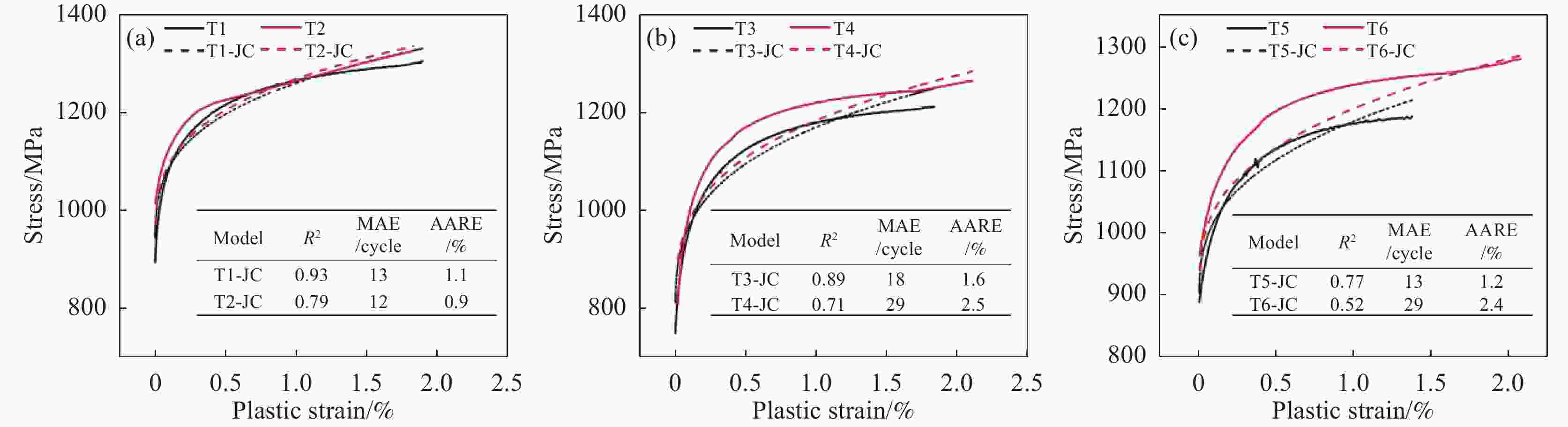
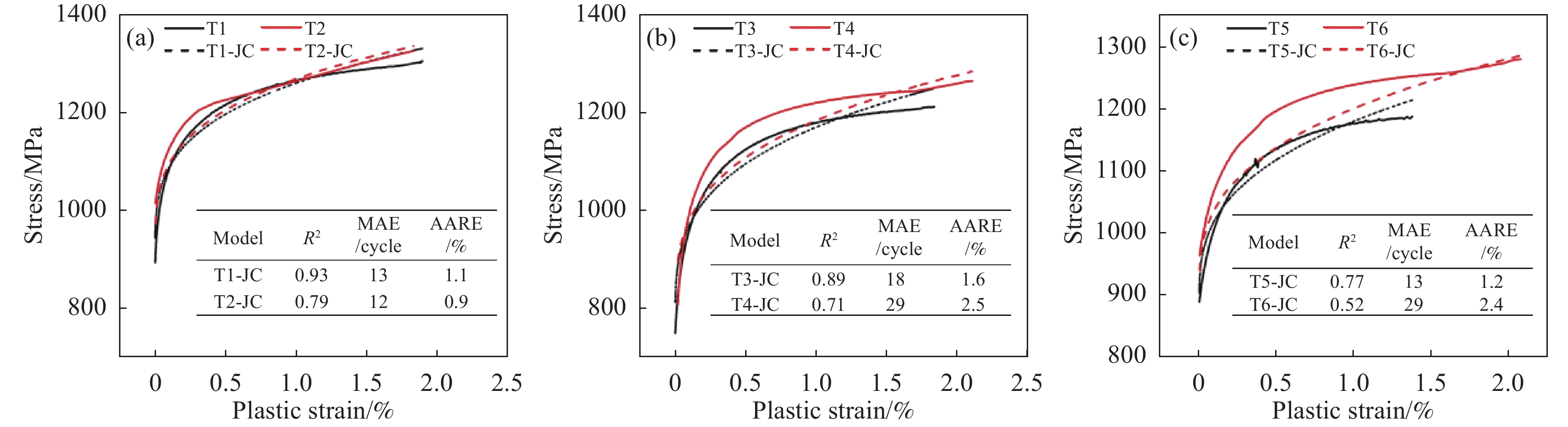
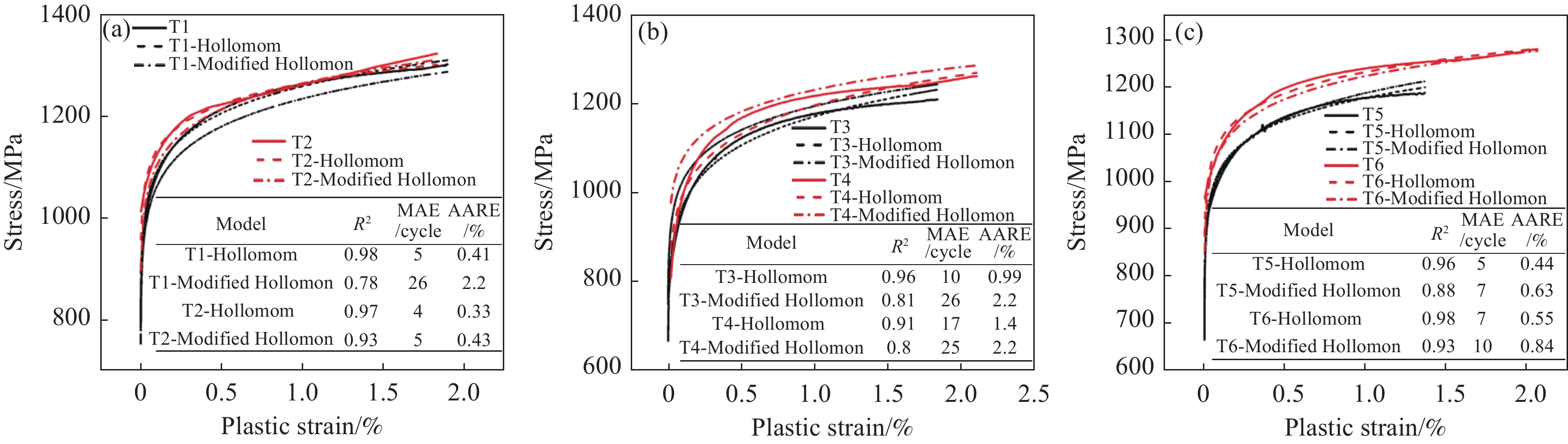
图 4 JC模型预测曲线与试验曲线对比
(a)0°构建方向;(b)12°构建方向;(c)16°构建方向
Figure 4. Comparison between JC model predictions and experimental data
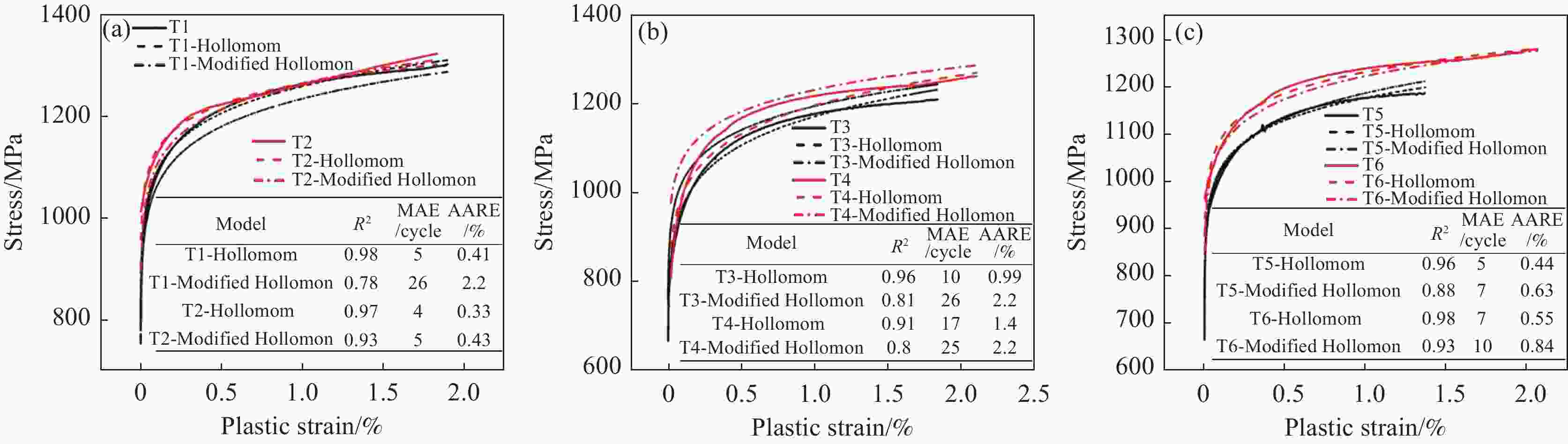
图 5 Hollomon模型预测曲线与试验曲线对比
(a)0°构建方向;(b)12°构建方向;(c)16°构建方向
Figure 5. Comparison between Hollomon model predictions and experimental data
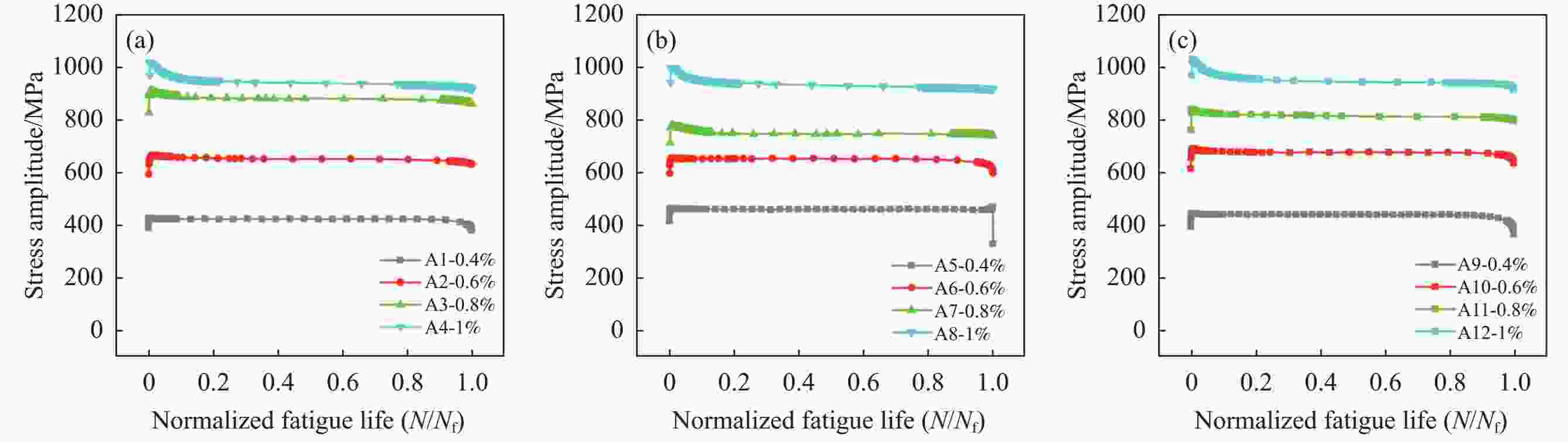
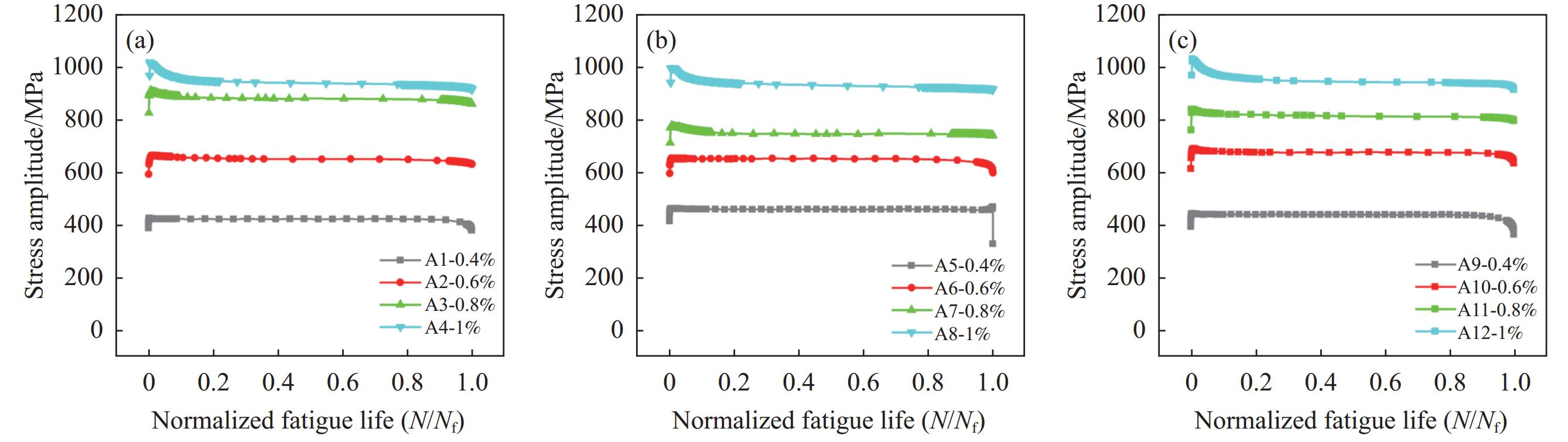
图 6 不同构建方向循环应力幅变化情况
(a)0°构建方向;(b)12°构建方向;(c)16°构建方向
Figure 6. Evolution of cyclic stress amplitude with different build directions
表 1 拉伸试验方案
Table 1. Tensile test programs
Specimen No. Building direction/(°) Strain rate/s−1 T1 0 5×10⁻⁵ T3 12 5×10⁻⁵ T5 16 5×10⁻⁵ T2 0 5×10⁻³ T4 12 5×10⁻³ T6 16 5×10⁻³  下载: 导出CSV
表 2 单轴疲劳应变控制试验方案
Table 2. Strain-controlled uniaxial fatigue test programs
Specimen No. Building direction/(°) Strain amplitude/% Nf /Cycle A1 0 0.4 11421 A2 0 0.6 2801 A3 0 0.8 2069 A4 0 1.0 910 A5 12 0.4 8794 A6 12 0.6 3933 A7 12 0.8 1546 A8 12 1.0 909 A9 16 0.4 9975 A10 16 0.6 4077 A11 16 0.8 2140 A12 16 1.0 940
下载: 导出CSV
表 3 不同本构模型拟合参数
Table 3. Fitting parameters of different constitutive models
Constitutive model Specimen No. A B $n_{{\mathrm{JC}}} $ C K nh JC T1,T2 892.7 1307.9 0.2751 0.0034 T3,T4 748.9 1552.9 0.2824 0.0059 T5,T6 889.2 1430.9 0.3343 0.0087 Hollomon T1 1684.3 0.0626 T2 1581.7 0.048 T3 1721.1 0.0828 T4 1735.1 0.08 T5 1547.9 0.0595 T6 1581.6 0.054
下载: 导出CSV
表 4 输入特征
Table 4. The input features
Uniaxial fatigue test parameters L−PBF parameters Loading strain amplitude/% Max. response stress amplitude of A1~A12/MPa Min. response stress amplitude of A1~A12/MPa Building direction/(°) 0.4, 0.6, 0.8, 1.0 473,884,839,889,579,604,1002,909,472,740,871,879 −220,−375,−883,−938,−352,−599,−479,
−920,−288,−533,−727,−9650, 12, 16
下载: 导出CSV
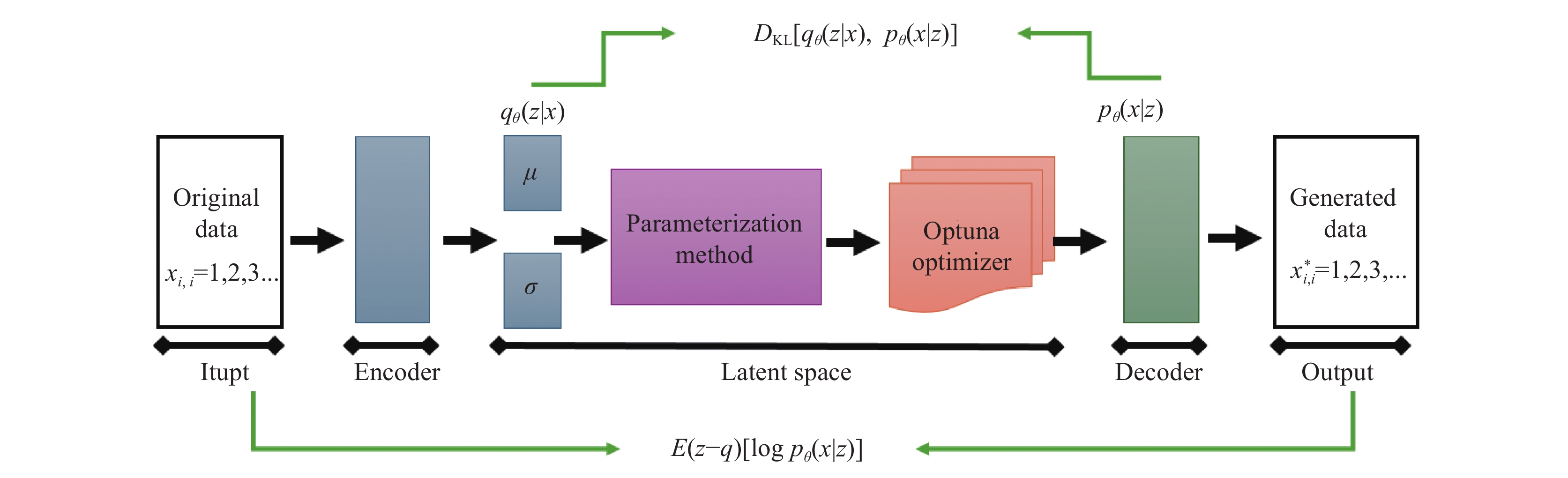
表 5 最优化VAE模型超参数
Table 5. Optimized hyperparameters of VAE models
Model Hyperparameters Latent space Batch size Learning rate VAE 2 119 4.48×10⁻²
下载: 导出CSV
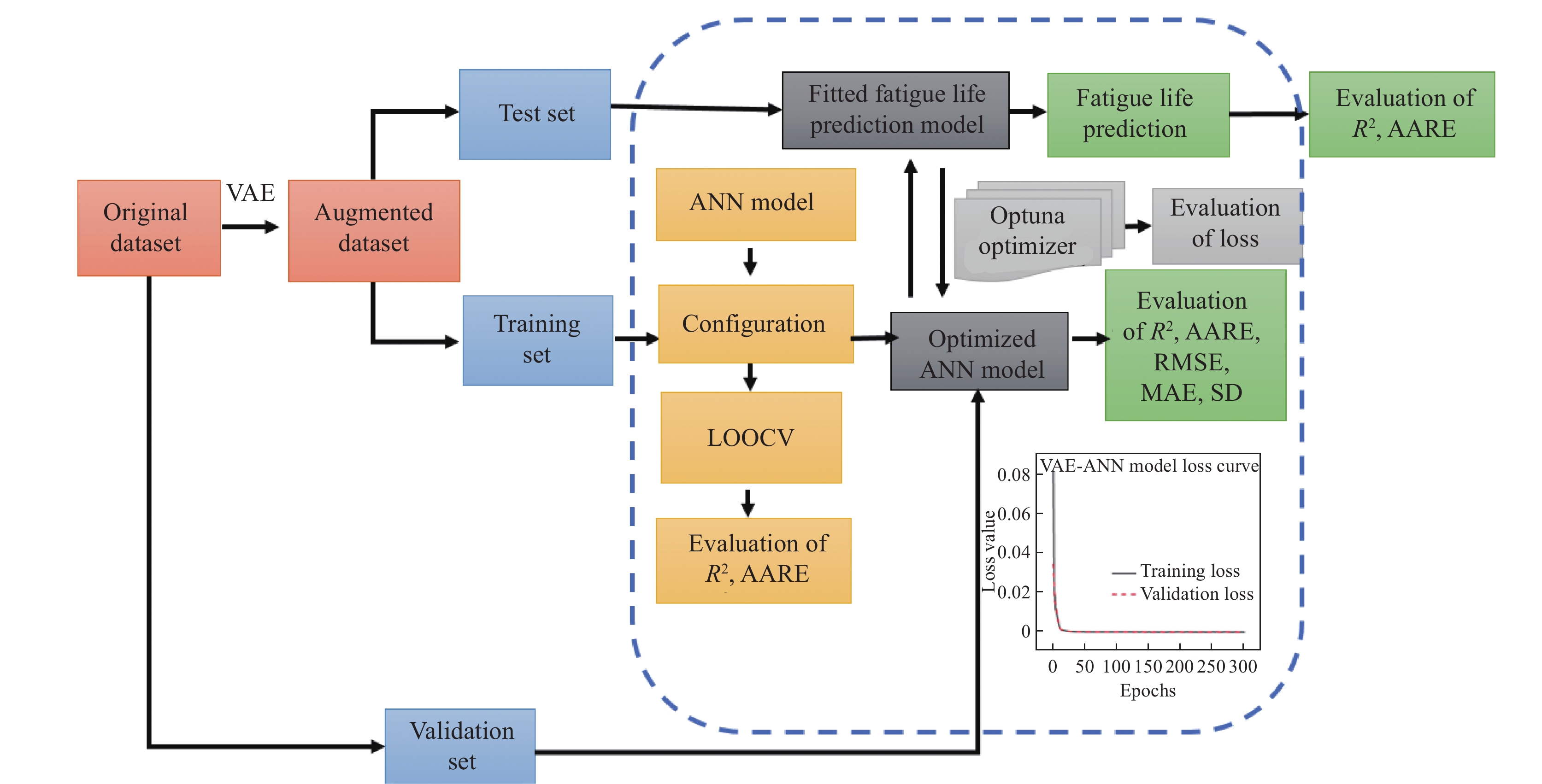
表 6 最优化VAE-ANN模型超参数
Table 6. Optimized hyperparameters of VAE-ANN models
Model Hyperparameters Hidden
layer 1Hidden
layer 2Hidden
layer 3Learning
rateVAE-ANN 204 111 25 0.97×10⁻⁴
下载: 导出CSV
-
[1] WANG Q, LI Z, ZHANG H J, et al. Research progress on additively manufactured Ti6Al4V matrix composites[J]. Materials China, 2023, 42(5): 375-390. (王琪, 李智, 张海军, 等. 增材制造Ti6Al4V基复合材料研究进展[J]. 中国材料进展, 2023, 42(5): 375-390. doi: 10.7502/j.issn.1674-3962.202109010WANG Q, LI Z, ZHANG H J, et al. Research progress on additively manufactured Ti6Al4V matrix composites[J]. Materials China, 2023, 42(5): 375-390. doi: 10.7502/j.issn.1674-3962.202109010 [2] WANG Q, ZHANG K, QIU D, et al. Additive manufacturing of high-strength commercially pure titanium through lanthanum oxide addition[J]. Materials Characterization, 2021, 176: 111074. doi: 10.1016/j.matchar.2021.111074 [3] OLIVEIRA J P, LALONDEP A D, MA J. Processing parameters in laser powder bed fusion metal additive manufacturing[J]. Materials & Design, 2020, 193: 108762. doi: 10.1016/j.matdes.2020.108762 [4] MOEINFAR K, KHODABAKHSHI F, KASHANI-BOZORG S F, et al. A review on metallurgical aspects of laser additive manufacturing (LAM): Stainless steels, nickel superalloys, and titanium alloys[J]. Journal of Materials Research and Technology, 2022, 16: 1029-1068. doi: 10.1016/j.jmrt.2021.12.039 [5] NICOLETTO G, KONEČNÁ R, FRKÁŇ M, et al. Surface roughness and directional fatigue behavior of as-built EBM and DMLS Ti6Al4V[J]. International Journal of Fatigue, 2018, 116: 140-148. doi: 10.1016/j.ijfatigue.2018.06.011 [6] PERSENOT T, BURR A, MARTIN G, et al. Effect of build orientation on the fatigue properties of as-built electron beam melted Ti-6Al-4V alloy[J]. International Journal of Fatigue, 2019, 118: 65-76. doi: 10.1016/j.ijfatigue.2018.08.006 [7] PAUL M, SOMAN S, SHAO S, et al. Fatigue crack growth in L-PBF Ti-6Al-4V: Influence of notch orientation, stress ratio, and volumetric defects[J]. International Journal of Fatigue, 2025, 198: 109027. doi: 10.1016/j.ijfatigue.2025.109027 [8] BARRICELLI L, PATRIARCA L, DU PLESSIS A, et al. Orientation-dependent fatigue assessment of Ti6Al4V manufactured by L-PBF: Size of surface features and shielding effect[J]. International Journal of Fatigue, 2023, 168: 107401. doi: 10.1016/j.ijfatigue.2022.107401 [9] ZHANG X, GONG S, WANG Y, et al. A modified SWT model for very high cycle fatigue life prediction of L-PBF Ti-6Al-4V alloy based on single defect: Effect of building orientation[J]. International Journal of Fatigue, 2024, 188: 108514. doi: 10.1016/j.ijfatigue.2024.108514 [10] MA T H, ZHOU C Y, GAO N, et al. Low cycle fatigue behavior of CP-Ti under multiaxial load-controlled mode at different multiaxial stress ratios[J]. International Journal of Fatigue, 2022, 160: 106868. doi: 10.1016/j.ijfatigue.2022.106868 [11] MA T H, CHANG L, GUO S, et al. Comparison of multiaxial low cycle fatigue behavior of CP-Ti under strain-controlled mode at different multiaxial strain ratios[J]. International Journal of Fatigue, 2020, 140: 105818. doi: 10.1016/j.ijfatigue.2020.105818 [12] ASTM F2924-14. Standard specification for additive manufacturing titanium-6aluminum-4vanadium with powder bed fusion[S]. West Conshohocken: ASTM International. 2021. [13] ASTM F1472-20a. Standard specification for wrought titanium-6aluminum-4vanadium alloy for surgical implant applications (UNS R56400) [S]. West Conshohocken: ASTM International. 2023. [14] SHANG D G, YAO W X. Study on multiaxial fatigue damage parameter based on critical plane approach[J]. Chinese Journal of Aeronautics, 1999(4): 295-298. (尚德广, 姚卫星. 基于临界面法的多轴疲劳损伤参量的研究[J]. 航空学报, 1999(4): 295-298.SHANG D G, YAO W X. Study on multiaxial fatigue damage parameter based on critical plane approach[J]. Chinese Journal of Aeronautics, 1999(4): 295-298. [15] National Technical Committee for Steel Standardization of China. Metallic materials—Tensile testing—Part 1: Method of test at room temperature: GB/T 228.1-2021[S]. Beijing: China Standard Press, 2021. (全国钢标准化技术委员会. 金属材料拉伸试验第1部分: 室温试验方法 GB/T 228.1-2021[S]. 北京: 中国标准出版社. 2021.National Technical Committee for Steel Standardization of China. Metallic materials—Tensile testing—Part 1: Method of test at room temperature: GB/T 228.1-2021[S]. Beijing: China Standard Press, 2021. [16] FANG X W, GUAN J J. Constitutive model and failure parameters of TC4 titanium alloy under quasi-static tension[J]. Journal of Mechanical Strength, 2022, 44(4): 831-836. (方新文, 管佳佳. TC4钛合金在准静态拉伸下的本构模型及失效参数[J]. 机械强度, 2022, 44(4): 831-836.FANG X W, GUAN J J. Constitutive model and failure parameters of TC4 titanium alloy under quasi-static tension[J]. Journal of Mechanical Strength, 2022, 44(4): 831-836. [17] JOHNSON G R, COOK W H. Fracture characteristics of three metals subjected to various strains, strain rates, temperatures and pressures[J]. Engineering Fracture Mechanics, 1985, 21(1): 31-48. doi: 10.1016/0013-7944(85)90052-9 [18] WANG Z J, WANG Z W. Simulation study of metal tensile experiments based on J-C constitutive model[J]. Xinjiang Iron and Steel, 2024(2): 31-33. (王子骏, 王子文. 基于J-C本构模型的金属拉伸实验模拟研究[J]. 新疆钢铁, 2024(2): 31-33. doi: 10.20146/j.cnki.1672-4224.2024.02.011WANG Z J, WANG Z W. Simulation study of metal tensile experiments based on J-C constitutive model[J]. Xinjiang Iron and Steel, 2024(2): 31-33. doi: 10.20146/j.cnki.1672-4224.2024.02.011 [19] WANG Y K, ZHAO J X. Tensile fracture test and numerical simulation of Q235 steel[J]. Journal of Plasticity Engineering, 2019, 26(1): 168-173. (王玉凯, 赵建新. Q235钢拉伸断裂试验与数值仿真[J]. 塑性工程学报, 2019, 26(1): 168-173.WANG Y K, ZHAO J X. Tensile fracture test and numerical simulation of Q235 steel[J]. Journal of Plasticity Engineering, 2019, 26(1): 168-173. [20] NEERAJ T, HOU D H, DAEHN G S, et al. Phenomenological and microstructural analysis of room temperature creep in titanium alloys[J]. Acta Materialia, 2000, 48(6): 1225-1238. doi: 10.1016/S1359-6454(99)00426-7 [21] CHEN D, LI Y, LIU K, et al. A physics-informed neural network approach to fatigue life prediction using small quantity of samples[J]. International Journal of Fatigue, 2023, 166: 107270. doi: 10.1016/j.ijfatigue.2022.107270 [22] WANG H, LI B, GONG J, et al. Machine learning-based fatigue life prediction of metal materials: Perspectives of physics-informed and data-driven hybrid methods[J]. Engineering Fracture Mechanics, 2023, 284: 109242. doi: 10.1016/j.engfracmech.2023.109242 [23] KINGMA D P, WELLING M. Auto-Encoding Variational Bayes[M]. arXiv, 2022. [24] HOŇAS J, BĚHAL J, HOMOLA P, et al. A machine learning based approach with an augmented dataset for fatigue life prediction of additively manufactured Ti-6Al-4V samples[J]. Engineering Fracture Mechanics, 2023, 293: 109709. doi: 10.1016/j.engfracmech.2023.109709 [25] ZHOU C, WANG H, HOU S, et al. A hybrid physics-based and data-driven method for gear contact fatigue life prediction[J]. International Journal of Fatigue, 2023, 175: 107763. doi: 10.1016/j.ijfatigue.2023.107763 -

计量
- 文章访问数: 0
- HTML全文浏览量: 0
- PDF下载量: 1
- 被引次数: 0