Distribution of inclusions along the width direction of continuous casting slab of ultra-low carbon automobile exposed panel
-
摘要: 超低碳钢因优异的深冲性能广泛用于汽车外板,但连铸坯中夹杂物易演变为表面缺陷。选取低Al、低O含量和高Al、高O含量的两炉次超低碳钢汽车外板两流连铸坯,在连铸坯1/4厚度,以及边部2 cm、1/4宽度、1/2宽度处取样,通过夹杂物自动分析仪(IAAS)对比分析了不同宽度处各种类型夹杂物的形貌、数量、尺寸以及夹杂物的空间分布,从而阐明超低碳钢汽车外板连铸坯在宽度方向上夹杂物的分布规律。结果表明连铸坯中夹杂物主要为簇状、独立颗粒、分散状的Al2O3、规则方形的TiN及核壳结构的Al2O3-TiN复合夹杂物。在数量密度上,小尺寸TiN在边部2 cm处富集,大尺寸Al2O3-TiN在1/4宽度区域富集,且高Al、高O含量炉次的大尺寸夹杂物数量显著更高。在尺寸分布上,Al2O3平均尺寸最大,高Al、高O含量促进复合夹杂物形成聚集,TiN倾向以小尺寸形式在边部富集。在空间分布上,TiN数量密度最高且主要在边部富集,Al2O3-TiN复合夹杂物在1/4宽度区域达到峰值,1/2宽度区域各类夹杂物密度整体降低,同时高Al、高O含量炉次的Al2O3夹杂物数量密度高于低Al、低O含量炉次。Abstract: Ultra-low carbon steel is widely used for automobile exposed panels due to its excellent deep-drawing properties, but inclusions in continuous casting slabs can easily evolve into surface defects. In this study, two-strand continuous casting slabs for two heats with low Al and O contents and high Al and O contents are selected for ultra-low carbon steel of automobile exposed panel. Samples are taken at the 1/4 thickness, and at the positions of 2 cm from the edge, 1/4 width, and 1/2 width of the slab. The morphology, quantity, size, and spatial distribution of inclusions along different width positions are compared and analyzed using the Inclusion Automatic Analysis System (IAAS), to clarify the distribution law of inclusions along the width direction of continuous casting slab of ultra-low carbon steel automotive exposed panel. The results show that the inclusions in the slabs are mainly cluster-like, independent particles, or dispersed Al2O3, regular square TiN, and core-shell structure Al2O3-TiN composite inclusions. In terms of number density, small-sized TiN inclusions are enriched at the position 2 cm from the edge; large-sized Al2O3-TiN inclusions are enriched in the 1/4 width region; and the number density of large-sized inclusions in the heat with high Al and O contents is significantly higher. In terms of size distribution, Al2O3 has the largest average size; the high Al and O contents promote the formation and aggregation of Al2O3-TiN composite inclusions; TiN tends to be enriched at the edge of 2 cm position in small sizes. The spatial distribution shows that TiN inclusions have the highest number density and are mainly enriched at the edge; the composite inclusions reach their peak number density in the 1/4 width region; the number density of all types of inclusions in the 1/2 width position is generally reduced. Meanwhile, the number density of Al2O3 inclusions in the heat with high Al and O contents is higher than that in the heat with low Al and O contents.
-
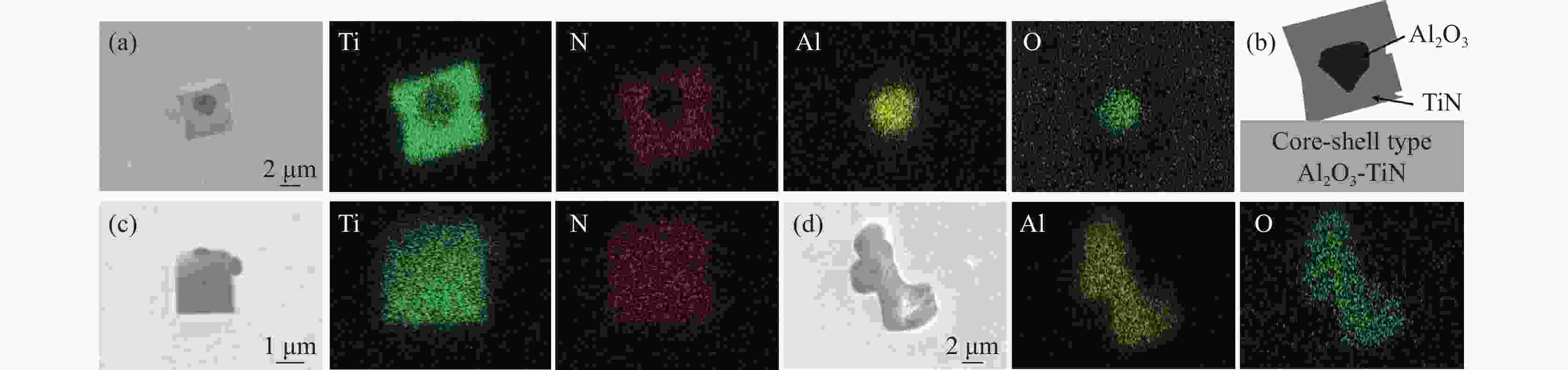
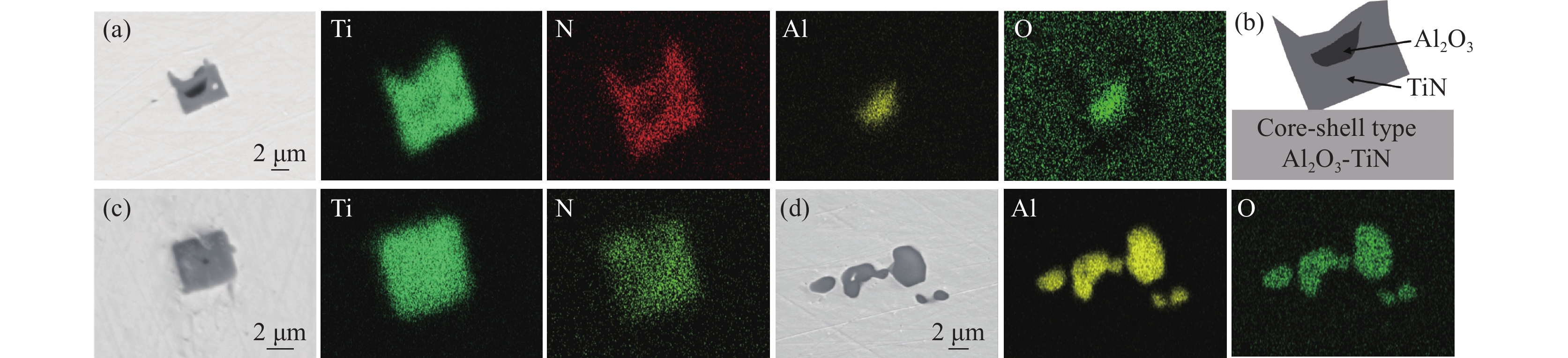
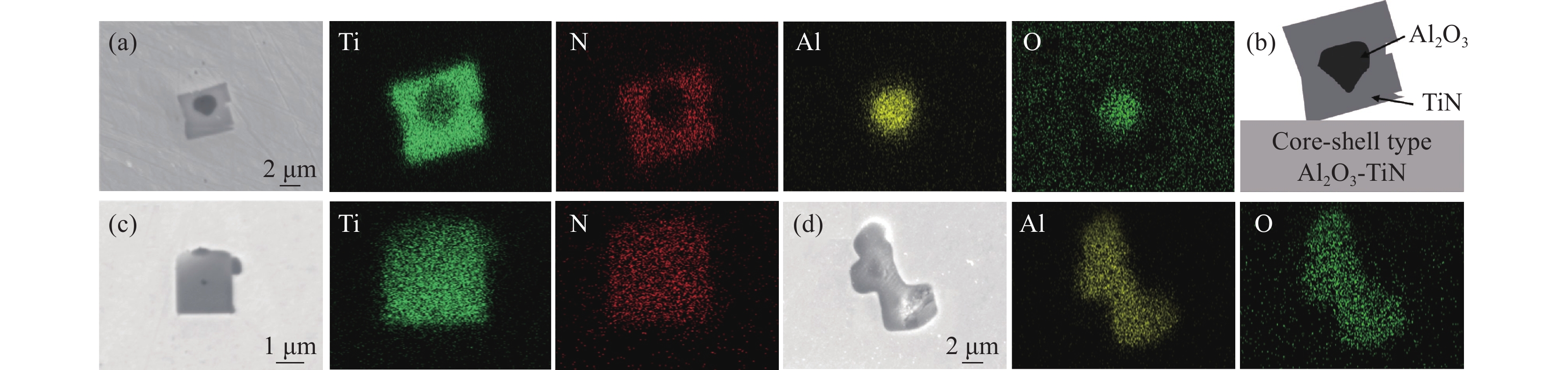
图 1 低Al、低O含量炉次连铸坯钢样中典型夹杂物的形貌与元素分布面扫描图
(a) Al2O3-TiN; (b) 核壳型Al2O3-TiN示意; (c)TiN; (d) Al2O3
Figure 1. Morphologies and element mapping diagram of typical inclusions in the slab of LAlO steel
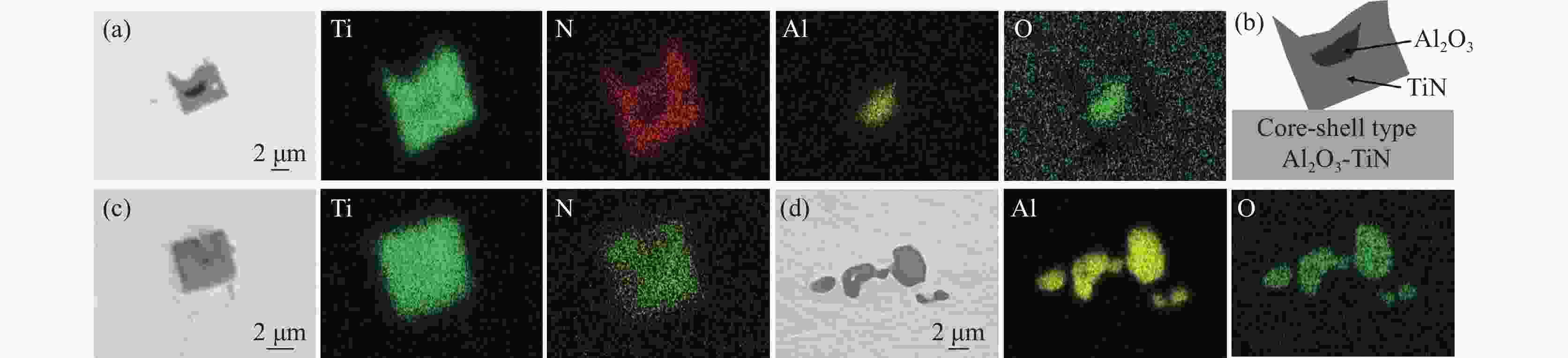
图 2 高Al、高O含量炉次连铸坯钢样中典型夹杂物的形貌与元素分布面扫描图
(a) Al2O3-TiN; (b) 核壳型Al2O3-TiN示意; (c)TiN; (d) 簇状Al2O3
Figure 2. Morphologies and element mapping images of typical inclusions in slab of HAlO steel
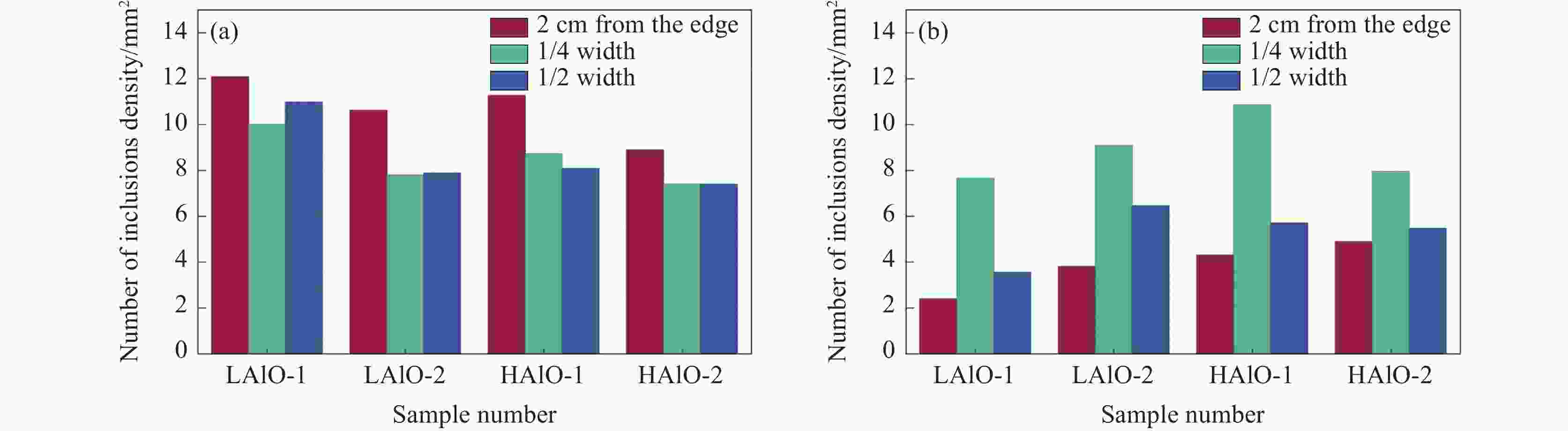
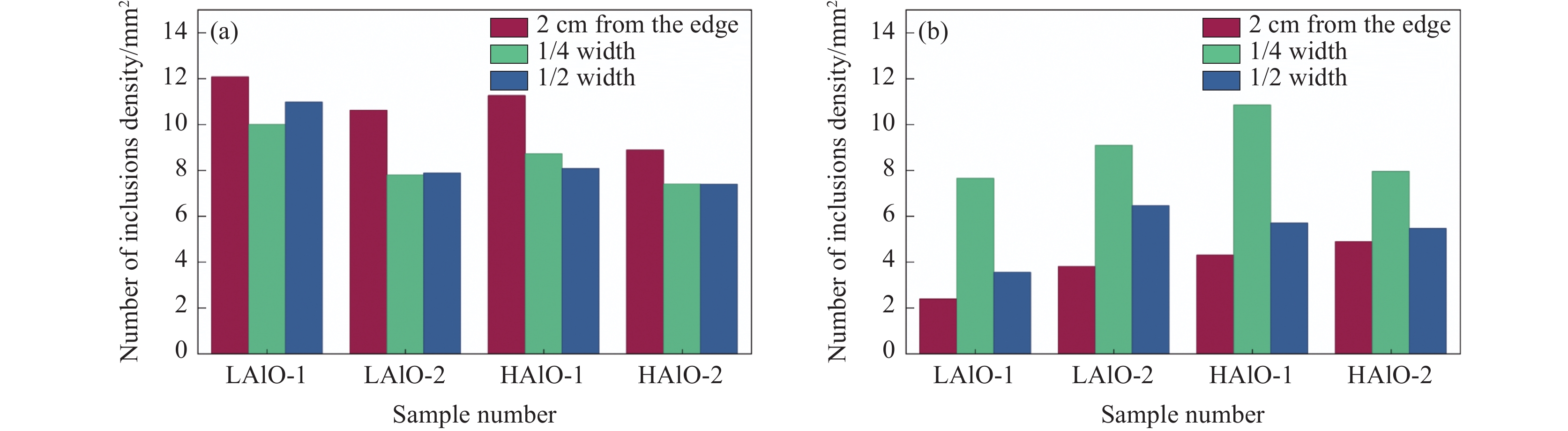
图 3 超低碳钢连铸坯1/4厚度处、宽度方向上1 ~ 5 μm和>5 μm夹杂物数量密度变化
(a) 1~5 μm夹杂物; (b) >5 μm夹杂物
Figure 3. Variation in number density of inclusions with the sizes of 1–5 μm and over 5 μm at the 1/4 thickness position along the width direction of ultra-low carbon steel continuous casting slabs
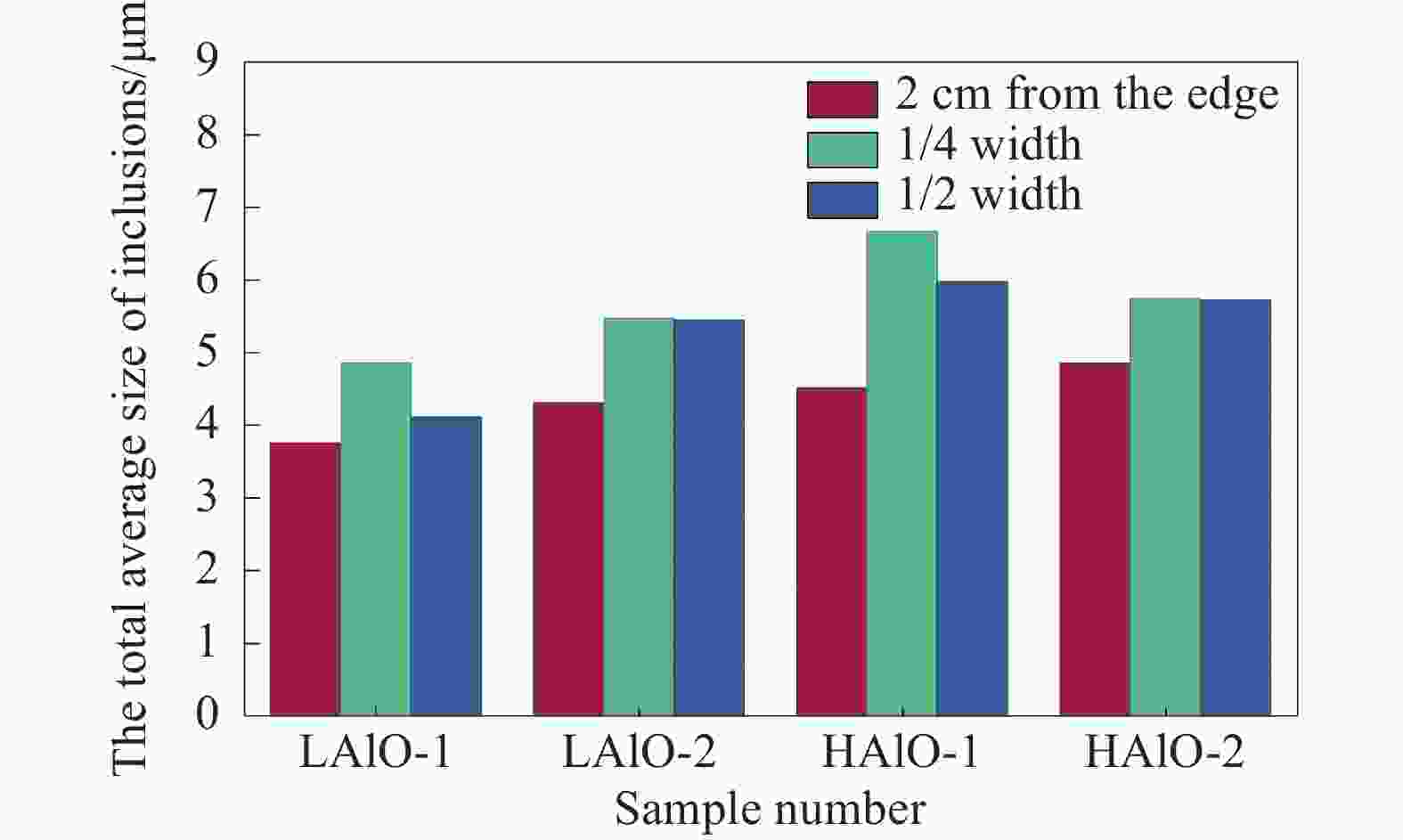
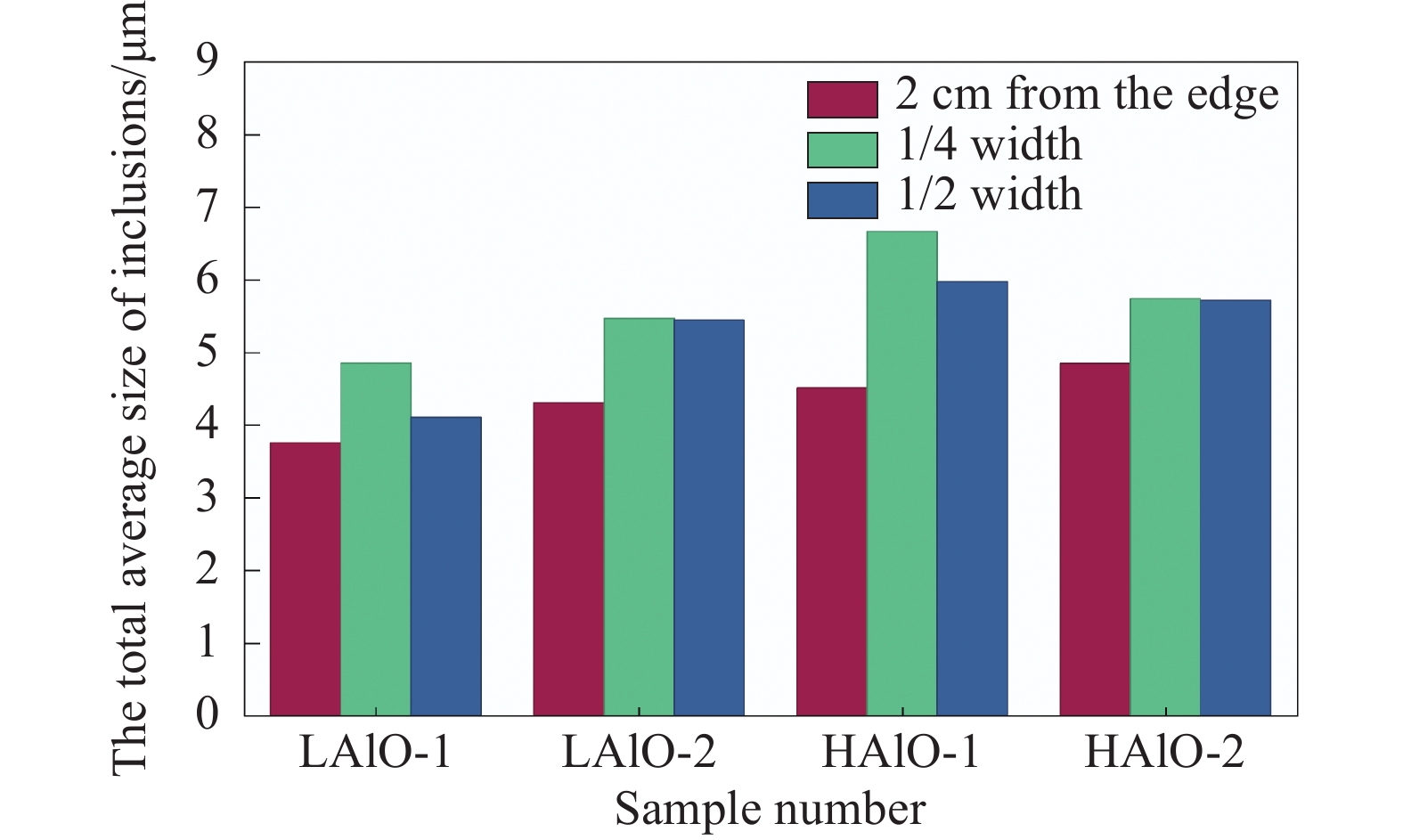
图 4 超低碳钢连铸坯1/4厚度处、宽度方向上夹杂物平均尺寸变化
Figure 4. Change in average size of inclusions at the 1/4 thickness along the width direction of the ultra-low carbon steel continuous casting slabs
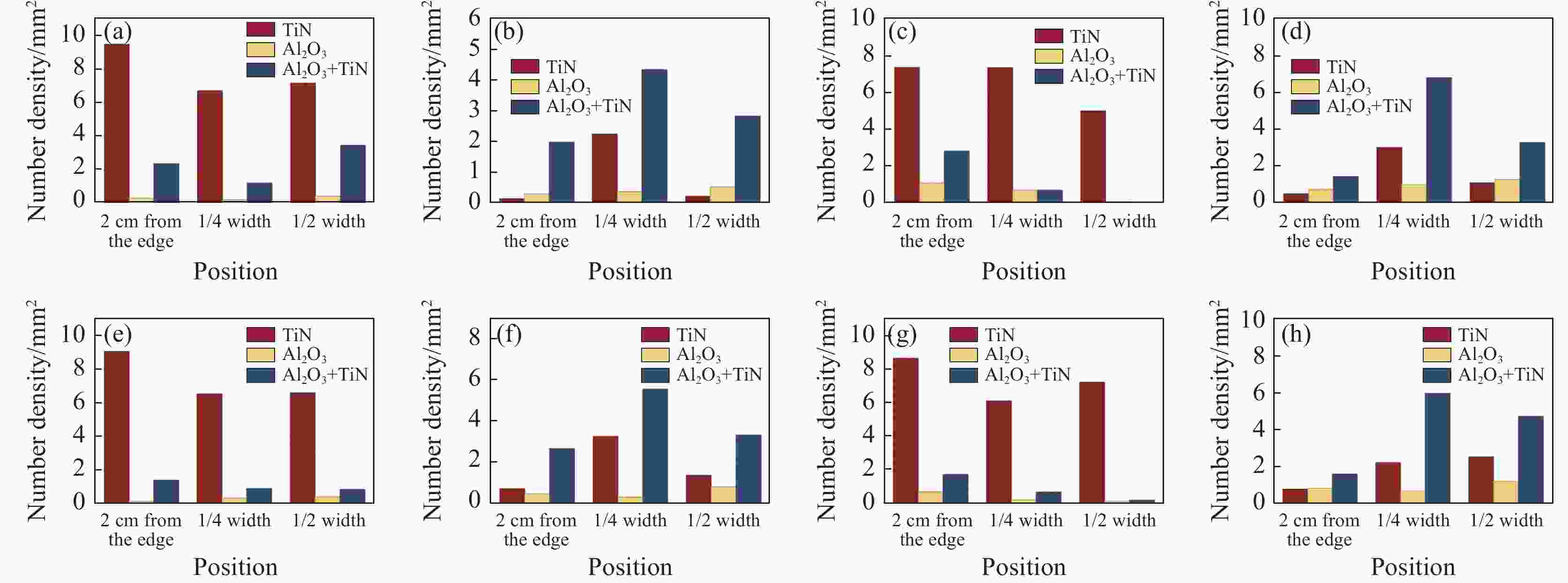
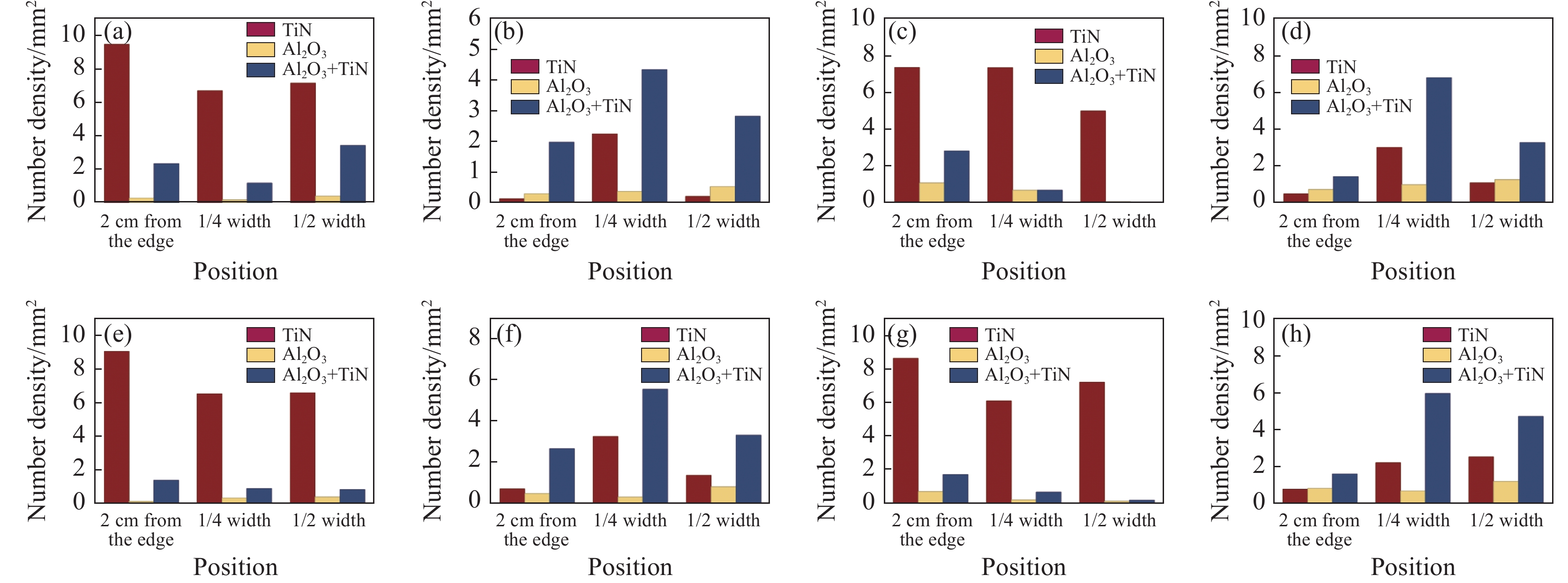
图 5 超低碳钢连铸坯1/4厚度处、宽度方向上1 ~ 5 μm和>5 μm不同类型夹杂物数量密度变化
(a) LAlO-1流: 1~5 μm; (b) LAlO-1流: > 5 μm; (c) HAlO-1流: 1 ~ 5 μm; (d) HAlO-1流:> 5 μm; (e) LAlO-2流:1 ~ 5 μm; (f) LAlO-2流: > 5 μm; (g) HAlO-2流: 1 ~ 5 μm; (h) HAlO-2流: > 5 μm
Figure 5. Changes in the number density of different types of inclusions with the sizes of 1–5 μm and >5 μm at 1/4 thickness along width direction in ultra-low carbon steel continuous casting slabs

图 6 超低碳钢连铸坯1/4厚度处、宽度方向上不同类型夹杂物平均尺寸变化
(a) LAlO-1流; (b) HAlO-1流; (c) LAlO-2流; (d) HAlO-2流
Figure 6. Changes in the average sizes of different types of inclusions at 1/4 thickness along width direction of ultra-low carbon steel continuous casting slabs
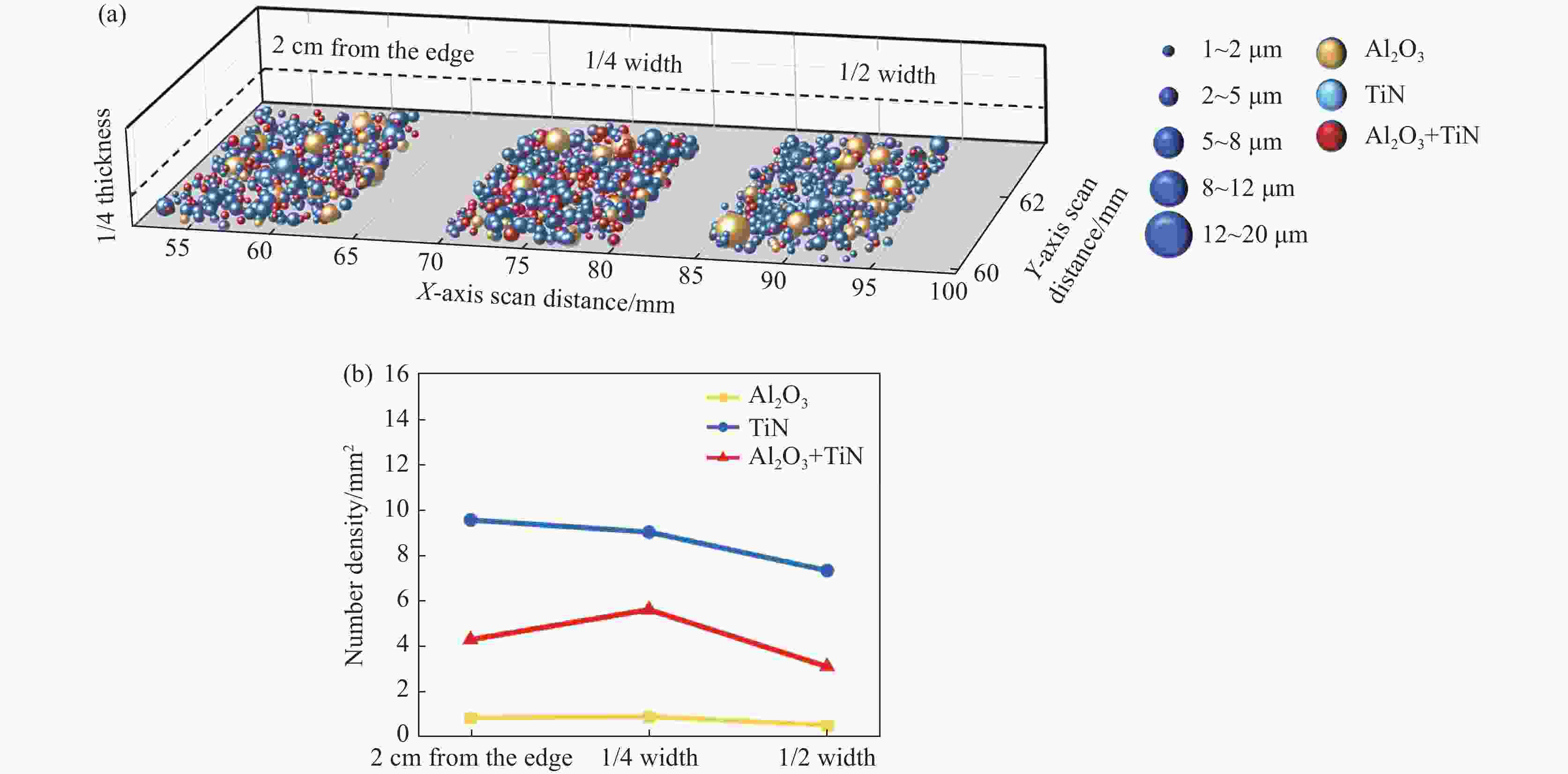
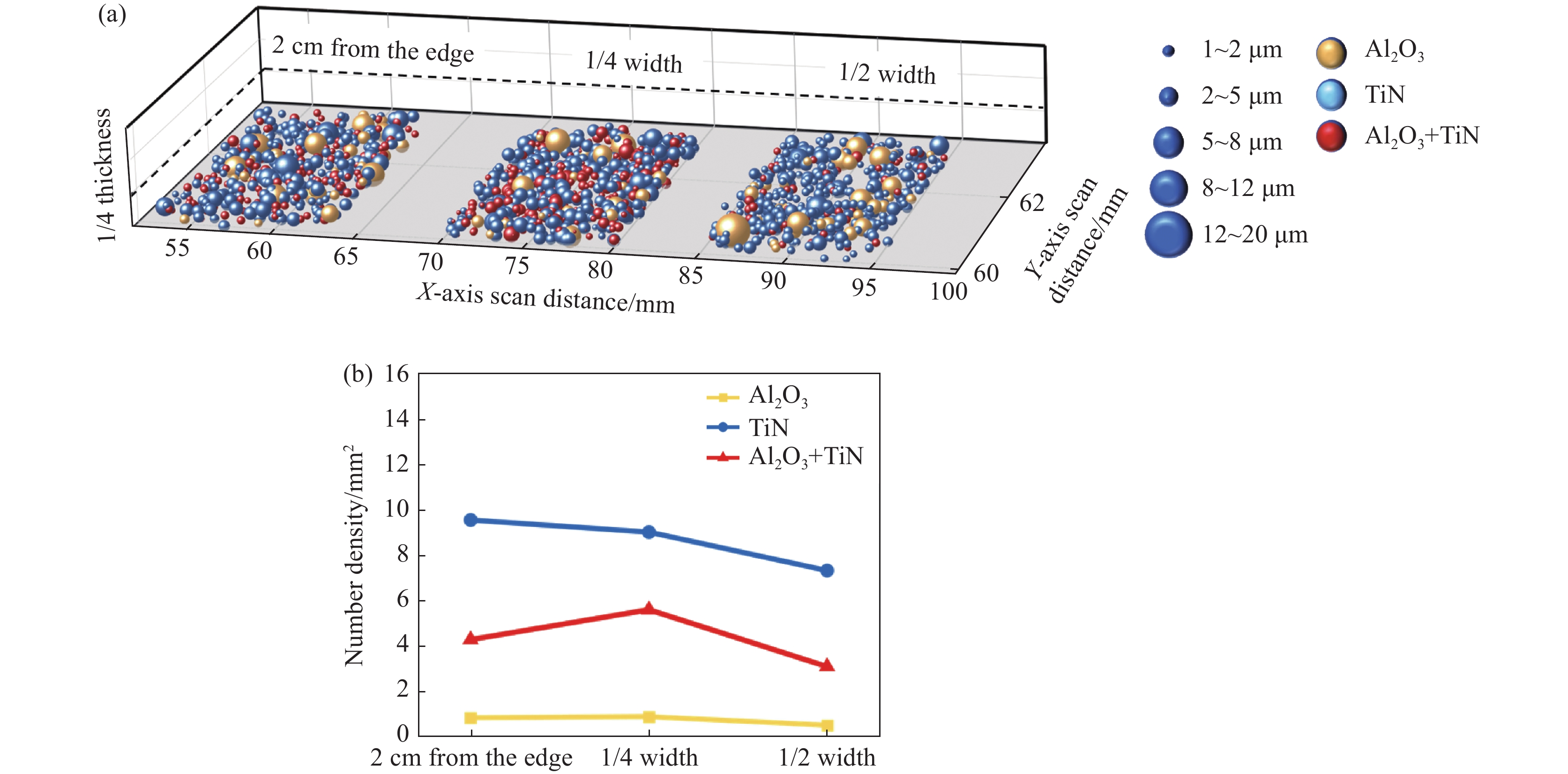
图 7 低Al、低O含量炉次1流连铸坯1/4厚度处、宽度方向上夹杂物的空间分布
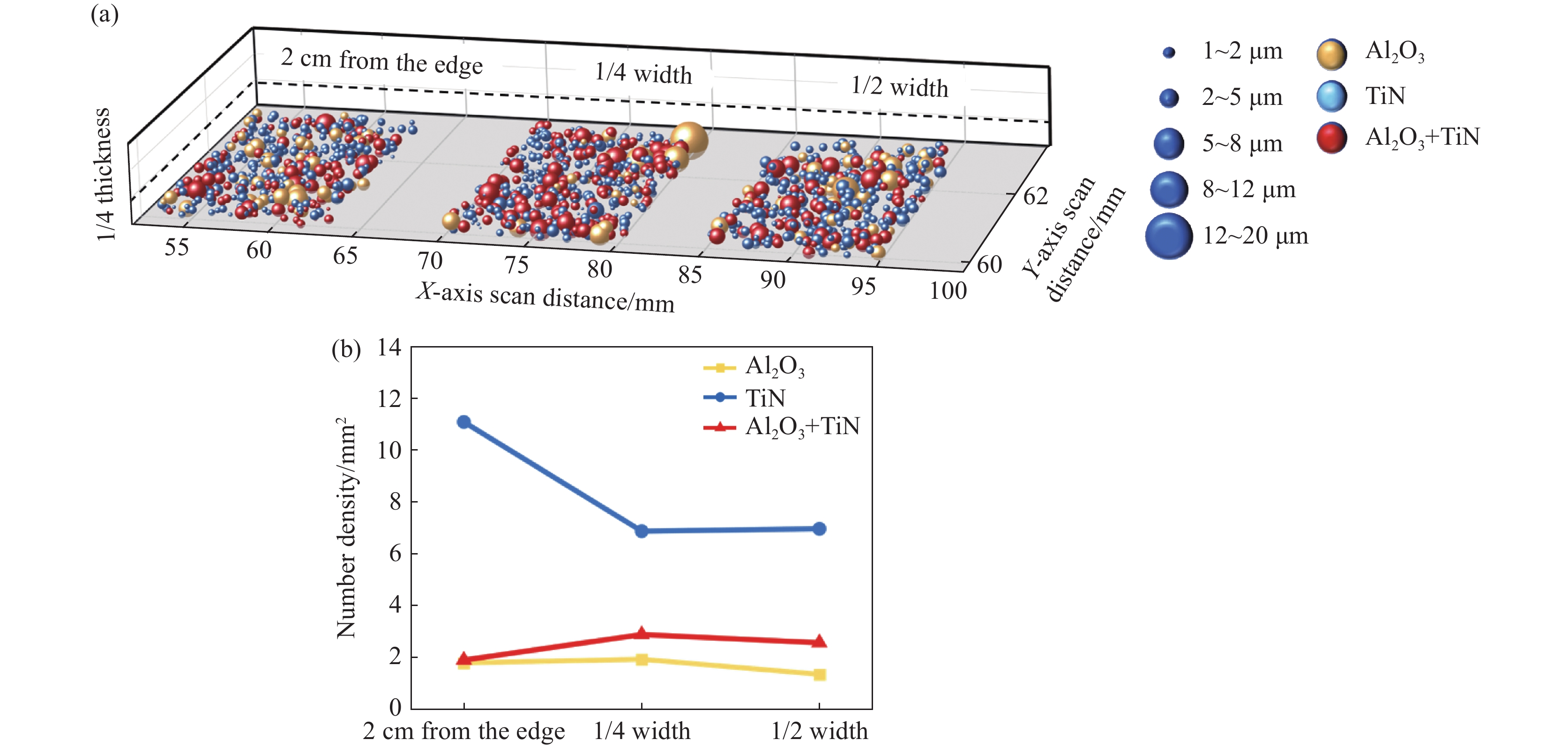
(a) 宽度方向上夹杂物空间分布; (b) 宽度方向上不同类型夹杂物的数量密度
Figure 7. Spatial distribution of inclusions at the 1/4 thickness position along the width direction of the continuous casting slabs for 1 strand of the heat with low Al and low O content
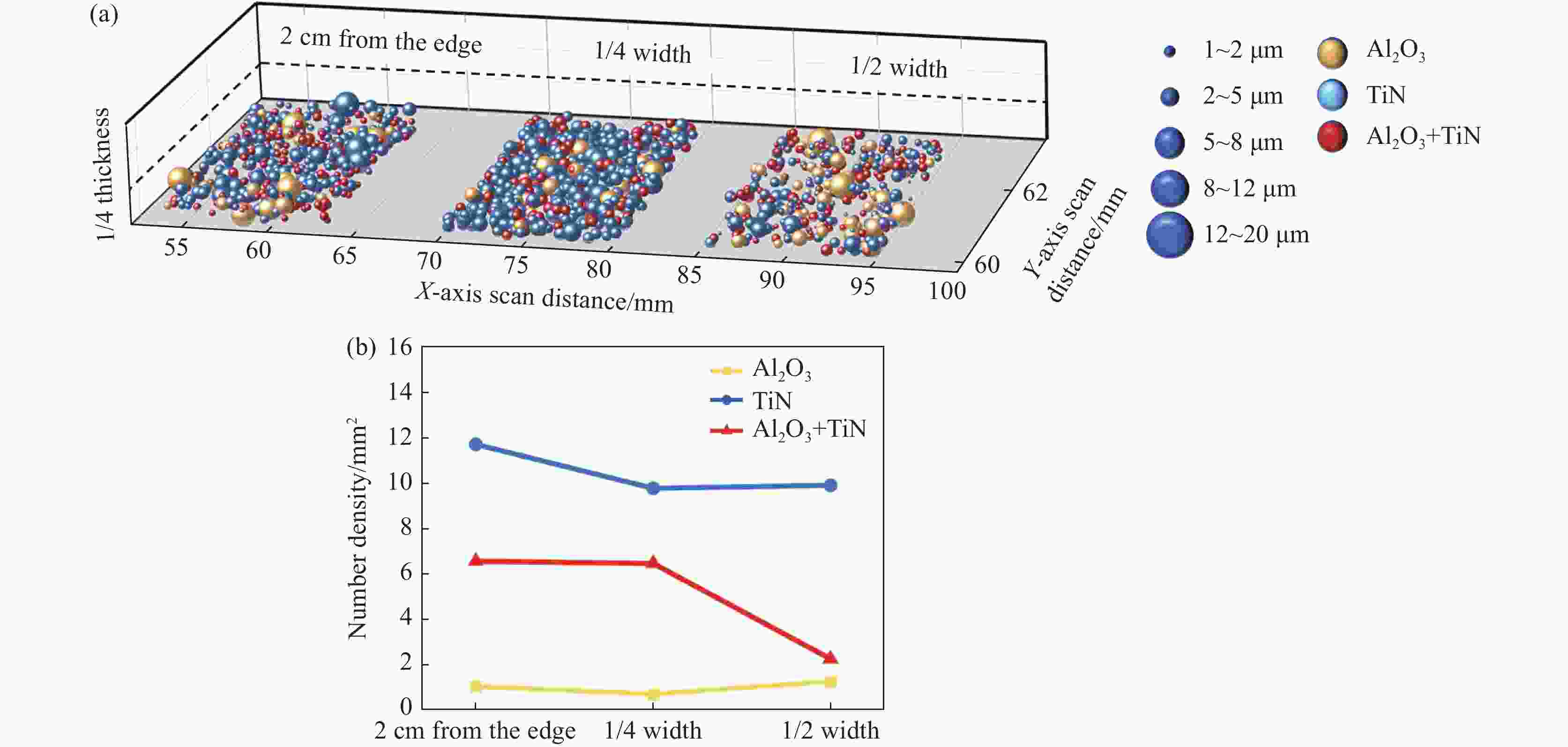
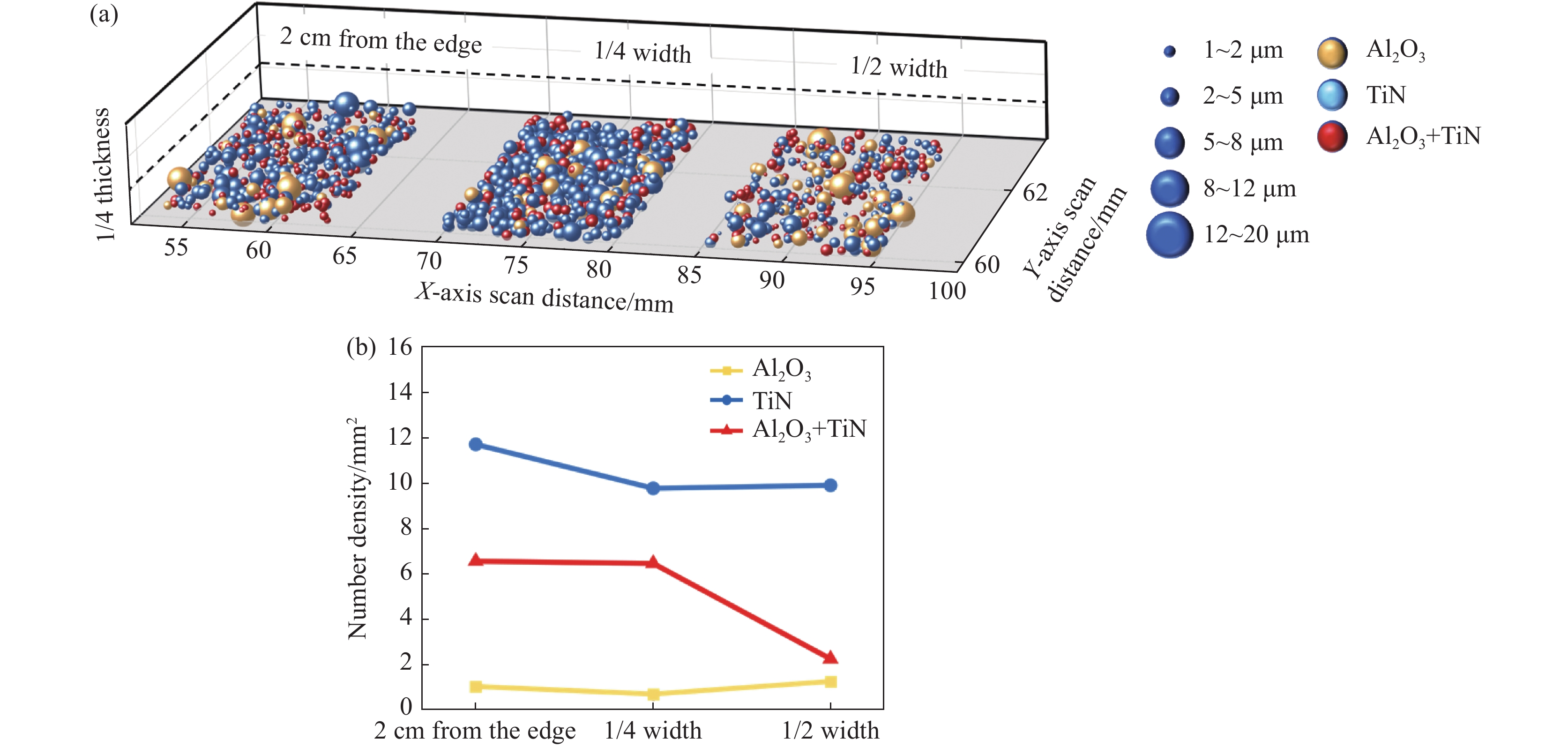
图 8 低Al、低O含量炉次2流连铸坯1/4厚度处、宽度方向上夹杂物的空间分布
(a) 宽度方向上夹杂物空间分布; (b) 宽度方向上不同类型夹杂物的数量密度
Figure 8. Spatial distribution of inclusions at the 1/4 thickness position along the width direction of the continuous casting slabs for 2 strand of the heat with low Al and low O content
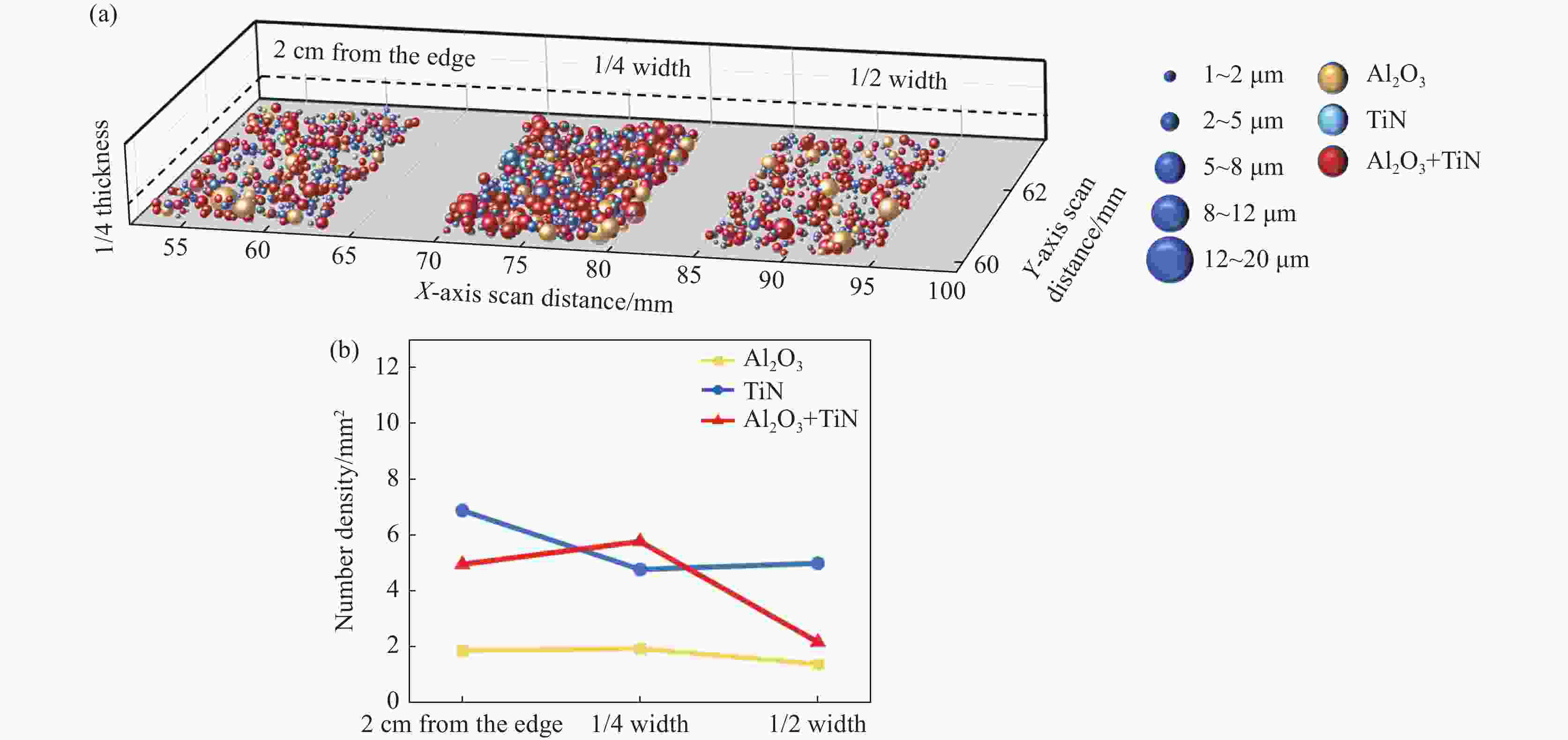
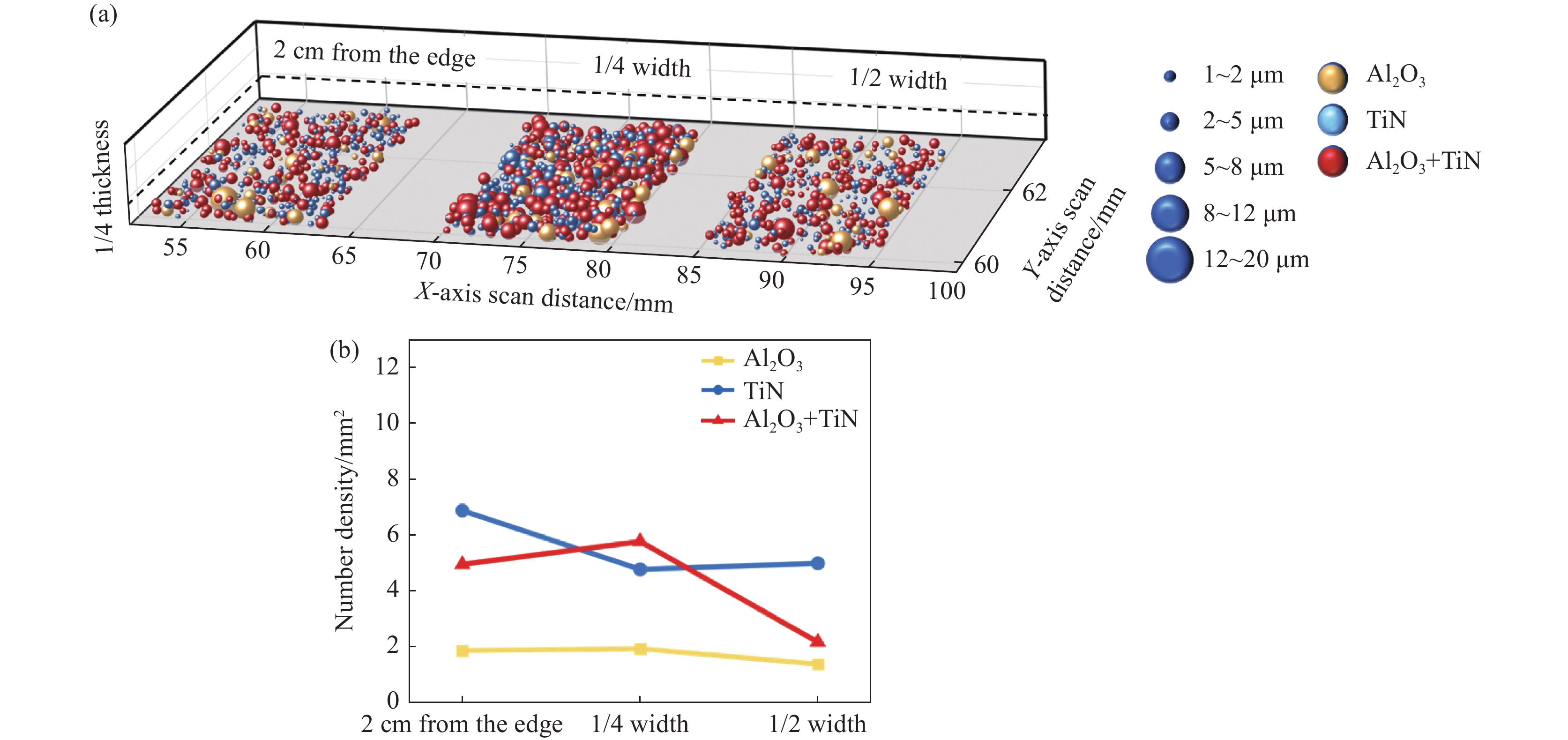
图 9 高Al、高O含量炉次1流连铸坯1/4厚度处、宽度方向上夹杂物的空间分布
(a) 宽度方向上夹杂物空间分布; (b) 宽度方向上不同类型夹杂物的数量密度
Figure 9. Spatial distribution of inclusions at the 1/4 thickness position along the width direction of the continuous casting slabs for 1 strand of the heat with high Al and high O content
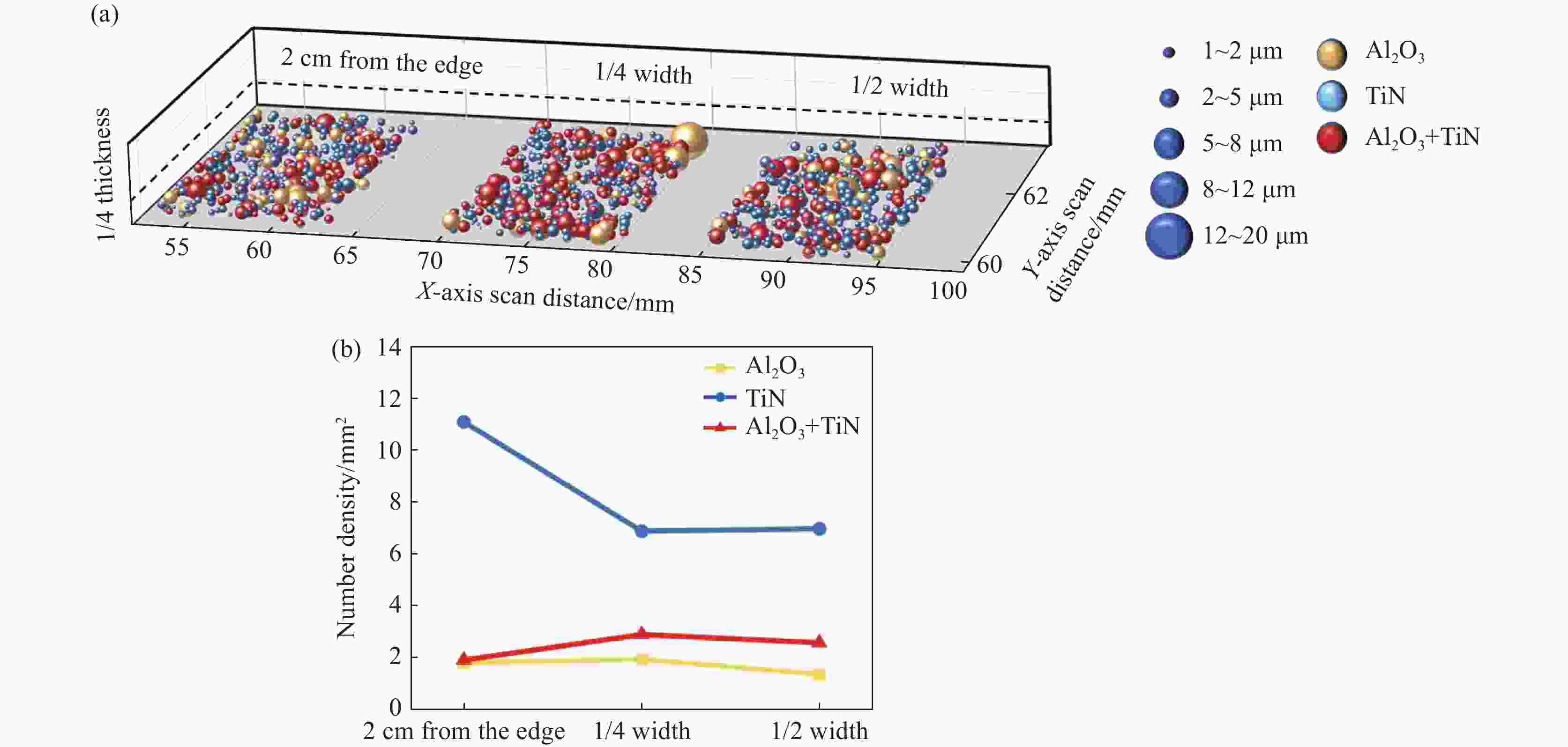
图 10 高Al、高O含量炉次2流连铸坯1/4厚度处、宽度方向上夹杂物的空间分布
(a) 宽度方向上夹杂物空间分布; (b) 宽度方向上不同类型夹杂物的数量密度
Figure 10. Spatial distribution of inclusions at the 1/4 thickness position along the width direction of the continuous casting slabs for 2 strand of the heat with high Al and high O content
表 1 超低碳钢连铸坯化学成分
Table 1. Chemical compositions of continuous casting slabs of ultra-low carbon steels
% Sample number C Si Mn P S Al Ti O N LAlO-1 <0.002 <0.02 0.11 0.018 0.01 0.025 0.041 0.0016 0.0023 LAlO-2 <0.002 <0.02 0.11 0.018 0.01 0.025 0.041 0.0016 0.0023 HAlO-1 <0.002 <0.02 0.11 0.018 0.01 0.035 0.042 0.0027 0.0023 HAlO-2 <0.002 <0.02 0.11 0.018 0.01 0.035 0.042 0.0027 0.0023  下载: 导出CSV
-
[1] EL BEALY M O. New macrosegregation criteria for quality problems in continuous casting of steel[J]. Ironmaking and Steelmaking, 2013, 40(8): 559-570. doi: 10.1179/1743281212Y.0000000085 [2] PAN H, WU G, LI Z. Quality control of casting slab for 510L steel[C]//Proceedings of the 2011 International Conference on Applied Mechanics, Materials and Manufacturing, ICAMMM 2011, November 18-20, 2011, Shenzhen, China, Trans Tech Publications: 2012. [3] PAN X Q, YANG J, PARK J, et. al. Distribution characteristics of inclusions along with the surface sliver defect on the exposed panel of automobile: A quantitative electrolysis method[J]. International Journal of Minerals, Metallurgy and Materials, 2020, 27(11): 1489-1498. [4] ZHANG Q, YANG J, LI T, et al. Characteristics of inclusions and microstructures around solidification hook of low-carbon steel continuous casting slab[J]. Metallurgical and Materials Transactions B, 2023, 54(5): 2439-2453. doi: 10.1007/s11663-023-02846-w [5] ZHAO C L, TANG F P, ZHU X L, et al. Experiment on distribution characteristics of surface inclusions in IF steel continuous casting billet[J]. Iron and Steel, 2017, 52(12): 42-47. (赵成林, 唐复平, 朱晓雷, 等. IF钢连铸坯表层夹杂分布特征的试验[J]. 钢铁, 2017, 52(12): 42-47. doi: 10.13228/j.boyuan.issn0449-749x.20170251ZHAO C L, TANG F P, ZHU X L, et al. Experiment on distribution characteristics of surface inclusions in IF steel continuous casting billet[J]. Iron and Steel, 2017, 52(12): 42-47. doi: 10.13228/j.boyuan.issn0449-749x.20170251 [6] GAO S, WANG M, GUO J L, et al. Evaluation of cleanliness and distribution of inclusions in the thickness direction of interstitial free (IF) steel slabs[J]. Chinese Journal of Engineering, 2020, 42(2): 194-202. (高帅, 王敏, 郭建龙, 等. IF钢铸坯厚度方向夹杂物分布及洁净度评估[J]. 工程科学学报, 2020, 42(2): 194-202.GAO S, WANG M, GUO J L, et al. Evaluation of cleanliness and distribution of inclusions in the thickness direction of interstitial free (IF) steel slabs[J]. Chinese Journal of Engineering, 2020, 42(2): 194-202. [7] TANG F P, CHANG G H, SU H, et al. Inclusions in ultra low carbon steel[J]. Iron and Steel, 2007, (1): 20-22, 30. (唐复平, 常桂华, 栗红, 等. 超低碳钢钢中夹杂物的研究[J]. 钢铁, 2007, (1): 20-22, 30.TANG F P, CHANG G H, SU H, et al. Inclusions in ultra low carbon steel[J]. Iron and Steel, 2007, (1): 20-22, 30. [8] WANG R, BAO Y P, YAN Z J, et al. Comparison between the surface defects caused by Al2O3 and TiN inclusions in interstitial-free steel auto sheets[J]. International Journal of Minerals Metallurgy and Materials, 2019, 26(2): 178-185. doi: 10.1007/s12613-019-1722-z [9] LI X, BAO Y, WANG M. Genetic evolution of inclusions in interstitial-free steel during the cold rolling processes[J]. Trans Indian Inst Met, 2018, 71(5): 1067-1072. doi: 10.1007/s12666-017-1241-4 [10] WANG M, BAO Y P, ZHAO L H, et al. Distribution and detriment of bubbles in continuous casting interstitial free steel slab[J]. ISIJ International, 2015, 55(4): 799-804. doi: 10.2355/isijinternational.55.799 [11] ZHOU M, JIANG M, YUAN P, et al. Characterization of large inclusions along the thickness direction in the ultra-low carbon slab[J]. Steelmaking, 2016, 32(2): 60-63,68. (周萌, 姜敏, 苑鹏, 等. 超低碳钢连铸坯厚度方向大尺寸夹杂物分布特征[J]. 炼钢, 2016, 32(2): 60-63,68.ZHOU M, JIANG M, YUAN P, et al. Characterization of large inclusions along the thickness direction in the ultra-low carbon slab[J]. Steelmaking, 2016, 32(2): 60-63,68. [12] ZHANG L, THOMAS B G. State of the art in evaluation and control of steel cleanliness[J]. ISIJ international, 2003, 43(3): 271-291. doi: 10.2355/isijinternational.43.271 [13] THOMAS B G, YUAN Q, ZHAO B, et al. Transient fluid-flow phenomena in the continuous steel-slab casting mold and defect formation[J]. JOM-e, 2006, 58: 16-36. [14] MIKI Y, THOMAS B G. Modeling of inclusion removal in a tundish[J]. Metallurgical and materials transactions B, 1999, 30(4): 639-654. doi: 10.1007/s11663-999-0025-6 [15] YU M Q, WANG Z Z, XU M H, et al. Refining process of superclean bearing steel[J]. Iron and Steel (Peking), 2006, 41(9): 26-29. (虞明全, 王治政, 徐明华, 等. 超纯轴承钢的精炼工艺[J]. 钢铁, 2006, 41(9): 26-29.YU M Q, WANG Z Z, XU M H, et al. Refining process of superclean bearing steel[J]. Iron and Steel (Peking), 2006, 41(9): 26-29. [16] UESUGI T. Production of high-carbon chromium bearing steel in vertical type continuous caster[J]. Transactions of the Iron and Steel Institute of Japan, 1986, 26(7): 614-620. doi: 10.2355/isijinternational1966.26.614 [17] WANG Q, LIU J H, LIU J F, et al. Inclusions distribution in IF steel slabs[J]. Iron Steel Vanadium Titanium, 2013, 34(4): 62-67. (王全, 刘建华, 刘建飞, 等. IF钢铸坯中夹杂物的分布规律[J]. 钢铁钒钛, 2013, 34(4): 62-67.WANG Q, LIU J H, LIU J F, et al. Inclusions distribution in IF steel slabs[J]. Iron Steel Vanadium Titanium, 2013, 34(4): 62-67. [18] ZHANG S, LIU Z, YUAN Y, et al. Removal and distribution behaviors of inclusion particles in the steel melt under different rotation modes during continuous casting[J]. Powder Technology, 2024, 448: 120311. doi: 10.1016/j.powtec.2024.120311 [19] THOMAS B G. Modeling of the continuous casting of steel—past, present, and future[J]. Metallurgical and materials transactions B, 2002, 33(6): 795-812. doi: 10.1007/s11663-002-0063-9 [20] YANG C, LIU Y. TiN inclusions formation in Ti-Al deoxidized ultra-low carbon steel; proceedings of the 2023 9th International Conference on Applied Materials and Manufacturing Technology, ICAMMT 2023, April 24, 2023 - April 26, 2023, Hybrid, Qingyuan, China, F, 2023[C]. Institute of Physics. [21] WITTE M, WIENER J, SHAHAMAT JAVID N, et al. Automated particle analysis to determine the distribution of non-metallic inclusions within continuously cast slabs of ultra low carbon (ULC) steel[J]. BHM Bergund Huttenmannische Monatshefte, 2024, 169(3): 124-131. [22] SAHAI Y, EMI T. Tundish technology for clean steel production[M]. 2007. [23] THOMAS B G, YUAN Q, MAHMOOD S, et al. Transport and entrapment of particles in steel continuous casting[J]. Metallurgical and Materials Transactions B, 2014, 45(1): 22-35. doi: 10.1007/s11663-013-9916-7 [24] GLADMAN T. Precipitation hardening in metals[J]. Materials science and technology, 1999, 15(1): 30-36. doi: 10.1179/026708399773002782 [25] OHTA H, SUITO H. Characteristics of particle size distribution of deoxidation products with Mg, Zr, Al, Ca, Si/Mn and Mg/Al in Fe-10 mass% Ni alloy[J]. ISIJ international, 2006, 46(1): 14-21. doi: 10.2355/isijinternational.46.14 -


计量
- 文章访问数: 0
- HTML全文浏览量: 0
- PDF下载量: 1
- 被引次数: 0