Influence of Mn/S ratio on inclusions and electrical conductivity of ultra-low carbon steel
-
摘要: 超低碳钢被广泛应用于电气工程、汽车工业等领域,因而需要良好的力学性能和导电性能。钢中FeS会造成“热脆”现象,而锰硫比则会直接影响超低碳钢中FeS的含量,从而影响其加工性能;同时,锰硫比的调控也会影响钢中元素含量与夹杂物特性,进而影响超低碳钢的导电率。为优化超低碳钢锰硫比调控,提高其综合性能,采用真空感应炉冶炼不同锰硫比的超低碳钢,利用光学显微镜、EBSD技术、EDS技术和导电率测试等手段研究了不同锰硫比超低碳钢的夹杂物特征和导电率演变规律。结果表明,钢中形成的夹杂物主要为类球状和长条状夹杂物,其中,类球状形貌占绝大部分,长条状形貌占比较小。部分夹杂物以MnO-SiO2系二元氧化夹杂物为核心,在其周围形成FeS和MnS或(Mn, Fe)S夹杂;部分夹杂物则直接形成氧化物和硫化物的复合夹杂物。随着锰硫比的升高,夹杂物数量呈先增加后降低的变化趋势,而夹杂物尺寸则呈先减小后增大的趋势。当锰硫比为6.4及以上时,钢中基本上无FeS夹杂物。此外,随着锰硫比的升高,超低碳钢的导电率呈单调增加的变化趋势;在锰硫比为9.0时,由于最大的夹杂物尺寸和较多的夹杂物数量,固溶在钢基体中的Mn和S元素含量显著降低,从而降低了电阻率,获得了最大的导电率。Abstract: Ultra-low carbon steel is widely used in electrical engineering, automotive industry and other related fields, requiring excellent mechanical properties and electrical conductivity. In steel, FeS can induce the phenomenon of "hot brittleness," and the manganese-to-sulfur(Mn/S) ratio directly affects the FeS content in ultra-low carbon steel, thereby influencing its processability. Meanwhile, the regulation of the manganese-sulfur ratio also impacts the element content and inclusion characteristics in steel, which in turn affects the electrical conductivity of ultra-low carbon steel. To optimize the Mn/S ratio regulation of ultra-low carbon steel and enhance its comprehensive performances, ultra-low carbon steel samples with different Mn/S ratios were smelted using a vacuum induction furnace. The inclusion characteristics and conductivity evolution of ultra-low carbon steel with varying Mn/S ratios were investigated by means of optical microscopy, EBSD, EDS and conductivity testing. The results indicate that the inclusions formed in the steel are primarily near-spherical and long strip-shaped, with the near-spherical inclusions accounting for the vast majority and the long strip-shaped ones for a small proportion. For some inclusions, MnO-SiO2 binary oxide inclusions serve as the core, around which FeS and MnS or (Mn, Fe)S inclusions are formed. Additionally, some inclusions directly form oxide-sulfide composite inclusions. With the increase of Mn/S ratio, the number of inclusions first increases and then decreases, while the size of inclusions first decreases and then increases. When the Mn/S ratio is 6.4 or higher, there are essentially no FeS inclusions present in the steel. Furthermore, as the Mn/S ratio increases, the electrical conductivity of the ultra-low carbon steel exhibits a monotonic increasing trend. At Mn/S =9.0, owing to the largest inclusion sizes and relatively high number of inclusions, the contents of Mn and S elements dissolved in the steel matrix are significantly reduced. Consequently, the electrical resistivity of the steel decreases, allowing it to achieve the highest electrical conductivity.
-
Key words:
- ultra-low carbon steel /
- Mn/S ratio /
- MnS /
- FeS /
- electrical conductivity
-

图 1 试样抛光态500倍金相图
(a)A1样w[Mn]/w[S]=4.2;(b)A2样w[Mn]/w[S]=5.0;(c)A3样w[Mn]/w[S]=6.4;(d)A4样w[Mn]/w[S]=9.0
Figure 1. Optical micrographs of the polished specimens at 500× magnification
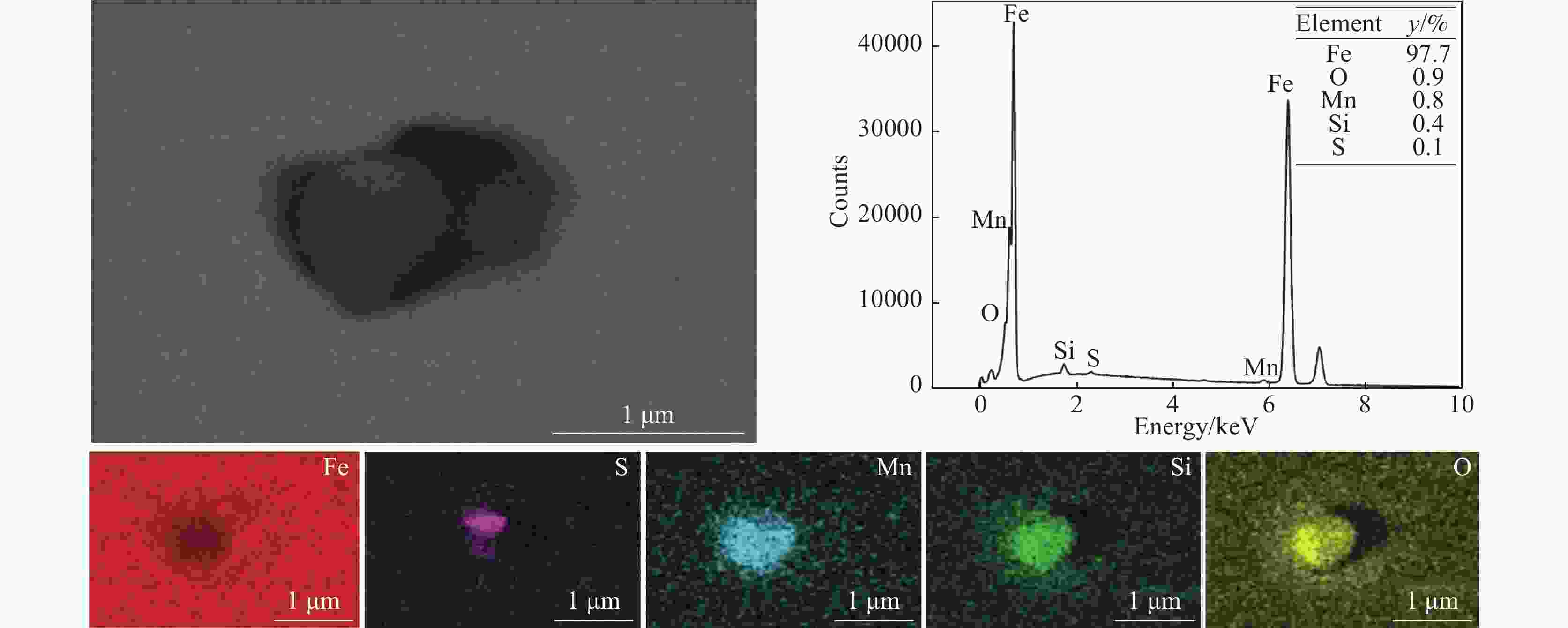
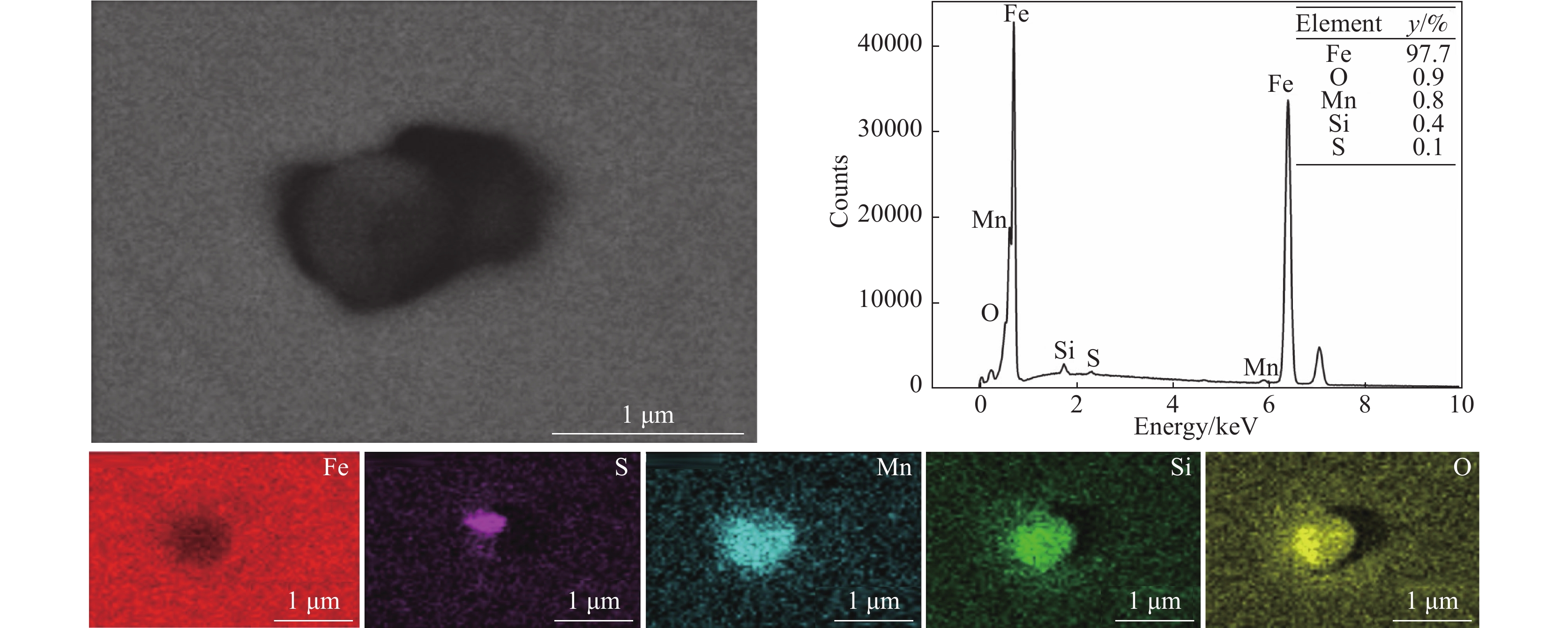
图 2 类球状夹杂物a形貌和元素分布
Figure 2. Morphology and elemental maps of near-spherical inclusion a
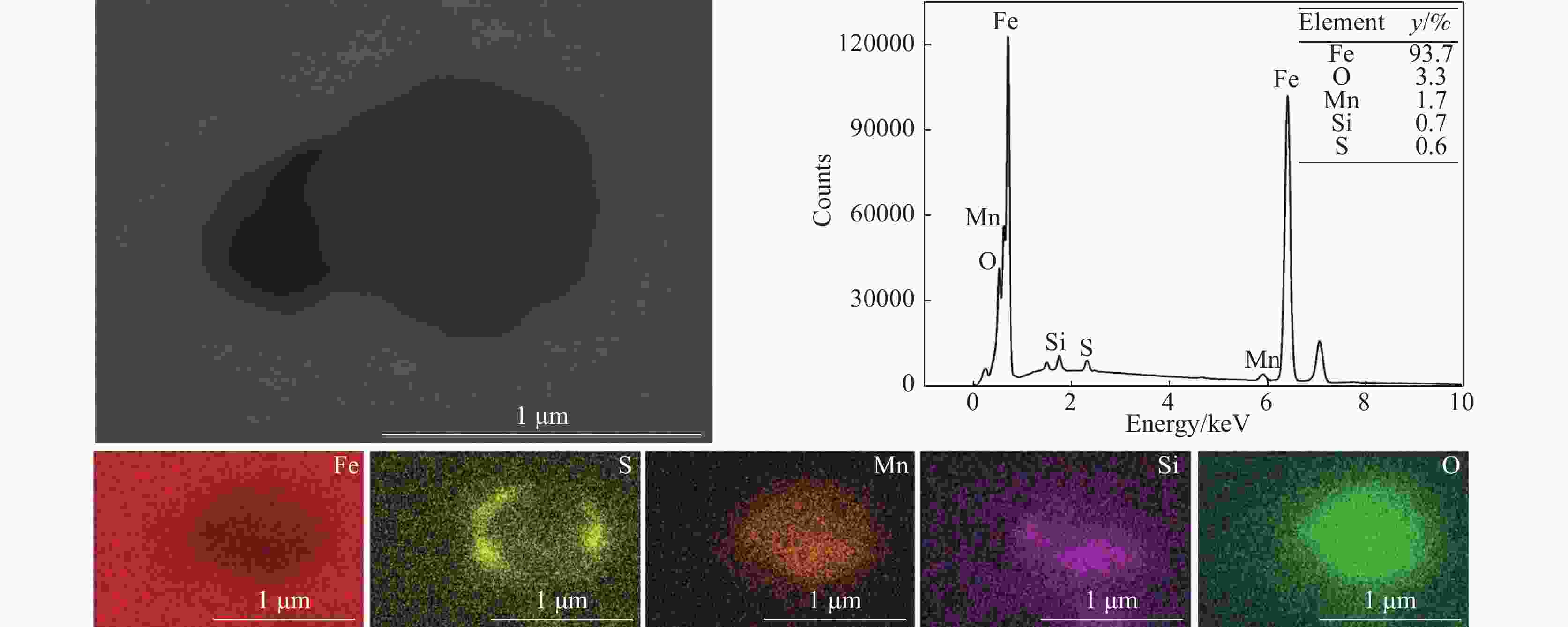
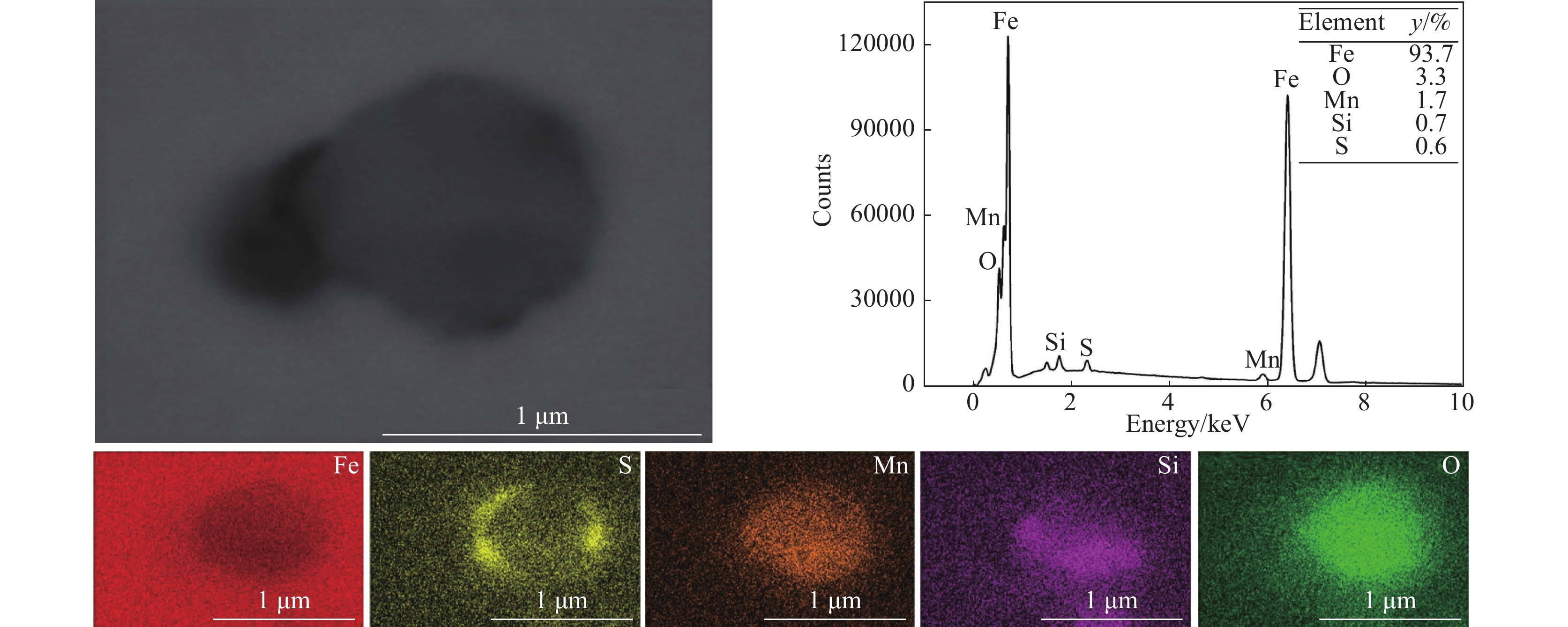
图 3 类球状夹杂物b形貌和元素分布
Figure 3. Morphology and elemental maps of near-spherical inclusion b
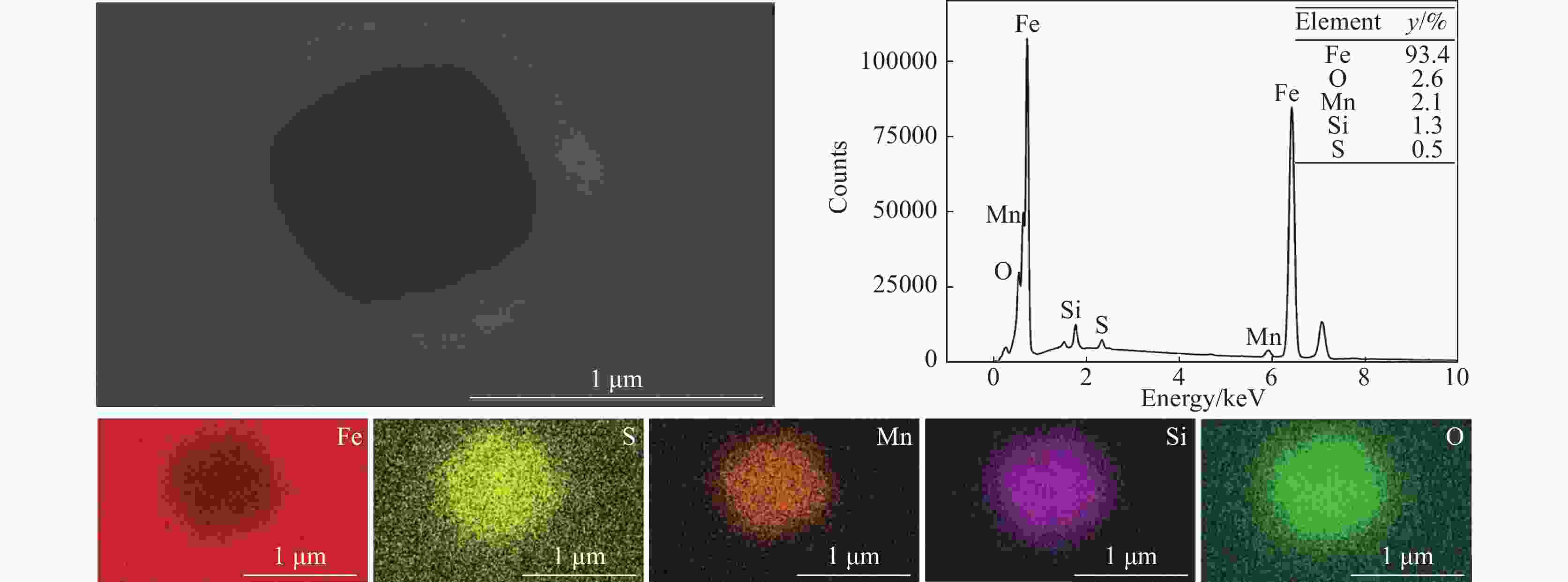
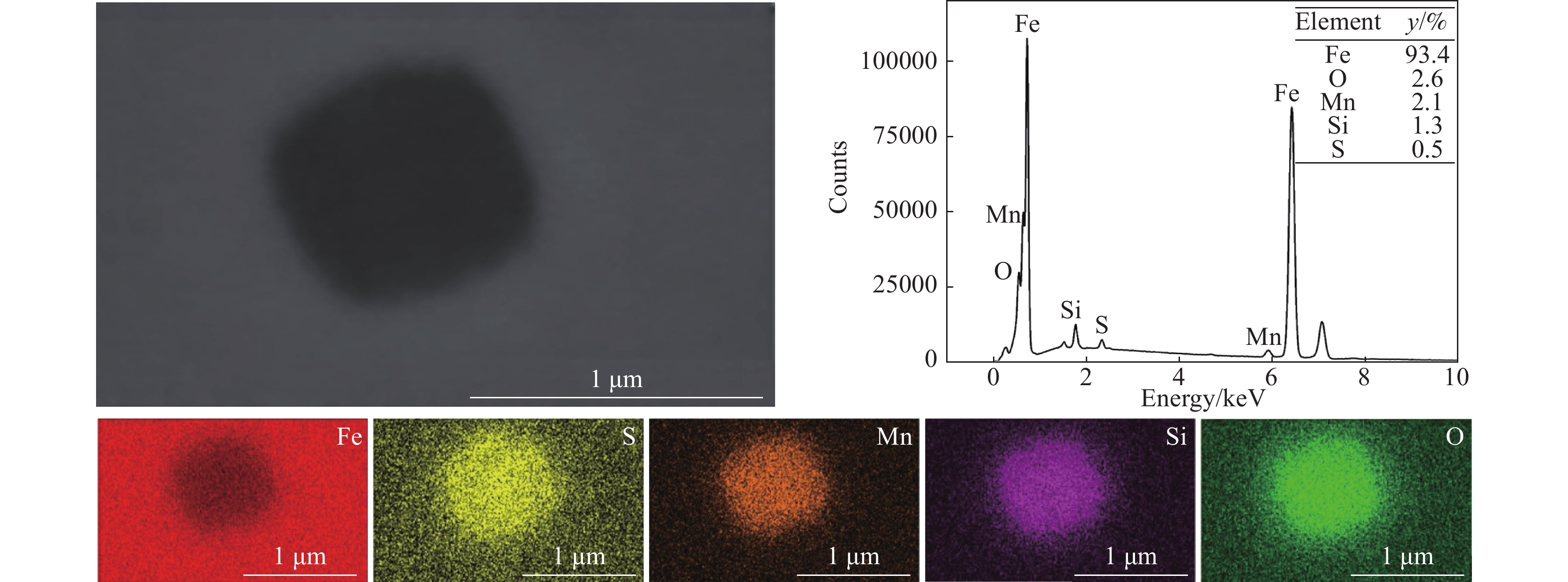
图 4 类球状夹杂物c形貌和元素分布
Figure 4. Morphology and elemental maps of near-spherical inclusion c
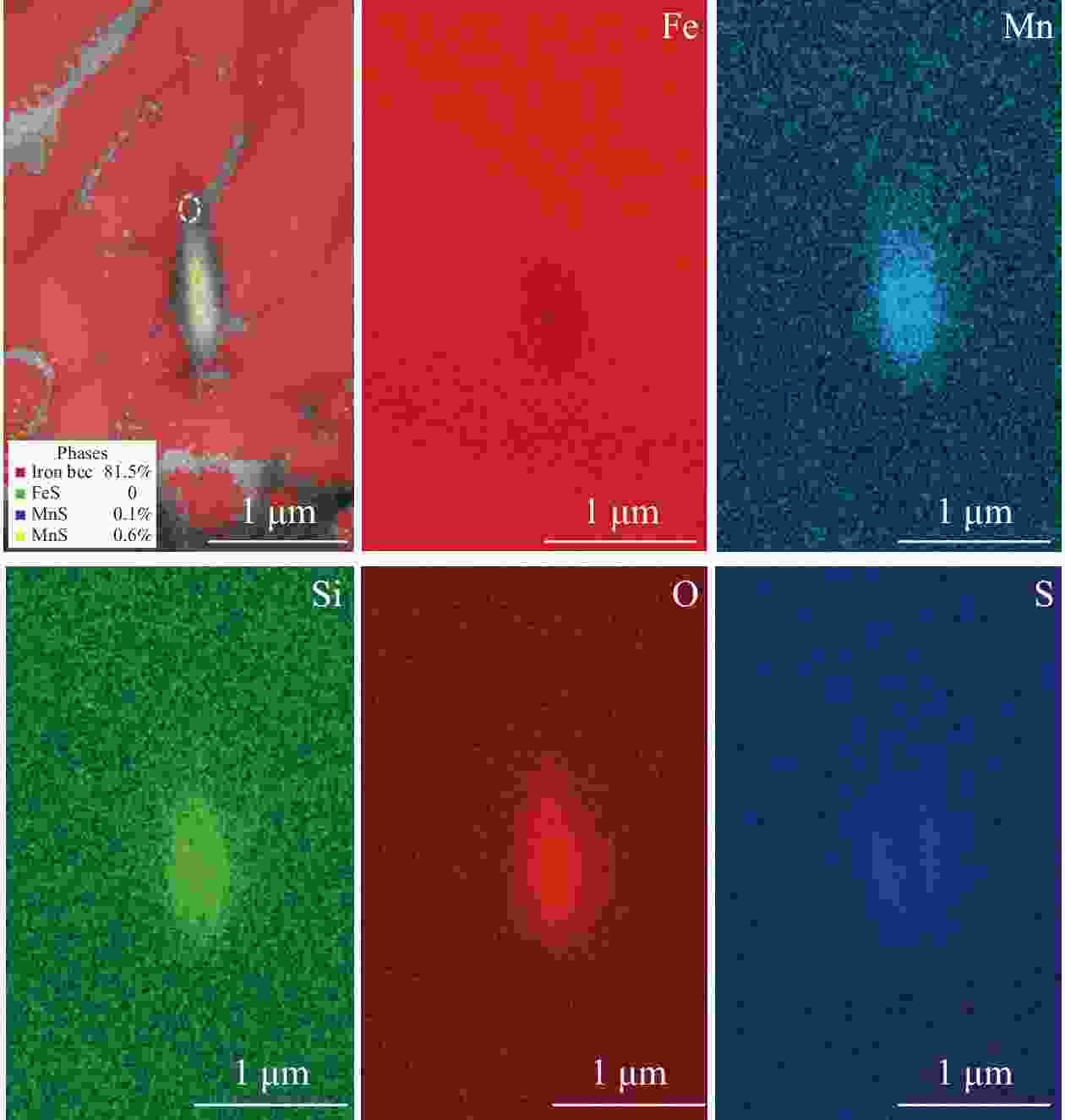
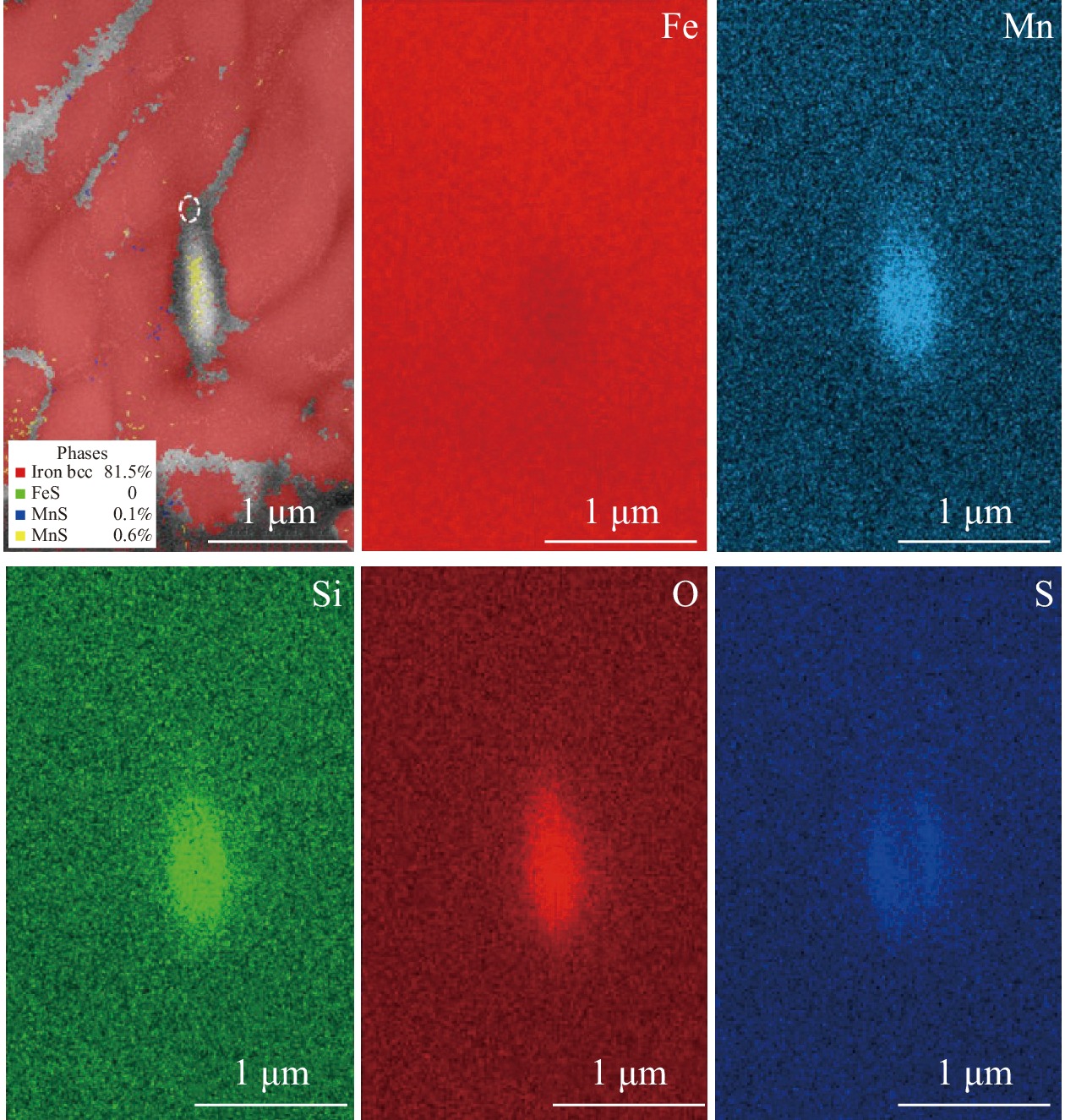
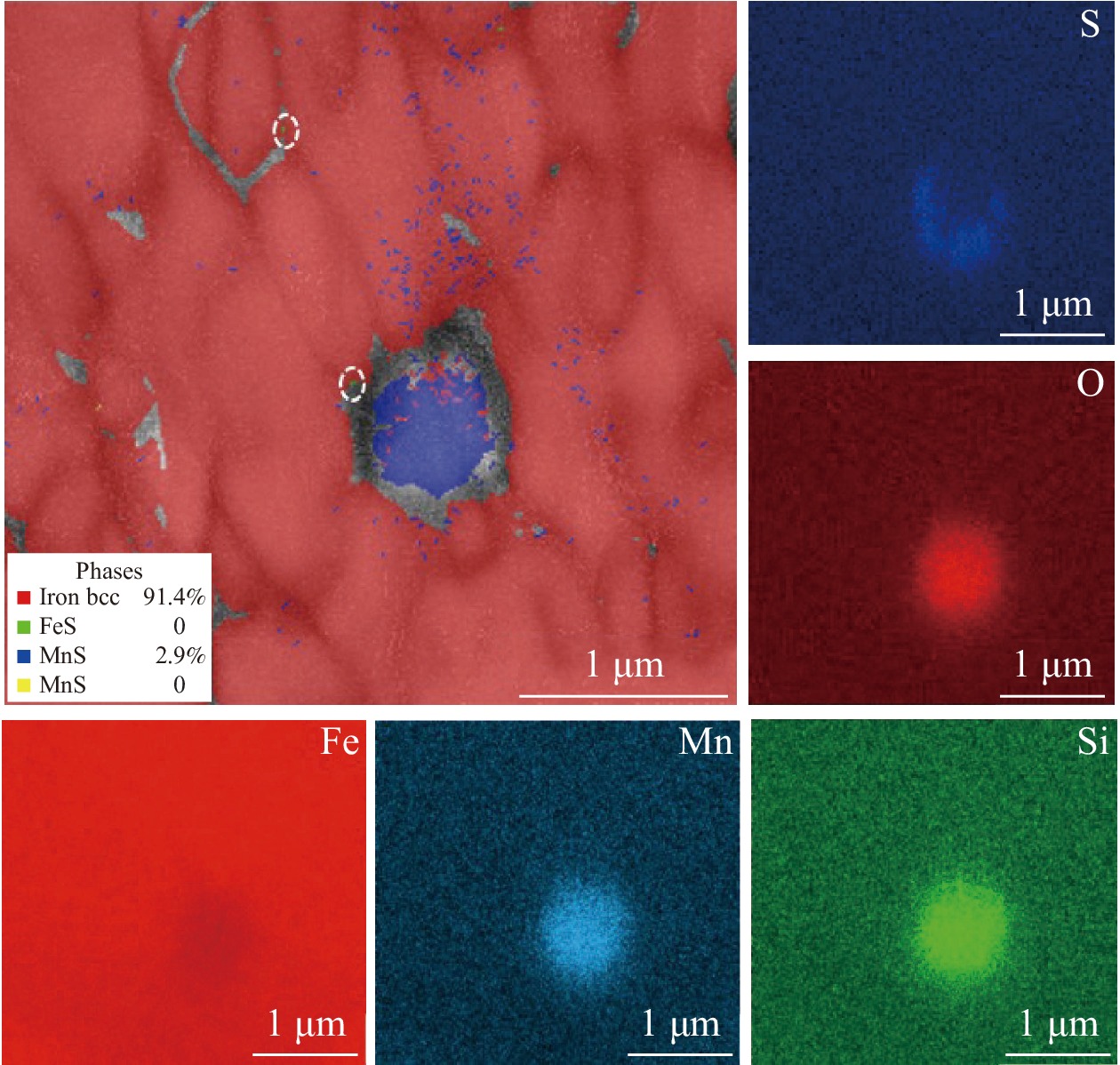
图 5 A1钢($w $[Mn]/$w $[S]=4.2)典型夹杂物的EBSD和能谱结果
Figure 5. EBSD and EDS results of typical inclusions in A1 steel($w $[Mn]/$w $[S]=4.2)
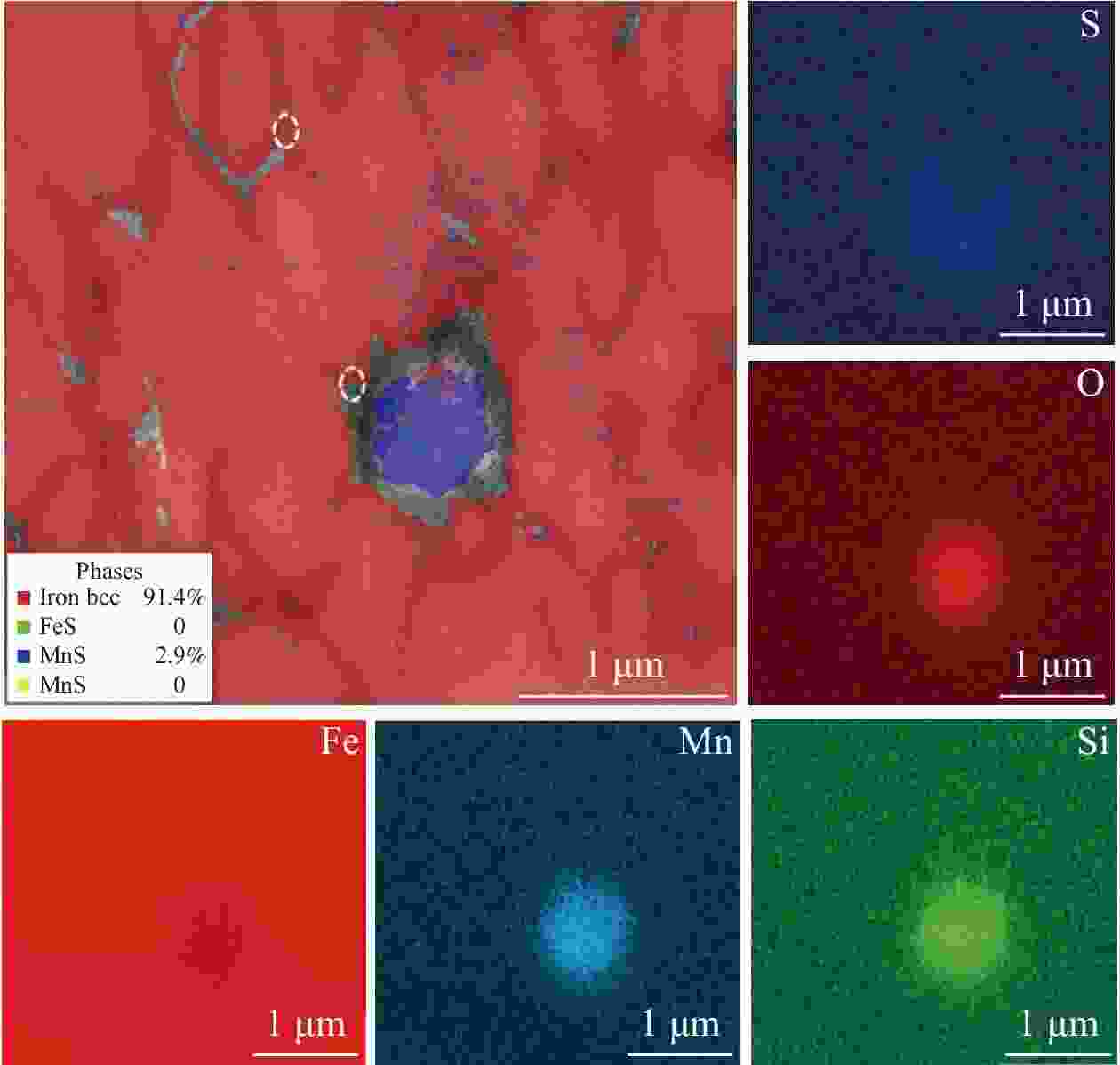
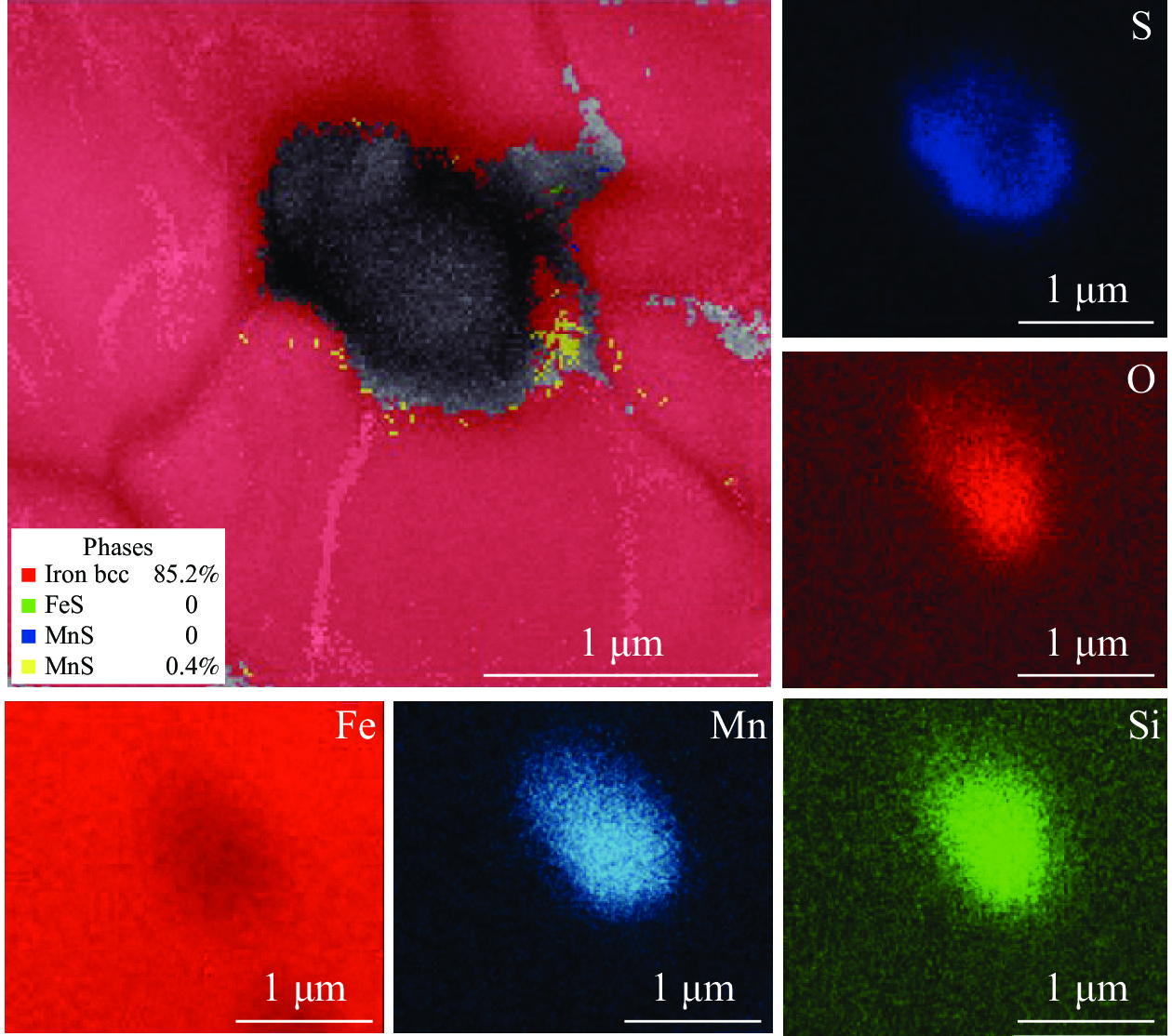
图 6 A2钢($w $[Mn]/$w $[S]=5.0)典型夹杂物的EBSD和能谱结果
Figure 6. EBSD and EDS results of typical inclusions in A2 steel($w $[Mn]/$w $[S]=5.0)
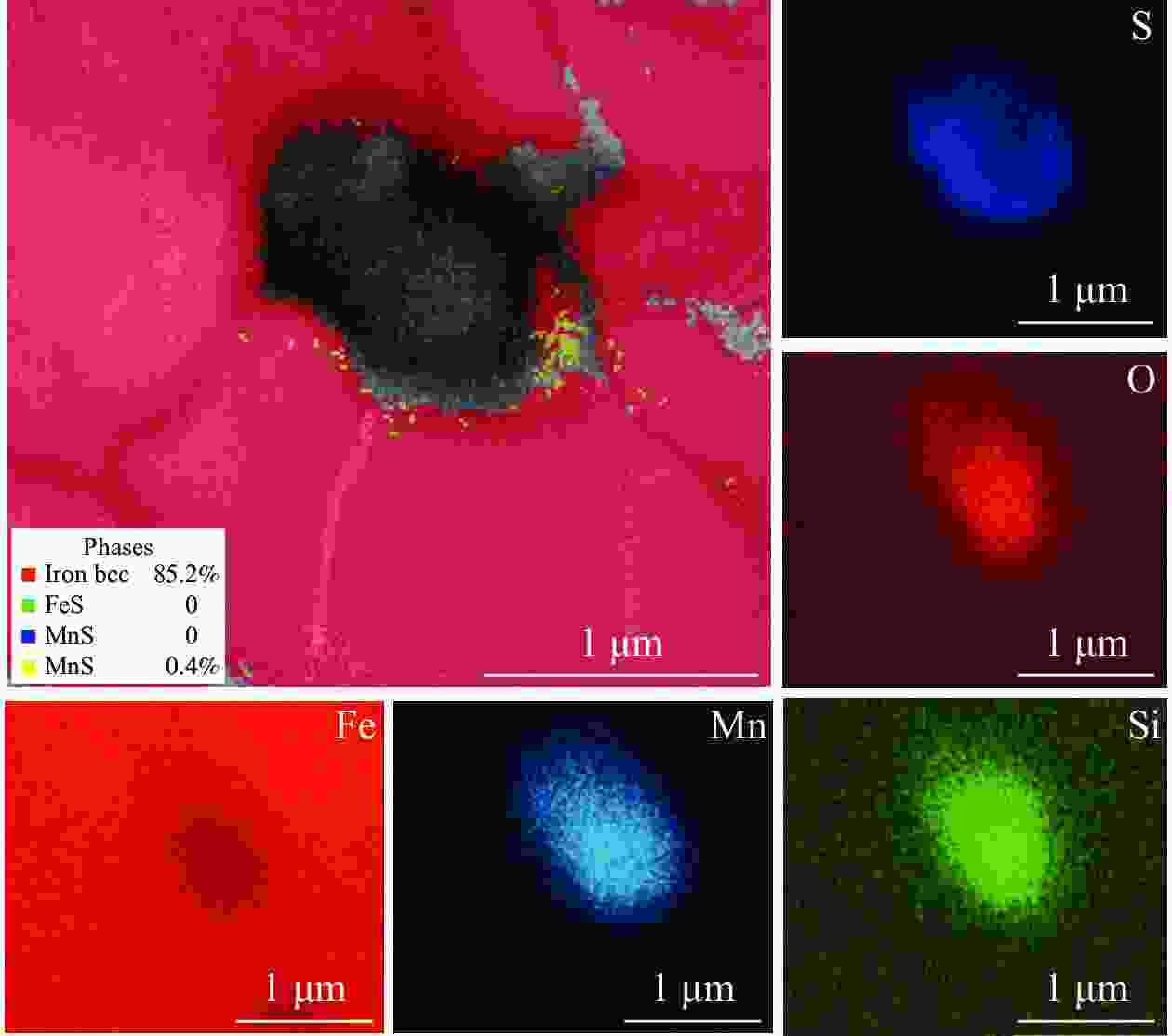
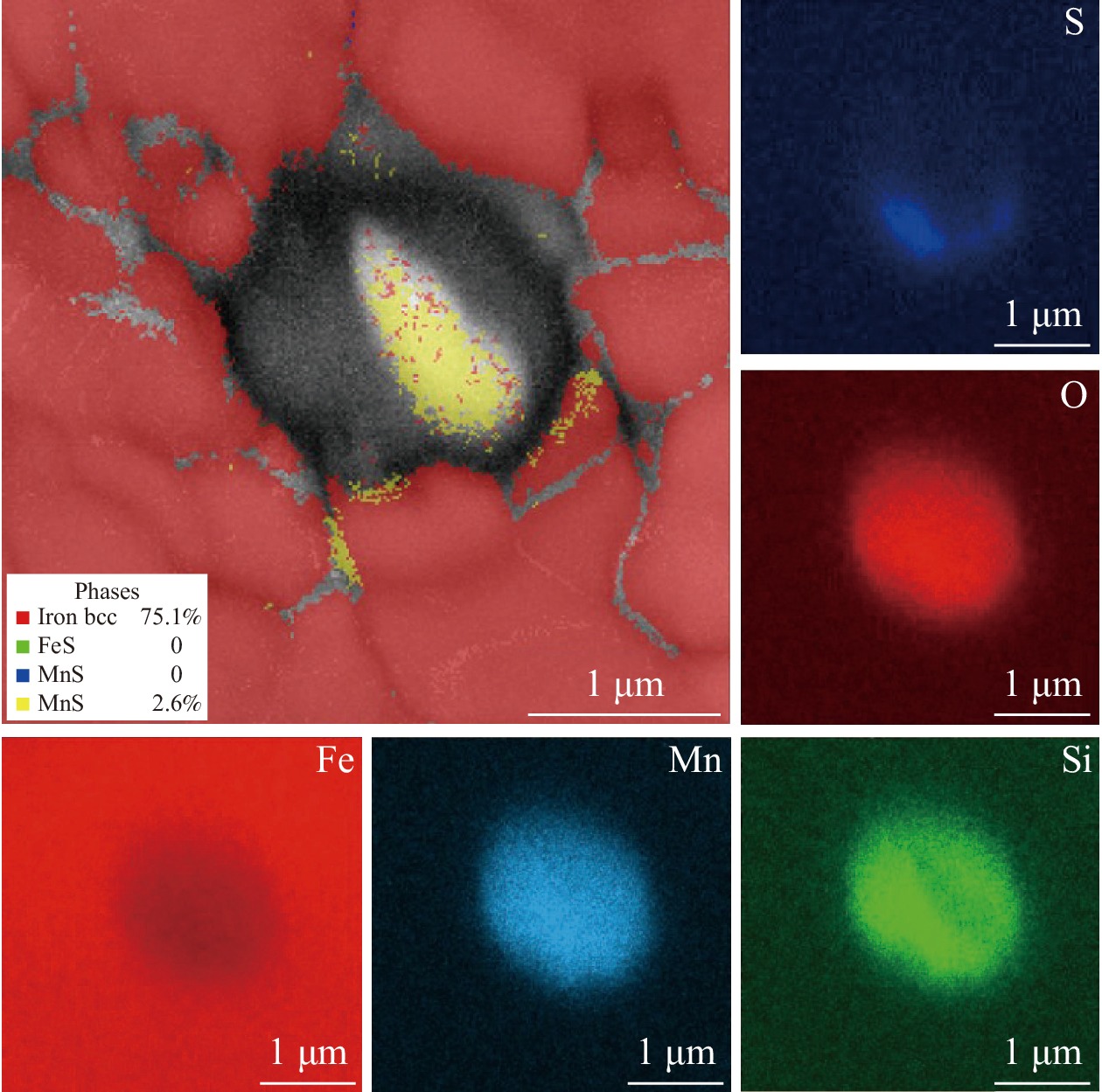
图 7 A3钢($w $[Mn]/$w $[S]=6.4)典型夹杂物的EBSD和能谱结果
Figure 7. EBSD and EDS results of typical inclusions in A3 steel($w $[Mn]/$w $[S]=6.4)
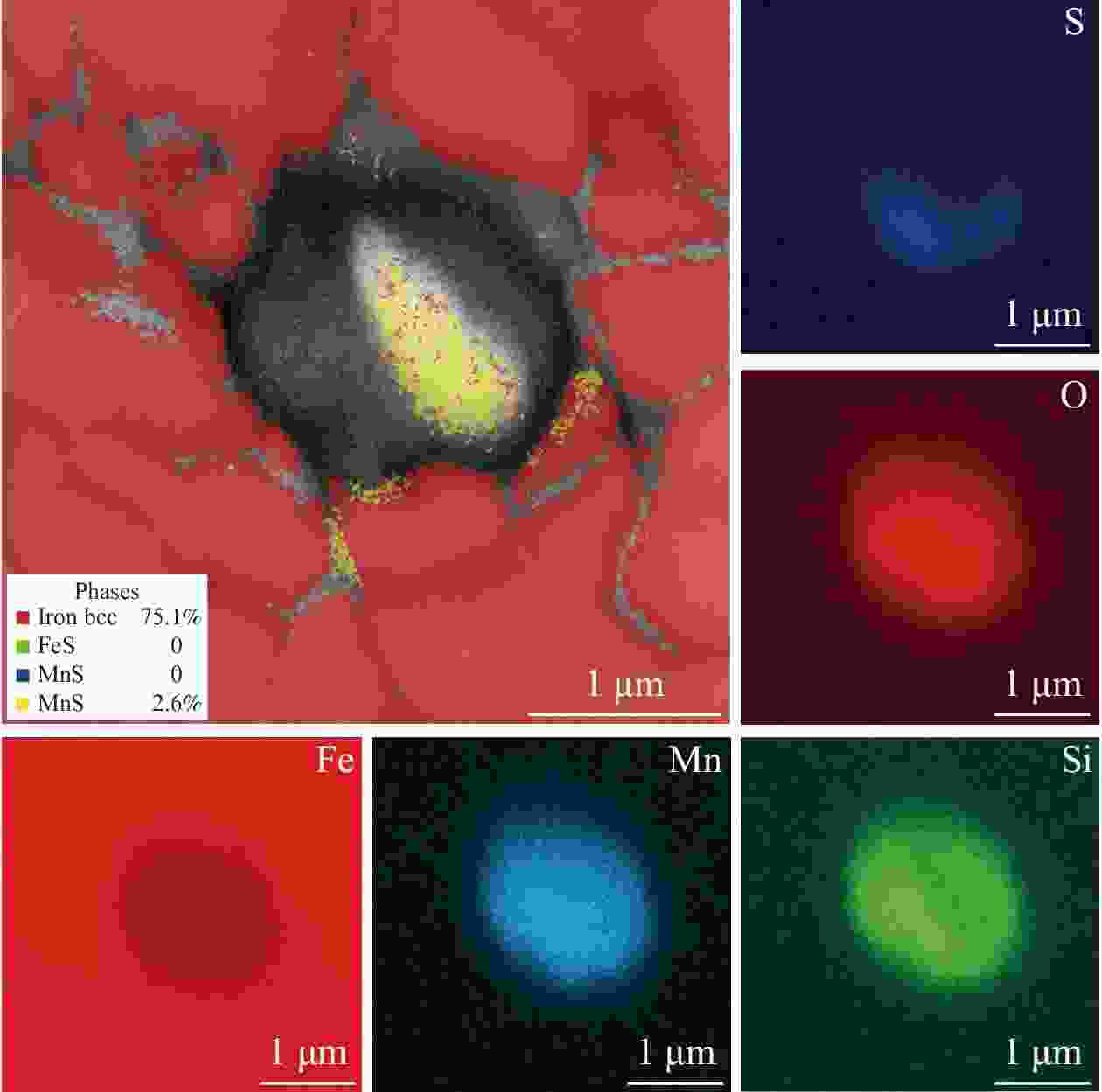
图 8 A4钢($w $[Mn]/$w $[S]=9.0)典型夹杂物的EBSD和能谱结果
Figure 8. EBSD and EDS results of typical inclusions in A4 steel($w $[Mn]/$w $[S]=9.0)
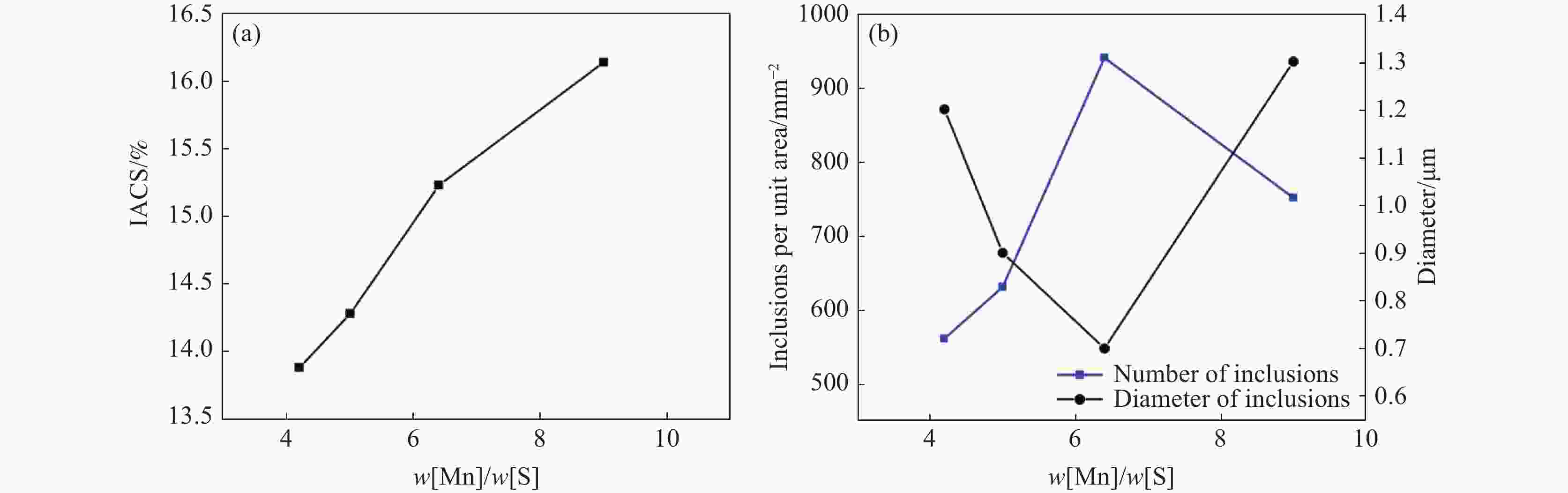
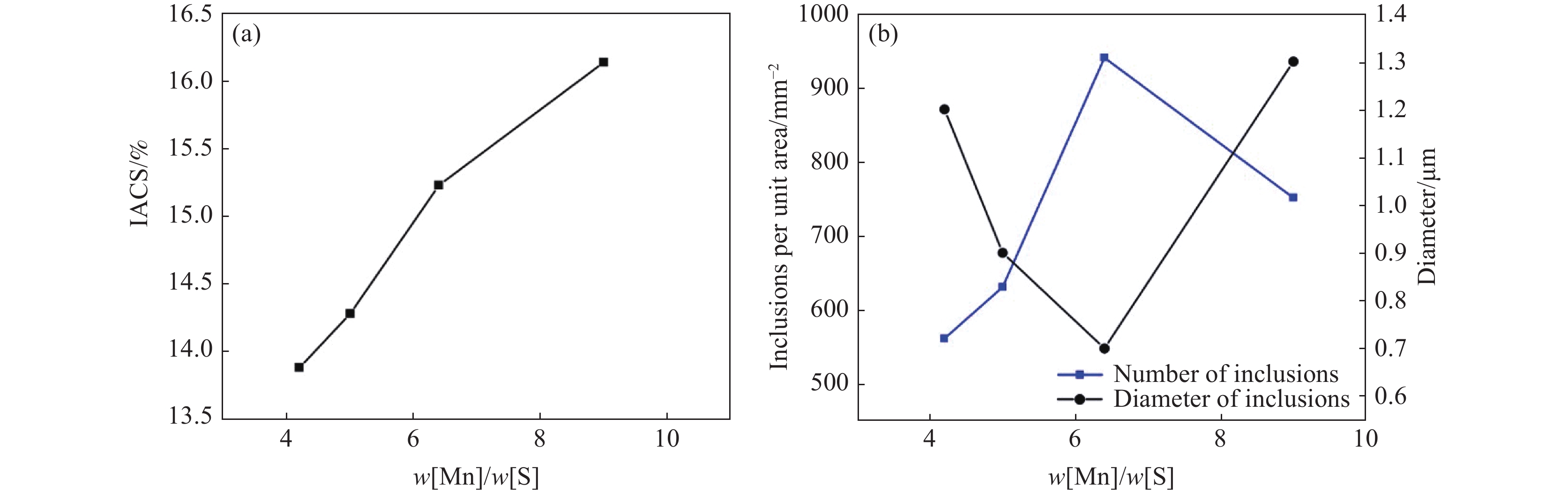
图 9 不同$w $[Mn]/$w $[S]下试样钢的特性参数
(a)导电率;(b)单位面积夹杂物数量与尺寸
Figure 9. Characteristic parameters of the sample steels under different $w $[Mn]/$w $[S]
表 1 试样的化学成分
Table 1. Chemical compositions of the samples
Sample C/% Si/% Mn/% S/% w[Mn]/w[S] A1 Target 0.05 0.05 0.10 0.025 4.0 Actual 0.05 0.05 0.11 0.026 4.2 A2 Target 0.05 0.05 0.10 0.020 5.0 Actual 0.04 0.05 0.10 0.020 5.0 A3 Target 0.05 0.05 0.10 0.015 6.7 Actual 0.04 0.06 0.09 0.014 6.4 A4 Target 0.05 0.05 0.10 0.010 10.0 Actual 0.05 0.05 0.09 0.010 9.0  下载: 导出CSV
-
[1] PAN X Q, YANG J, ZHI J J, et al. Evolution of inclusions in steelmaking process for ultra low carbon BH auto exposed panel[J]. Iron and Steel, 2019, 54(8): 48-57. (潘晓倩, 杨健, 职建军, 等. 超低碳汽车外板BH钢炼钢过程中夹杂物的演变[J]. 钢铁, 2019, 54(8): 48-57.PAN X Q, YANG J, ZHI J J, et al. Evolution of inclusions in steelmaking process for ultra low carbon BH auto exposed panel[J]. Iron and Steel, 2019, 54(8): 48-57. [2] HUANG S Y, LUO G, YANG J, et al. Effect of oxygen content on evolution of inclusions in ultra low carbon steel during steelmaking and continuous casting[J]. Steelmaking, 2021, 37(4): 38-48. (黄淑媛, 罗钢, 杨健, 等. 氧含量对超低碳钢炼钢连铸过程夹杂物演变的影响[J]. 炼钢, 2021, 37(4): 38-48.HUANG S Y, LUO G, YANG J, et al. Effect of oxygen content on evolution of inclusions in ultra low carbon steel during steelmaking and continuous casting[J]. Steelmaking, 2021, 37(4): 38-48. [3] YUAN P, ZHANG J, LIU D Z, et al. Formation mechanism and control technology of Al-Ti inclusions in ultra low carbon steel[J]. Iron and Steel, 2018, 53(7): 24-30. (苑鹏, 章军, 刘道正, 等. 超低碳钢中Al-Ti夹杂物的形成机理和控制技术[J]. 钢铁, 2018, 53(7): 24-30. doi: 10.13228/j.boyuan.issn0449-749x.20170558YUAN P, ZHANG J, LIU D Z, et al. Formation mechanism and control technology of Al-Ti inclusions in ultra low carbon steel[J]. Iron and Steel, 2018, 53(7): 24-30. doi: 10.13228/j.boyuan.issn0449-749x.20170558 [4] TANG X C, CHENG G H, LIU Y J, et al. Microstructure and properties evolution during annealing in low-carbon Nb containing steel with high strength and electrical conductivity: an experimental and theoretical study[J]. Journal of Materials Research and Technology, 2023, 27: 3054-3066. doi: 10.1016/j.jmrt.2023.10.093 [5] TANG X C, KUANG C, ZHOU W L, et al. Effect of annealing process on microstructure and electrical conductivity of cold-rolled Ti microalloyed conductive steel[J]. Materials Characterization, 2023, 201: 112930. doi: 10.1016/j.matchar.2023.112930 [6] LIANG T T, CHEN T, WANG J, et al. The correlation between electrical conductivity and thermal conductivity of binary Mg alloys[J]. Journal of Alloys and Compounds, 2025, 1035: 181553. doi: 10.1016/j.jallcom.2025.181553 [7] PAN S H, YUAN J, ZHANG P, et al. Effect of electron concentration on electrical conductivity in in situ Al-TiB2 nanocomposites[J]. Applied Physics Letters, 2020, 116(1). [8] SEGERCRANTZ N, BAUMGARTNER Y, TING M, et al. Undoped p-type GaN1-xSbx alloys: Effects of annealing[J]. Applied Physics Letters, 2016, 109(25). [9] WANG D, WANG Q J, XU B F, et al. The effect of Fe content on the microstructure and properties of Cu-3Ti alloy[J]. Journal of Materials Research and Technology, 2025, 37: 444-454. doi: 10.1016/j.jmrt.2025.05.264 [10] TRINH T T, THANGADURAI V. Effect of Ti substitution for Nb in double perovskite-type Ba3CaNb2O9 on chemical stability and electrical conductivity[J]. Electrochimica Acta, 2010, 56(1): 227-237. doi: 10.1016/j.electacta.2010.08.094 [11] TAKENAKA S, TAKAHASHI R, ISHIKAWA K, et al. Quantification of changes in lattice defect density in BCC iron during plastic deformation using electrical resistivity measurements[J]. ISIJ International, 2024, 64(5): 868-873. doi: 10.2355/isijinternational.ISIJINT-2023-441 [12] PENG C, LIU H J, HUANG X S. Analysis on factors influencing electrical conductivity of GRD XGM2[J]. Jiangxi Metallurgy, 2015, 35(2): 30-32. (彭冲, 刘辉杰, 黄小山. 影响XGM2导电率的原因分析[J]. 江西冶金, 2015, 35(2): 30-32.PENG C, LIU H J, HUANG X S. Analysis on factors influencing electrical conductivity of GRD XGM2[J]. Jiangxi Metallurgy, 2015, 35(2): 30-32. [13] CAO H L, ZHAO P H, XIAO X, et al. The effect of solution and aging heat treatment on the strength and conductivity of 6063 aluminum alloy[J]. Light Alloy Fabrication Technology, 2024, 52(12): 1-5. (曹海龙, 赵沛浩, 肖翔, 等. 固溶和时效热处理对6063铝合金强度和导电率的影响[J]. 轻合金加工技术, 2024, 52(12): 1-5.CAO H L, ZHAO P H, XIAO X, et al. The effect of solution and aging heat treatment on the strength and conductivity of 6063 aluminum alloy[J]. Light Alloy Fabrication Technology, 2024, 52(12): 1-5. [14] LIAO Q Y, WANG Z, HU W X, et al. Effect of solid solution and precipitation on thermal conductivity and mechanical properties of Mg-Zn-Cu-Ce magnesium alloy[J]. Journal of Materials Research and Technology, 2025, 35: 5923-5932. doi: 10.1016/j.jmrt.2025.02.244 [15] AHN J H, HAN S Z, CHOI E A, et al. Simple optimization for strength and conductivity of Cu-Ni-Si alloy with discontinuous precipitation[J]. Materials Characterization, 2022, 184: 111605. doi: 10.1016/j.matchar.2021.111605 [16] CAO Y C, HAN S Z, CHOI E A, et al. Effect of inclusion on strength and conductivity of Cu-Ni-Si alloys with discontinuous precipitation[J]. Journal of Alloys and Compounds, 2020, 843: 156006. doi: 10.1016/j.jallcom.2020.156006 [17] KLEIN S, MUJICA R L, WALTER M, et al. Diffusion processes during cementite precipitation and their impact on electrical and thermal conductivity of a heat-treatable steel[J]. Journal of Materials Science, 2017, 52(1): 375-390. doi: 10.1007/s10853-016-0338-1 [18] LIU W D, QU H, ZHOU Y. Relationship between the covalent bond energy of sulfides and their precipitation behavior in steel[J]. Journal of Material and Heat Treatment, 2007, 2(28): 136-140. (刘伟东, 屈华, 周宇. 钢中部分硫化物共价键能与其析出行为的关系[J]. 材料热处理学报, 2007, 2(28): 136-140.LIU W D, QU H, ZHOU Y. Relationship between the covalent bond energy of sulfides and their precipitation behavior in steel[J]. Journal of Material and Heat Treatment, 2007, 2(28): 136-140. [19] JIANG G H. Laboratory study on smelting technology of sulfur-containing free-cutting steel[D]. Kunming: Kunming University of Science and Technology, 2007. (蒋光辉. 含硫易切削钢冶炼技术实验室研究[D]. 昆明: 昆明理工大学, 2007.JIANG G H. Laboratory study on smelting technology of sulfur-containing free-cutting steel[D]. Kunming: Kunming University of Science and Technology, 2007. [20] ITO Y, MASUMITSU N, MATSUBARA K. Formation of manganese sulfide in steel[J]. Transactions of the iron and steel institute of Japan, 1981, 21(7): 477-484. doi: 10.2355/isijinternational1966.21.477 [21] LI C L, HU T, ZHOU N, et al. Effect of mass ratio of manganese to sulfur on mechanical properties and cutability of 1215MS free-cutting steel[J]. Shanghai Metals, 2023, 45(2): 69-74. (李成良, 胡涛, 周楠, 等. 锰硫比对1215MS易切削钢力学和切削性能的影响[J]. 上海金属, 2023, 45(2): 69-74. doi: 10.19947/j.issn.1001-7208.2023.02.011LI C L, HU T, ZHOU N, et al. Effect of mass ratio of manganese to sulfur on mechanical properties and cutability of 1215MS free-cutting steel[J]. Shanghai Metals, 2023, 45(2): 69-74. doi: 10.19947/j.issn.1001-7208.2023.02.011 [22] JIA W J, LI J Z, SHUAI X Y. Development of cable steel DL05[J]. Steelmaking, 2013, 29(6): 19-22. (贾万军, 李具中, 帅习元. 电缆钢DL05的试制开发[J]. 炼钢, 2013, 29(6): 19-22.JIA W J, LI J Z, SHUAI X Y. Development of cable steel DL05[J]. Steelmaking, 2013, 29(6): 19-22. [23] YUAN M L. The development and research of XGM2 high wire rod product[D]. Xi'an: Xi'an University of Architecture and Technology, 2014. (袁模亮. XGM2高线盘条产品开发与研究[D]. 西安: 西安建筑科技大学, 2014.YUAN M L. The development and research of XGM2 high wire rod product[D]. Xi'an: Xi'an University of Architecture and Technology, 2014. [24] HOU Z W. Study on refinement control of MnS inclusions in heavy rail steel[D]. Beijing: University of Science and Technology Beijing, 2022. (侯泽旺. 重轨钢MnS夹杂物细化控制研究[D]. 北京: 北京科技大学, 2022.HOU Z W. Study on refinement control of MnS inclusions in heavy rail steel[D]. Beijing: University of Science and Technology Beijing, 2022. [25] KANG J H, YU K M, LEE S H, et al. Electrical conductivity evaluation techniques for superalloy single-crystal steel[J]. Journal of Electrical Engineering & Technology, 2023, 18(2): 1419-1427. doi: 10.1007/s42835-022-01344-4 [26] LI Y W, WANG X. Comparison of metallographic method and electron microscope energy spectrum method for determination of inclusion types[J]. Automobile Technology & Material, 2016, 1: 50-53. (李延伟, 王雪. 金相法与电镜能谱法对夹杂物种类判定的对比[J]. 汽车工艺与材料, 2016, 1: 50-53.LI Y W, WANG X. Comparison of metallographic method and electron microscope energy spectrum method for determination of inclusion types[J]. Automobile Technology & Material, 2016, 1: 50-53. [27] LÜ J G, XIAO L P. Non-metallic inclusions in steel and their metallographic examination[J]. Physical Testing and Chemical Analysis (Part A: Physical Testing), 2015, 51(4): 229-233. (吕建刚, 肖李鹏. 钢中非金属夹杂物及其金相检验[J]. 理化检验(A:物理分册), 2015, 51(4): 229-233.LÜ J G, XIAO L P. Non-metallic inclusions in steel and their metallographic examination[J]. Physical Testing and Chemical Analysis (Part A: Physical Testing), 2015, 51(4): 229-233. [28] FURUSETH S, KJEKSHUS A, NIKLASSON R J V, et al. On the properties of alpha-MnS and MnS2[J]. Acta Chemica Scandinavica, 1965, 19: 1405-1410. [29] ROSSITER P L. The electrical resistivity of metals and alloys[M]. Cambridge university press, 1991. [30] SU C, LI D J, LUO A A, et al. Effect of solute atoms and second phases on the thermal conductivity of Mg-RE alloys: A quantitative study[J]. Journal of Alloys and Compounds, 2018, 747: 431-437. doi: 10.1016/j.jallcom.2018.03.070 [31] FANG M T, YUAN H Z, XIE X, et al. Precipitation and growth of MnS inclusions in heavy rail steel slab[J]. Iron and Steel, 2023, 58(5): 59-69. (房孟婷, 袁华志, 谢鑫, 等. 重轨钢铸坯中MnS夹杂物的析出与长大[J]. 钢铁, 2023, 58(5): 59-69.FANG M T, YUAN H Z, XIE X, et al. Precipitation and growth of MnS inclusions in heavy rail steel slab[J]. Iron and Steel, 2023, 58(5): 59-69. -


计量
- 文章访问数: 0
- HTML全文浏览量: 0
- PDF下载量: 0
- 被引次数: 0