Study on improving lead poisoning resistance of SCR catalysts for iron-steel sintering machines
-
摘要: 采用浸渍法制备粉体催化剂,研究了Mo、Ce掺杂对V-W/Ti催化剂抗铅中毒性能的提升作用。借助BET、XPS、H2-TPR和NH3-TPD等表征手段分析了催化剂的理化性质。结果表明,Mo、Ce掺杂能够提高催化剂的低温还原能力,为催化剂提供额外的酸性位点,减少铅毒化给催化剂孔结构、氧空位带来的负面影响,V-W-MoCe/Ti-Pb经高浓度铅毒化后,在150~400 ℃反应区间依旧具有较好的低温脱硝活性和较宽的温度窗口,250~400 ℃ NOx转化率大于90%。活性衰减率为20%时,V-W-MoCe/Ti系成型催化剂的铅毒化耐受性较V-W/Ti系提升5.7倍,在含铅等重金属特征烟气脱硝工况中具有重要的应用推广意义。Abstract: Powder catalysts were synthesized via the impregnation method to investigate the effect of Mo and Ce doping on improving the lead poisoning resistance of V-W/Ti catalysts. The physicochemical properties of the catalysts were characterized using BET, XPS, H2-TPR, and NH3-TPD. The results showed that doping with Mo and Ce enhanced the low-temperature reducibility of the catalysts, provide additional acid sites, and alleviated the detrimental effects of lead poisoning on the pore structure and oxygen vacancies. After exposure to high concentrations of lead, the V-W-MoCe/Ti-Pb catalyst still maintained excellent low-temperature denitration activity and a broad operating temperature window between 150–400 °C. Specifically, the NOₓ conversion exceeded 90% in the range of 250–400 °C. When the decay of activity reached 20%, the lead poisoning tolerance of the molded V-W-MoCe/Ti catalyst was 5.7 times higher than that of the V-W/Ti catalyst. These findings provide valuable insights for the application and promotion of such catalysts in denitrating flue gases containing lead and other heavy metals.
-
Key words:
- iron-steel sintering flue gas /
- lead poisoning /
- denitration /
- poisoning resistance
-
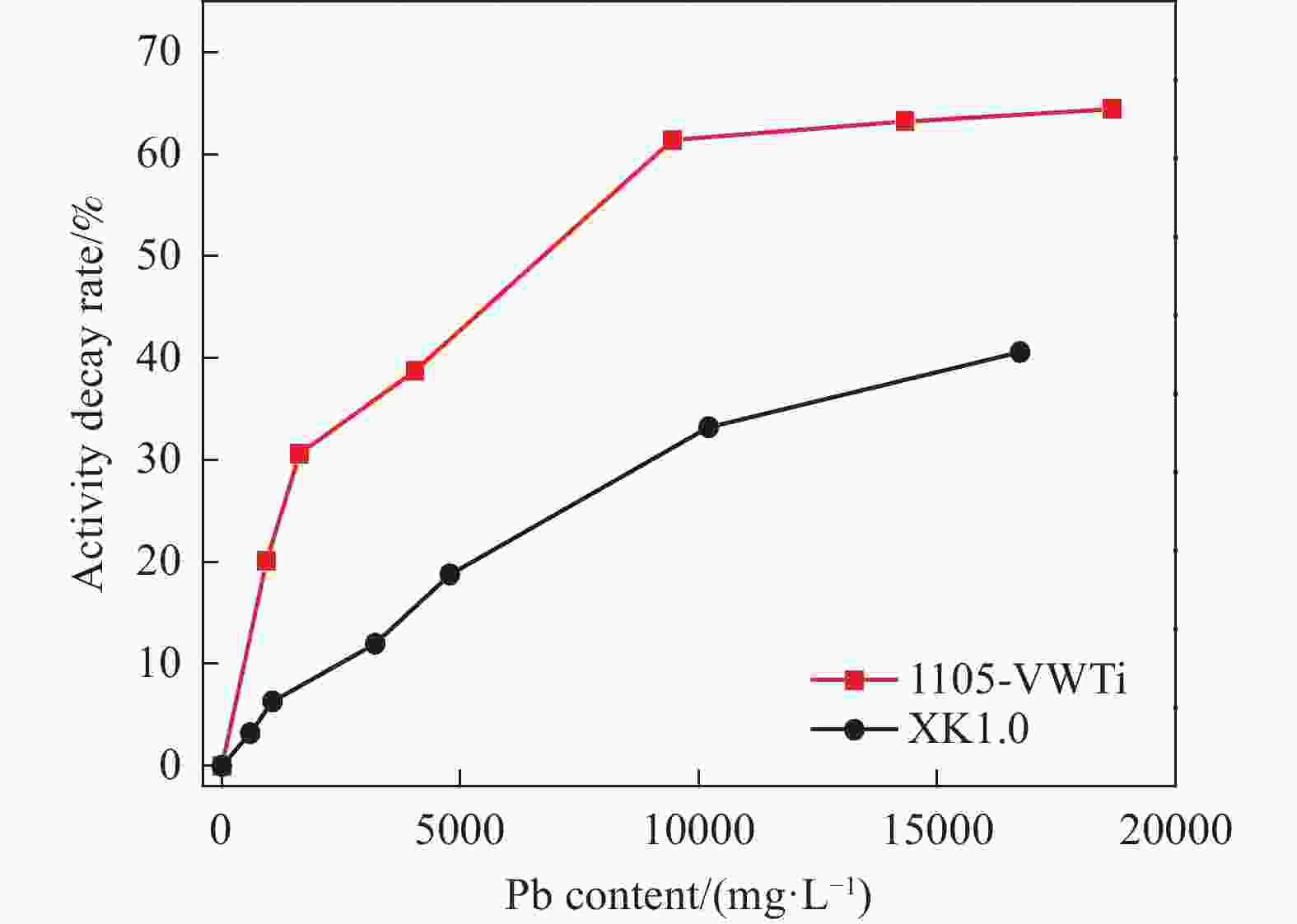
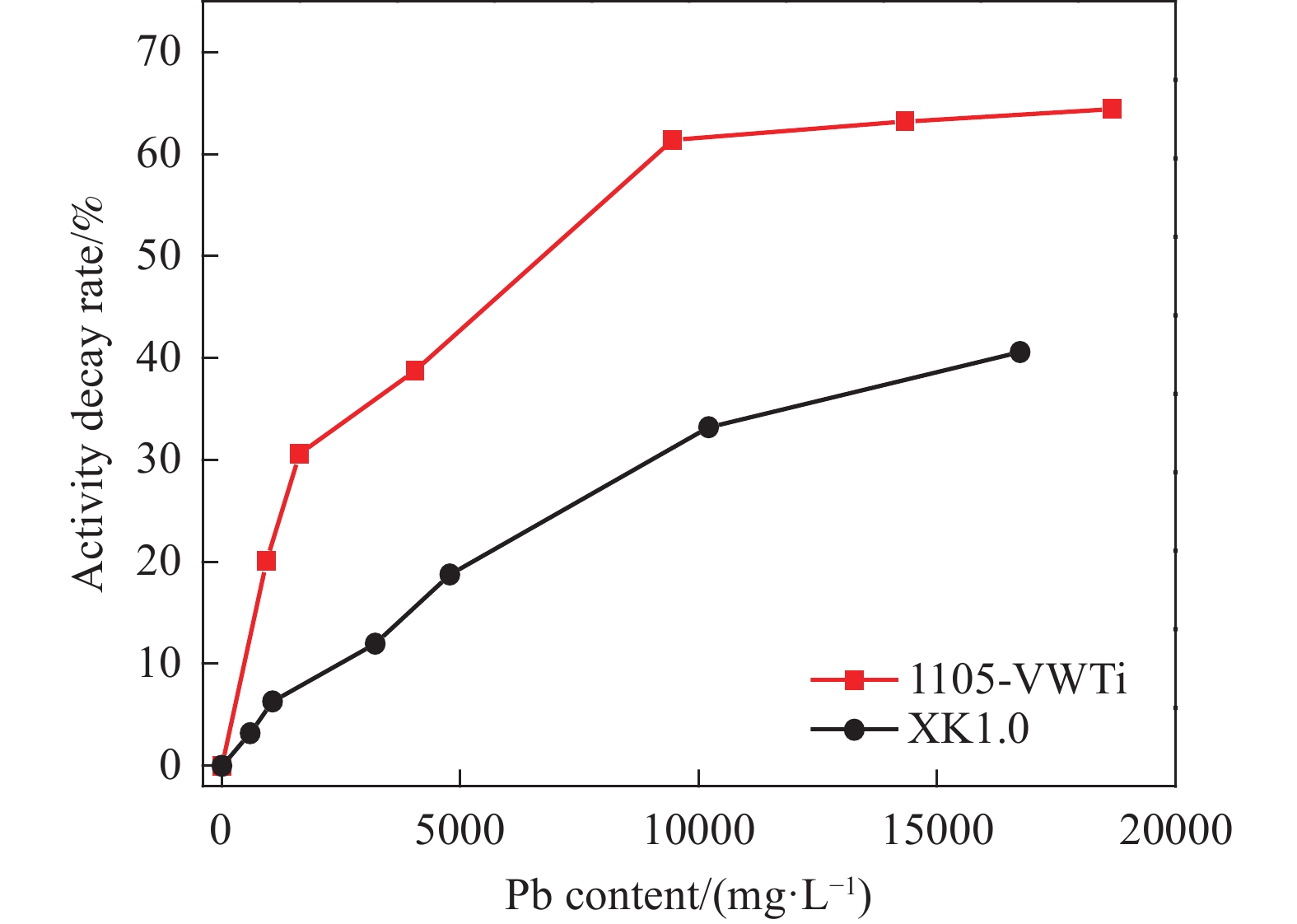
图 6 1105-VWTi和XK1.0催化剂的铅毒化耐受性能
Figure 6. Lead poisoning tolerance performance of 1105-VWTi and XK1.0 catalysts
表 1 不同催化剂的孔结构分析数据
Table 1. Pore structure data of different catalysts
Sample SBET/
(m2·g−1)Pore volume /
(cm3·g−1)Pore size /
(nm)V-W/Ti 83.1 0.369 10.6 V-W-Mo/Ti 82.3 0.362 11.1 V-W-Ce/Ti 81.7 0.355 11.1 V-W-MoCe/Ti 84.2 0.376 10.5 V-W/Ti-Pb 66.7 0.284 12.8 V-W-Mo/Ti-Pb 71.3 0.312 12.5 V-W-Ce/Ti-Pb 74.5 0.340 11.8 V-W-MoCe/Ti-Pb 83.7 0.392 10.8  下载: 导出CSV
表 2 不同催化剂的XPS分析数据
Table 2. XPS analysis data of different catalysts
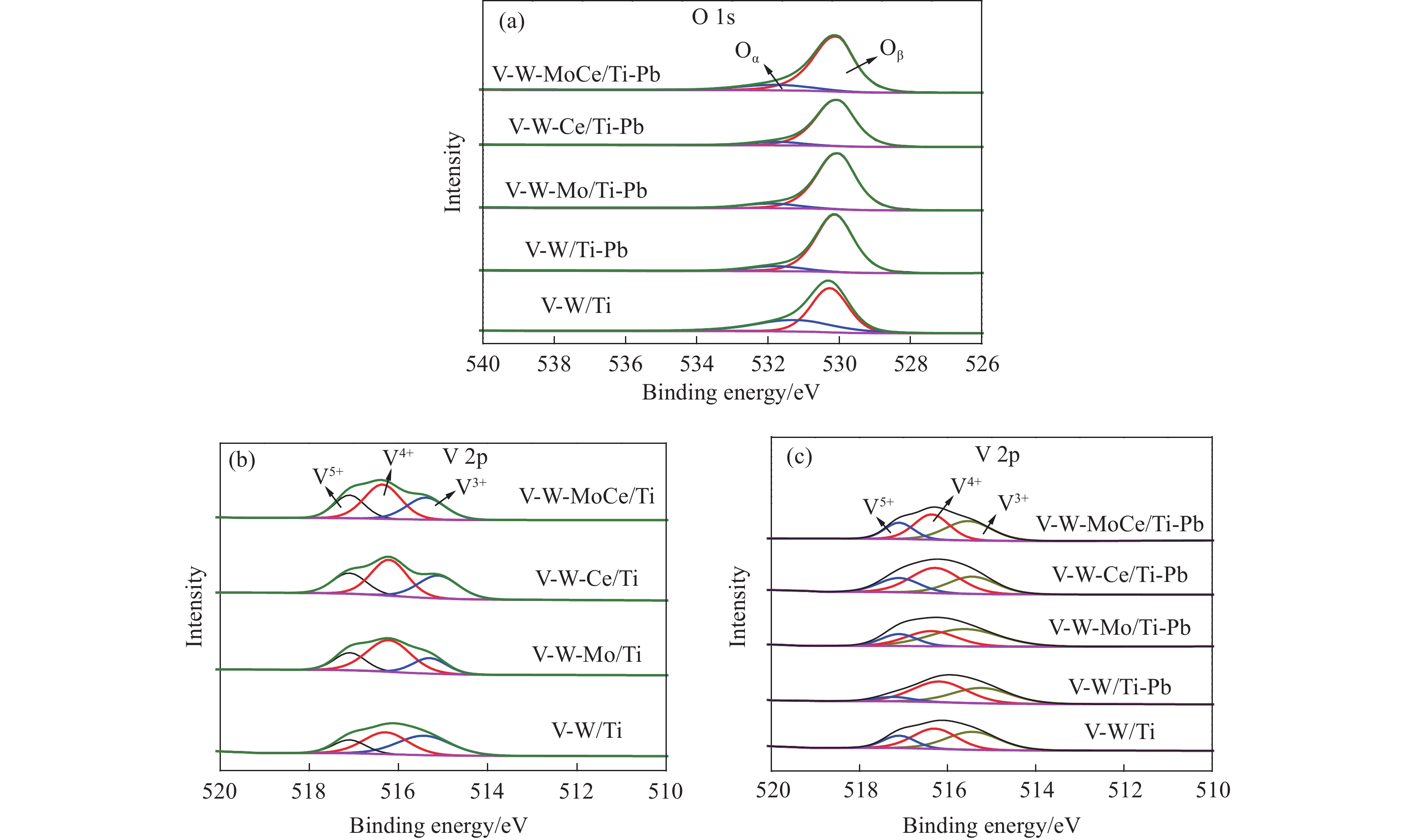
Sample Oα/(Oα+Oβ) V5+/(V5++V4++V3+) V-W/Ti 0.24 0.18 V-W-Mo/Ti 0.22 V-W-Ce/Ti 0.24 V-W-MoCe/Ti 0.25 V-W/Ti-Pb 0.10 0.08 V-W-Mo/Ti-Pb 0.15 0.18 V-W-Ce/Ti-Pb 0.17 0.22 V-W-MoCe/Ti-Pb 0.19 0.25
下载: 导出CSV
表 3 1105-VWTi和XK1.0催化剂的铅毒化样检测数据
Table 3. Analysis data of 1105-VWTi and XK1.0 catalysts-poisoned
Sample Pb content
/(mg·L-1)Catalytic activity
K/(m·h-1)Activity
degradation/%1105-VWTi-original sample 0 43.17 0 1105-VWTi-1000 935 34.51 20.06 1105-VWTi-2000 1624 29.96 30.60 1105-VWTi-5000 4050 26.43 38.78 1105-VWTi-10000 9455 16.66 61.41 1105-VWTi-15000 14329 15.88 63.22 1105-VWTi-20000 18675 15.36 64.42 XK1.0-original sample 0 54.73 0 XK1.0-1000 592 52.98 3.20 XK1.0-2000 1061 51.28 6.31 XK1.0-5000 3214 48.17 11.98 XK1.0-10000 4782 44.46 18.77 XK1.0-15000 10209 36.55 33.22 XK1.0-20000 16743 32.52 40.58
下载: 导出CSV
-
[1] FINLAYSON-PITTS B J, PITTS J N. Tropospheric air pollution: Ozone, airborne toxics, polycyclic aromatic hydrocarbons, and particles[J]. Science, 1997, 276(5315): 1045-1051. doi: 10.1126/science.276.5315.1045 [2] WANG W, SONG J, LIU L Q, et al. Discussion on desulfurization and denitrification technology of sintering flue gas[J]. Energy Conservation & Environmental Protection, 2020(8): 58-60. (王伟, 宋静, 刘璐琦, 等. 烧结烟气脱硫脱硝技术探讨[J]. 节能与环保, 2020(8): 58-60.WANG W, SONG J, LIU L Q, et al. Discussion on desulfurization and denitrification technology of sintering flue gas[J]. Energy Conservation & Environmental Protection, 2020(8): 58-60. [3] WANG C Z, GU T, ZHANG Z L, et al. Emission characteristics of multi-pollutants from iron-steel sintering and coking flue gas and application status of purification technology[J]. Contemporary Chemical Industry, 2025, 54(1): 172-179. (王成志, 顾甜, 张忠良, 等. 钢铁烧结、焦化烟气多污染物排放特征与净化技术应用现状[J]. 当代化工, 2025, 54(1): 172-179.WANG C Z, GU T, ZHANG Z L, et al. Emission characteristics of multi-pollutants from iron-steel sintering and coking flue gas and application status of purification technology[J]. Contemporary Chemical Industry, 2025, 54(1): 172-179. [4] ZHOU J L, MA Z R, LI G, et al. Research progress on anti-poisoning of SCR catalysts in flue gas of coal and renewable fuel co-fired power plant[J]. Chemical Industry and Engineering Progress, 2023, 42(12): 6286-6300. (周佳丽, 马子然, 李歌, 等. 燃煤耦合可再生燃料电厂抗中毒脱硝催化剂研究进展[J]. 化工进展, 2023, 42(12): 6286-6300. doi: 10.16085/j.issn.1000-6613.2023-0126ZHOU J L, MA Z R, LI G, et al. Research progress on anti-poisoning of SCR catalysts in flue gas of coal and renewable fuel co-fired power plant[J]. Chemical Industry and Engineering Progress, 2023, 42(12): 6286-6300. doi: 10.16085/j.issn.1000-6613.2023-0126 [5] WANG B, WANG M X, HAN L N, et al. Improved activity and SO2 resistance by Sm-modulated redox of MnCeSmTiOx mesoporous amorphous oxides for low-temperature NH3-SCR of NO[J]. ACS Catalysis, 2020, 10(16): 9034-9045. doi: 10.1021/acscatal.0c02567 [6] PENG Y, WANG D, LI B, et al. Impacts of Pb and SO2 poisoning on CeO2–WO3/TiO2–SiO2 SCR catalyst[J]. Environmental Science & Technology, 2017, 51(20): 11943-11949. [7] JIANG Y, GAO X, ZHANG Y X, et al. Effects of PbCl2 on selective catalytic reduction of NO with NH3 over vanadia-based catalysts[J]. Journal of Hazardous Materials, 2014, 274: 270-278. doi: 10.1016/j.jhazmat.2014.04.026 [8] WU Y, ZHOU X, ZHOU J, et al. A comprehensive review of the heavy metal issues regarding commercial vanadium-titanium-based SCR catalyst[J]. Science of The Total Environment, 2023, 857: 159712. doi: 10.1016/j.scitotenv.2022.159712 [9] KONG M, ZHANG H D, WANG Y C, et al. Deactivation mechanisms of MnOx-CeO2/Ti-bearing blast furnace slag low-temperature SCR catalyst by PbO and PbCl2[J]. Molecular Catalysis, 2022, 521: 112209. doi: 10.1016/j.mcat.2022.112209 [10] CHEN J P, YANG R T. Mechanism of poisoning of the V2O5/TiO2 catalyst for the reduction of NO by NH3[J]. Journal of Catalysis, 1990, 125(2): 411-420. doi: 10.1016/0021-9517(90)90314-a [11] TANG Y X, WANG K X, WANG Y H, et al. Recent advances in the research on the poisoning mechanisms and anti-poisoning methods of alkali (earth) metal for denitrification catalysts[J]. Energy Environmental Protection, 2024, 38(4): 88-100. (汤雨萱, 王凯欣, 王雨禾, 等. 脱硝催化剂碱(土)金属中毒机制及抗中毒方法研究进展[J]. 能源环境保护, 2024, 38(4): 88-100.TANG Y X, WANG K X, WANG Y H, et al. Recent advances in the research on the poisoning mechanisms and anti-poisoning methods of alkali (earth) metal for denitrification catalysts[J]. Energy Environmental Protection, 2024, 38(4): 88-100. [12] HUANG L, YUE Y W, ZONG Y H, et al. Investigation of the effect of Ce on the K resistance of V-Mo/Ti de-NOx catalyst[J]. Iron Steel Vanadium Titanium, 2022, 43(5): 52-58. (黄力, 岳彦伟, 纵宇浩, 等. Ce对V-Mo/Ti脱硝催化剂抗K中毒性能的影响研究[J]. 钢铁钒钛, 2022, 43(5): 52-58. doi: 10.7513/j.issn.1004-7638.2022.05.008HUANG L, YUE Y W, ZONG Y H, et al. Investigation of the effect of Ce on the K resistance of V-Mo/Ti de-NOx catalyst[J]. Iron Steel Vanadium Titanium, 2022, 43(5): 52-58. doi: 10.7513/j.issn.1004-7638.2022.05.008 [13] XU J. Study on NH3-SCR denitration performance and mechanism of magnetive rare earth tailings catalyst modified by Mo-Ce[D]. Inner Mongolia: Inner Mongolia University of Science & Technology, 2023. (许杰. Mo-Ce修饰磁选稀土尾矿催化剂NH3-SCR性能及脱硝机理研究[D]. 内蒙古: 内蒙古科技大学, 2023.XU J. Study on NH3-SCR denitration performance and mechanism of magnetive rare earth tailings catalyst modified by Mo-Ce[D]. Inner Mongolia: Inner Mongolia University of Science & Technology, 2023. [14] LIETTI L, NOVA I, RAMIS G, et al. Characterization and reactivity of V2O5–MoO3/TiO2 de-NOx SCR catalysts[J]. Journal of Catalysis, 1999, 187(2): 419-435. doi: 10.1006/jcat.1999.2603 [15] DING S P, LIU F D, SHI X Y, et al. Significant promotion effect of Mo additive on a novel Ce–Zr mixed oxide catalyst for the selective catalytic reduction of NOx with NH3[J]. ACS Applied Materials & Interfaces, 2015, 7(18): 9497-9506. doi: 10.1021/acsami.5b00636 [16] HUANG L, WANG H, ZONG Y H, et al. Influence of yttrium addition on denitrification performance of V2O5-MoO3/TiO2 catalyst[J]. Modern Chemical Industry, 2020, 40(3): 162-166. (黄力, 王虎, 纵宇浩, 等. Y改性对V2O5-MoO3/TiO2催化剂脱硝性能的影响[J]. 现代化工, 2020, 40(3): 162-166. doi: 10.16606/j.cnki.issn0253-4320.2020.03.035HUANG L, WANG H, ZONG Y H, et al. Influence of yttrium addition on denitrification performance of V2O5-MoO3/TiO2 catalyst[J]. Modern Chemical Industry, 2020, 40(3): 162-166. doi: 10.16606/j.cnki.issn0253-4320.2020.03.035 [17] JEONG Y E, KUMAR P A, HA H P, et al. Effect of hydrothermal aging on NOx reduction performance for Sb–V–CeO2/TiO2 catalyst[J]. Research on Chemical Intermediates, 2018, 44(11): 6803-6829. doi: 10.1007/s11164-018-3523-9 [18] WANG D E, LI G B, LI C, et al. Commercial V2O5-WO3 /TiO2 catalysts for heavy metal ( Pb, Cu, Zn) poisoning mechanism[J]. Journal of Molecular Catalysis (CHINA), 2019, 33(6): 508-523. (王殿二, 李国波, 李超, 等. 商业V2O5-WO3/TiO2催化剂重金属(Pb、Cu、Zn)中毒机理研究[J]. 分子催化, 2019, 33(6): 508-523.WANG D E, LI G B, LI C, et al. Commercial V2O5-WO3 /TiO2 catalysts for heavy metal ( Pb, Cu, Zn) poisoning mechanism[J]. Journal of Molecular Catalysis (CHINA), 2019, 33(6): 508-523. [19] FEI Y F, ZHONG Z P, ZHOU J W, et al. Ce(SO4)2 modification of V-W/Ti catalyst for improve its resistance to alkaline-earth metalis poisoning[J]. Modern Chemical Industry, 2025, 45(4): 153-159. (费亦凡, 仲兆平, 周峻伍, 等. Ce(SO4)2改性对V-W/Ti催化剂抗碱土中毒性能提升的影响[J]. 现代化工, 2025, 45(4): 153-159. doi: 10.16606/j.cnki.issn0253-4320.2025.04.027FEI Y F, ZHONG Z P, ZHOU J W, et al. Ce(SO4)2 modification of V-W/Ti catalyst for improve its resistance to alkaline-earth metalis poisoning[J]. Modern Chemical Industry, 2025, 45(4): 153-159. doi: 10.16606/j.cnki.issn0253-4320.2025.04.027 [20] YAO J, LIU S G, LIN W S, et al. Study on performance of Ce-Cr-Ni/TiO2 catalysts in CO-SCR[J]. Modern Chemical Industry, 2019, 39(5): 123-127. (姚佳, 刘少光, 林文松, 等. Ce-Cr-Ni/TiO2催化剂的CO-SCR性能研究[J]. 现代化工, 2019, 39(5): 123-127. doi: 10.16606/j.cnki.issn0253-4320.2019.05.027YAO J, LIU S G, LIN W S, et al. Study on performance of Ce-Cr-Ni/TiO2 catalysts in CO-SCR[J]. Modern Chemical Industry, 2019, 39(5): 123-127. doi: 10.16606/j.cnki.issn0253-4320.2019.05.027 [21] STANMORE B R. The formation of dioxins in combustion systems[J]. Combustion and Flame, 2004, 136(3): 398-427. doi: 10.1016/j.combustflame.2003.11.004 [22] PENG Y, SI W Z, LI X, et al. Comparison of MoO3 and WO3 on arsenic poisoning V2O5/TiO2 catalyst: DRIFTS and DFT study[J]. Applied Catalysis B: Environmental, 2016, 181: 692-698. doi: 10.1016/j.apcatb.2015.08.030 [23] CHNEG J, LU H L, SONG L Y, et al. Study on catalytic performance of NH3-SCR on Sm-doped V-Mo-TiO2 catalyst[J]. Journal of the Chinese Society of Rare Earths : 1-20. (程杰, 卢辉丽, 宋丽云, 等. 钐掺杂V-Mo-TiO2催化剂NH3-SCR催化性能研究[J]. 中国稀土学报: 1-20.CHNEG J, LU H L, SONG L Y, et al. Study on catalytic performance of NH3-SCR on Sm-doped V-Mo-TiO2 catalyst[J]. Journal of the Chinese Society of Rare Earths : 1-20. [24] CHENG J, XU R N, SONG L Y, et al. Unveiling the role of microwave induction on V2O5@AC catalysts with enhanced activity for low temperature NH3-SCR reaction: an experimental and DFT study[J]. Environmental Science: Nano, 2023, 10(5): 1313-1328. doi: 10.1039/D3EN00171G [25] LI Y Y, ZHANG Z P, ZHAO X Y, et al. Effects of Nb-modified CeVO4 to form surface Ce-O-Nb bonds on improving low-temperature NH3-SCR deNOx activity and resistance to SO2 & H2O[J]. Fuel, 2023, 331: 125799. doi: 10.1016/j.fuel.2022.125799 [26] SHI Z W, PENG Q G, E J Q, et al. Mechanism, performance and modification methods for NH3-SCR catalysts: A review[J]. Fuel, 2023, 331: 125885. doi: 10.1016/j.fuel.2022.125885 -

计量
- 文章访问数: 0
- HTML全文浏览量: 0
- PDF下载量: 0
- 被引次数: 0