A study on the melting process of novel Ti551 titanium alloy using VAR numerical simulation
-
摘要: 为满足深海装备对耐压材料的需要,围绕新型α+β钛合金Ti551的熔炼工艺展开系统研究,在数值模拟优化熔炼参数的基础上,成功实现了从150 kg试验模型到3 t级工业铸锭的放大制备,并采用真空自耗电弧熔炼(VAR)工艺进行验证,最终获得纯净度高、组织均匀性良好的3 t级Ti551工业铸锭。研究重点考察了熔炼电流与稳弧电流对铸锭成分均匀性和熔池形貌的影响,通过五种不同熔炼工艺的对比试验,得出在熔炼电流为21~24 kA、稳弧电流为15 A、稳弧交流时间为30 s的优化工艺条件下,所获效果最优的结论。基于该工艺制备的3 t工业铸锭表面光洁,无冷隔、皮下气孔及夹渣等缺陷,成分均匀性良好,其中Cr、Fe、Sn、V、Zr等关键元素的极差均不超过0.03,未出现明显宏观偏析,综合性能满足深海装备对原材料的严苛要求。
-
关键词:
- 新型Ti551钛合金 /
- 真空自耗电弧熔炼 /
- 数值模拟 /
- 成分均匀
Abstract: To meet the demand for pressure-resistant materials in deep-sea equipment, this study investigated the melting process of a novel α+β titanium alloy Ti551 based on Vacuum Arc Remelting (VAR) numerical simulation. By optimizing parameters through numerical simulation, the melting process was directly scaled up from a 150 kg model to produce 3-ton industrial-scale ingots via VAR. The results demonstrate the successful production of high-purity, highly homogeneous 3-ton Ti551 industrial ingots. The study focused on the effects of melting current and arc-stabilizing current on compositional homogeneity and pool profile, identifying reduced melting current as the optimal parameter. Through comparative experiments of five different melting processes, it was concluded that the optimized process conditions—a melting current of 21~24 kA, an arc-stabilizing current of 15 A, and an AC arc stabilization time of 30 s—yielded the best results. Based on this optimized process, the produced 3-ton industrial ingots exhibited a smooth surface free from defects such as cold shuts, subsurface porosity, and slag inclusions. The ingots demonstrated good compositional uniformity, with the range of key elements including Cr, Fe, Sn, V, and Zr all within 0.03, indicating no significant macrosegregation. The overall properties meet the stringent requirements for raw materials used in deep-sea equipment. -
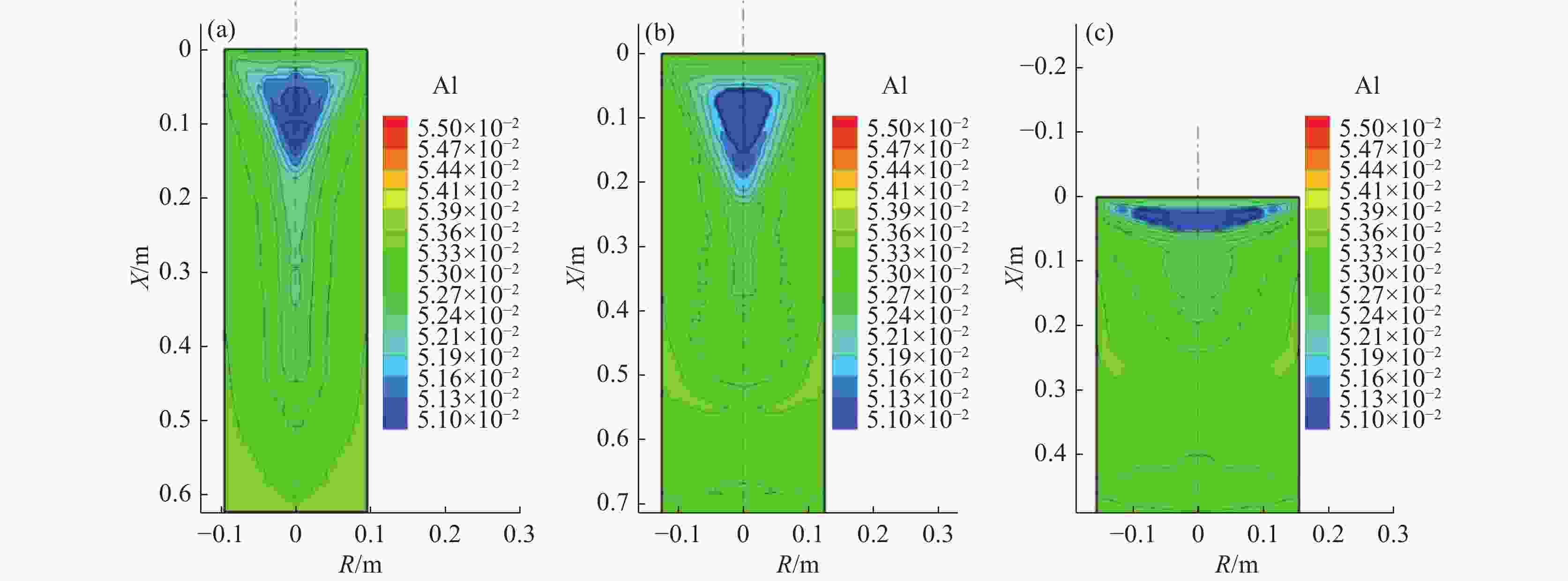
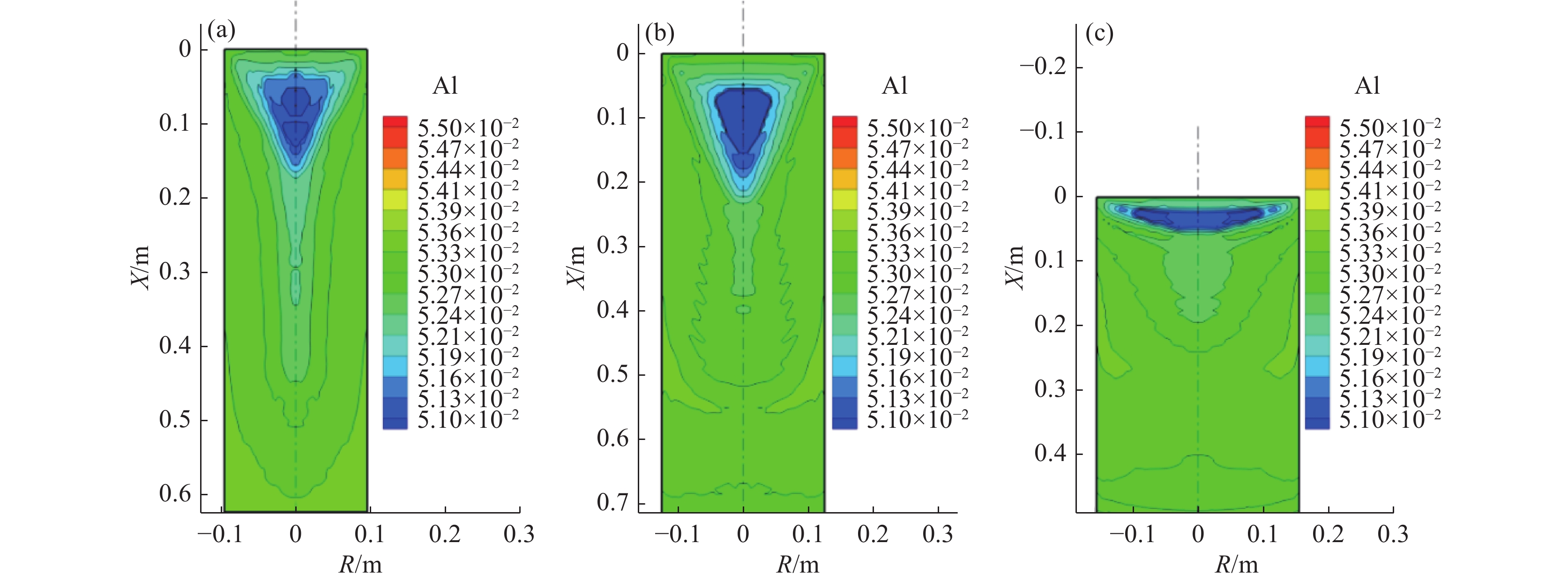
图 1 MeltFlow-VAR模拟计算150 kg Ti551熔炼中各铸锭的Al元素分布
(a)一次锭;(b)二次锭;(c)三次锭
Figure 1. MeltFlow-VAR simulation calculation of Al element distribution of each ingot in 150 kg Ti551 smelting
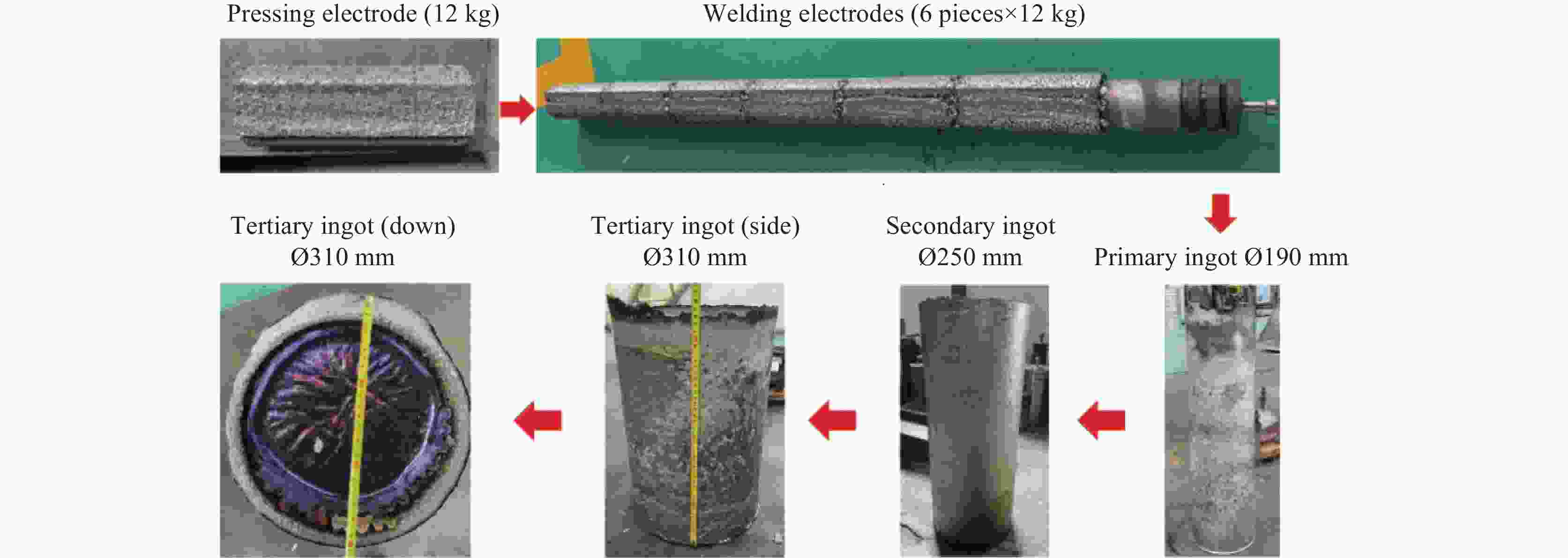
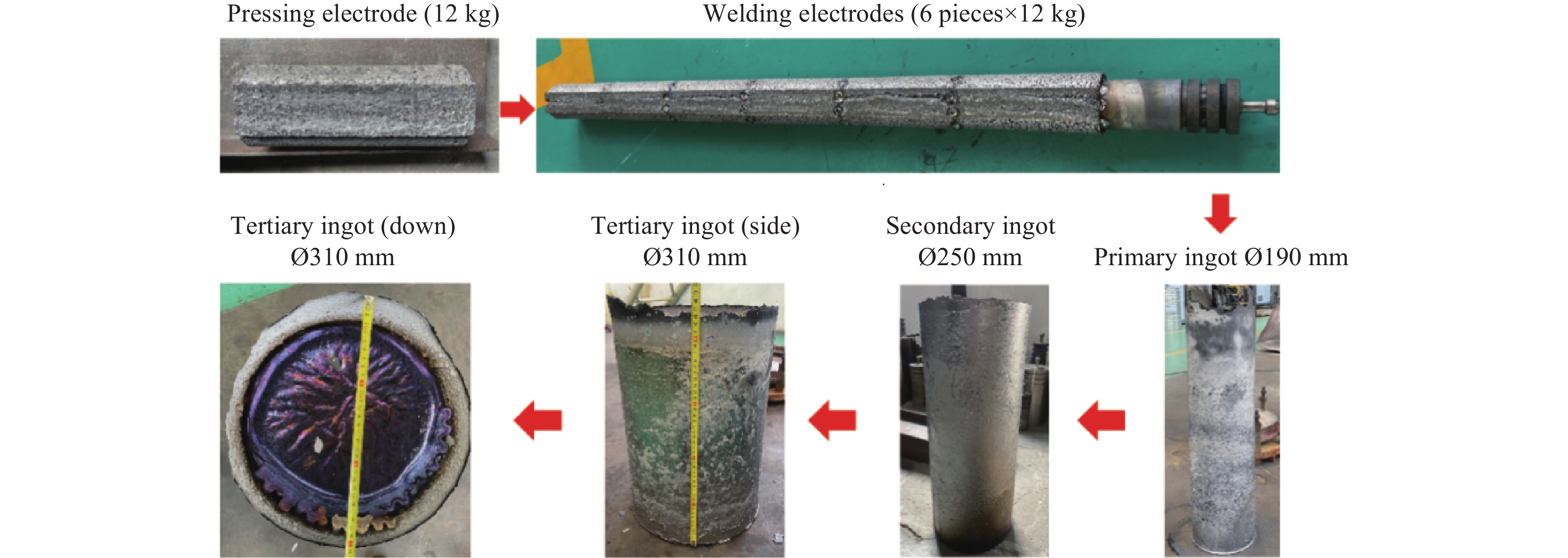
图 2 VAR熔炼制备150 kg Ti551钛合金铸锭的流程
Figure 2. Process of preparing 150 kg Ti551 titanium alloy ingot by VAR melting
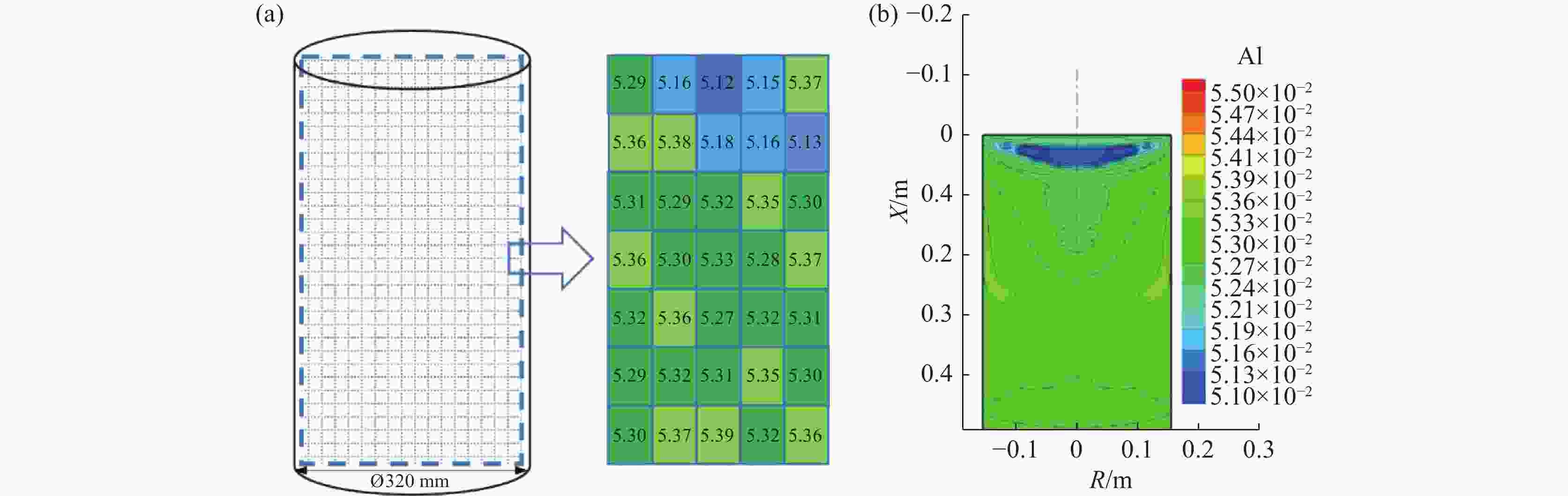
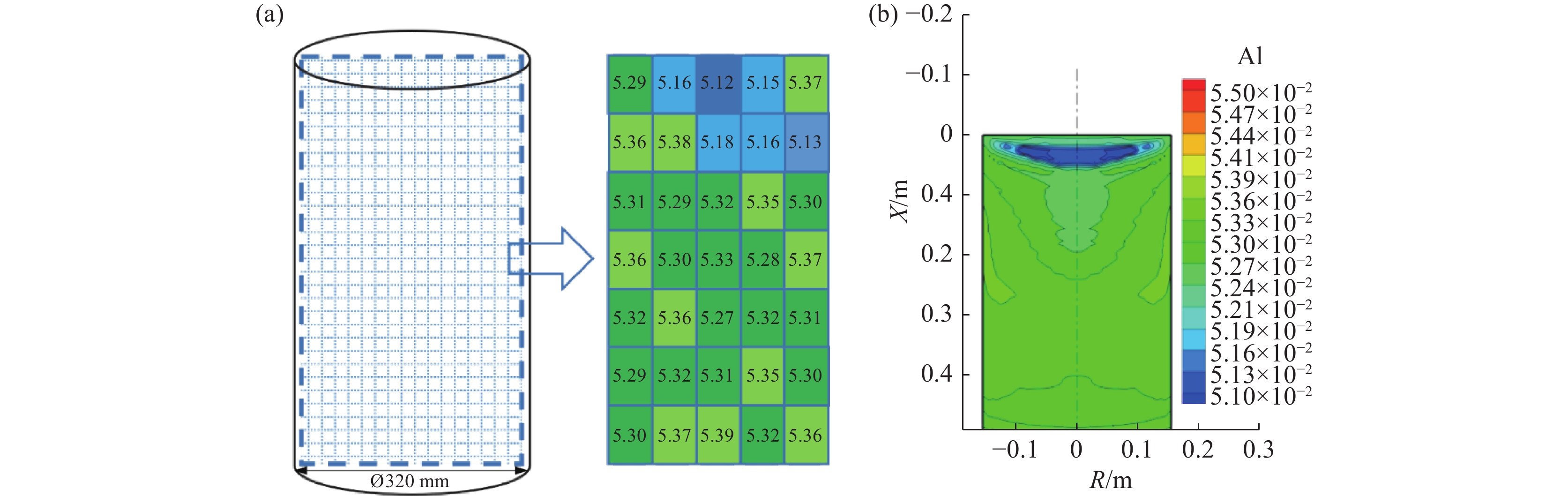
图 3 VAR实际和数值模拟计算的150 kg Ti551结果对比
(a) VAR;(b)数值模拟计算
Figure 3. Comparison between actual results and numerical simulation of VAR for 150 kg Ti551
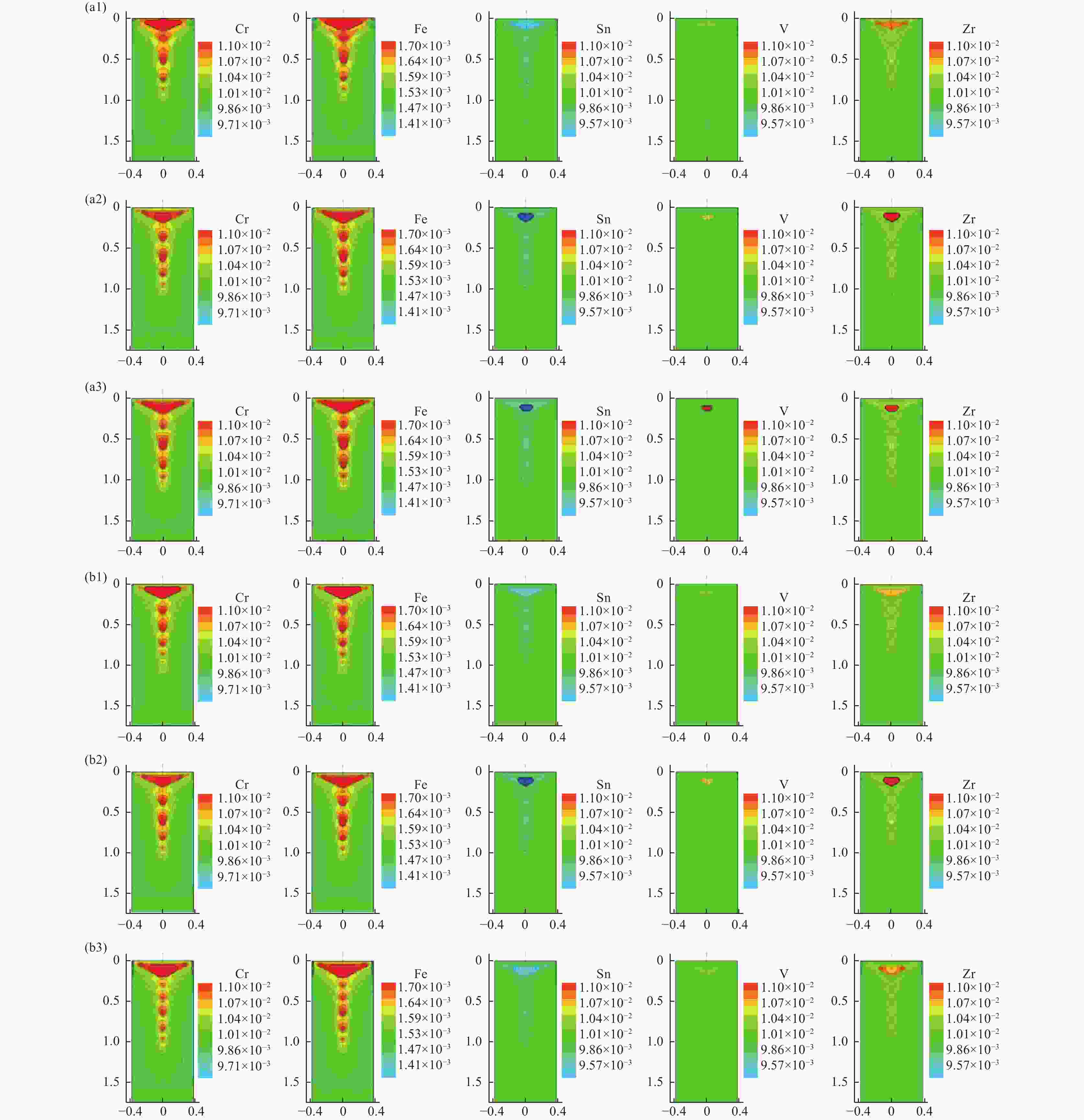
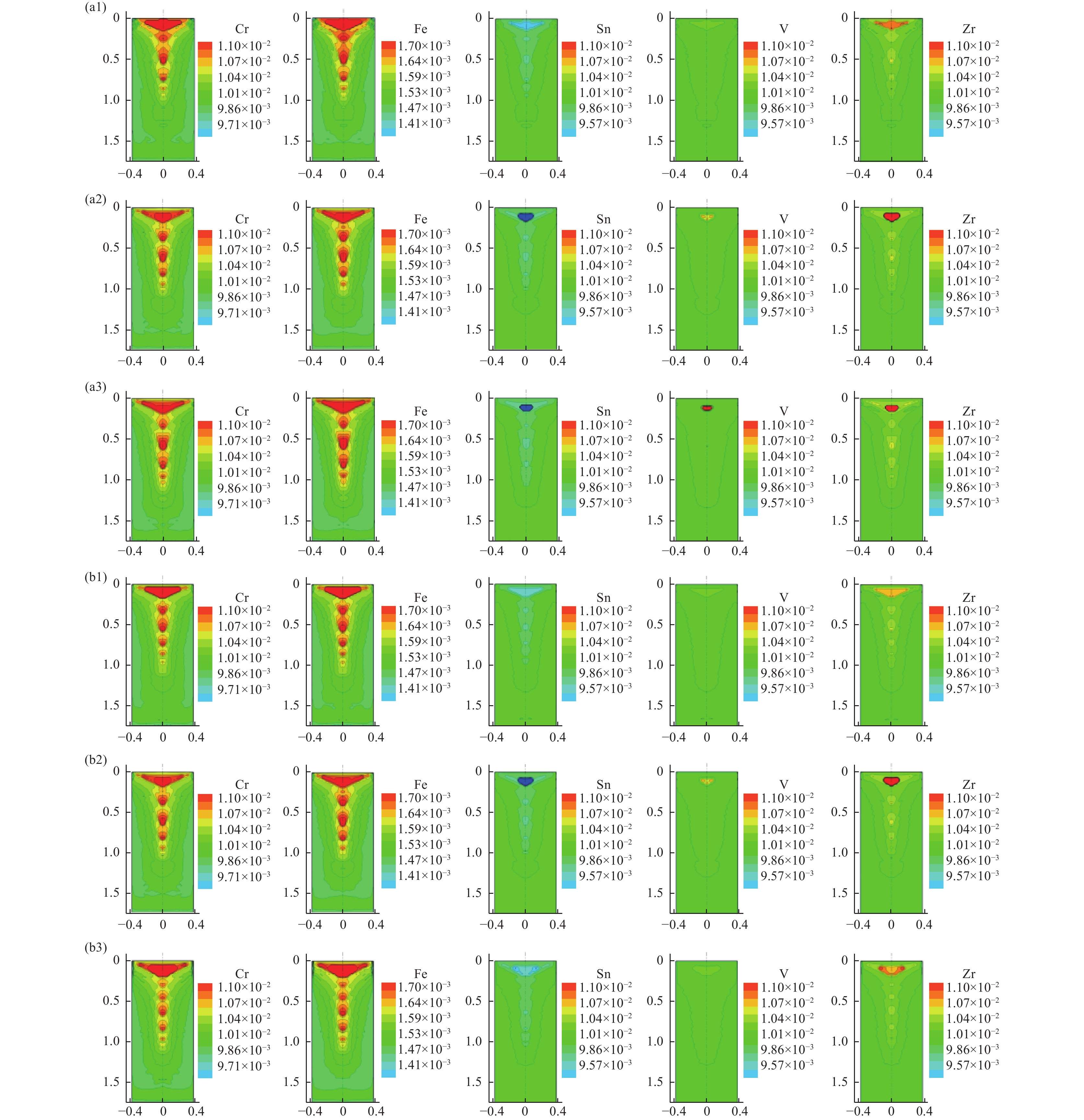
图 4 数值模拟计算熔炼电流和稳弧电流情况下3 t Ti551钛合金铸锭中合金元素的分布
熔炼电流:(a1)工艺3,(a2)工艺1,(a3)工艺2;稳弧电流:(b1)工艺5,(b2)工艺1,(b3)工艺4
Figure 4. Numerical simulation of the distribution of alloy elements in a 3 t Ti551 titanium alloy ingot under melting current and arc stabilization current conditions
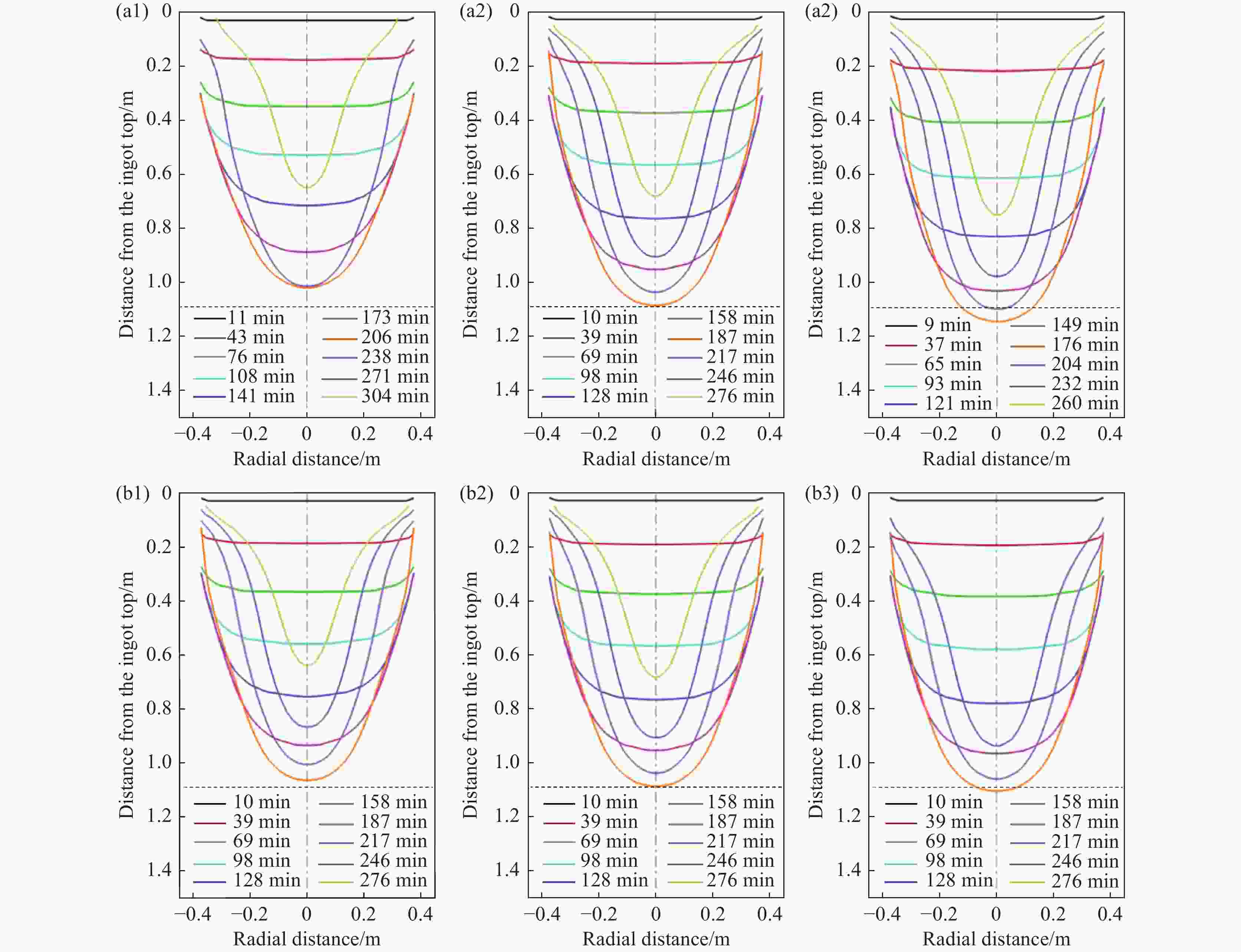
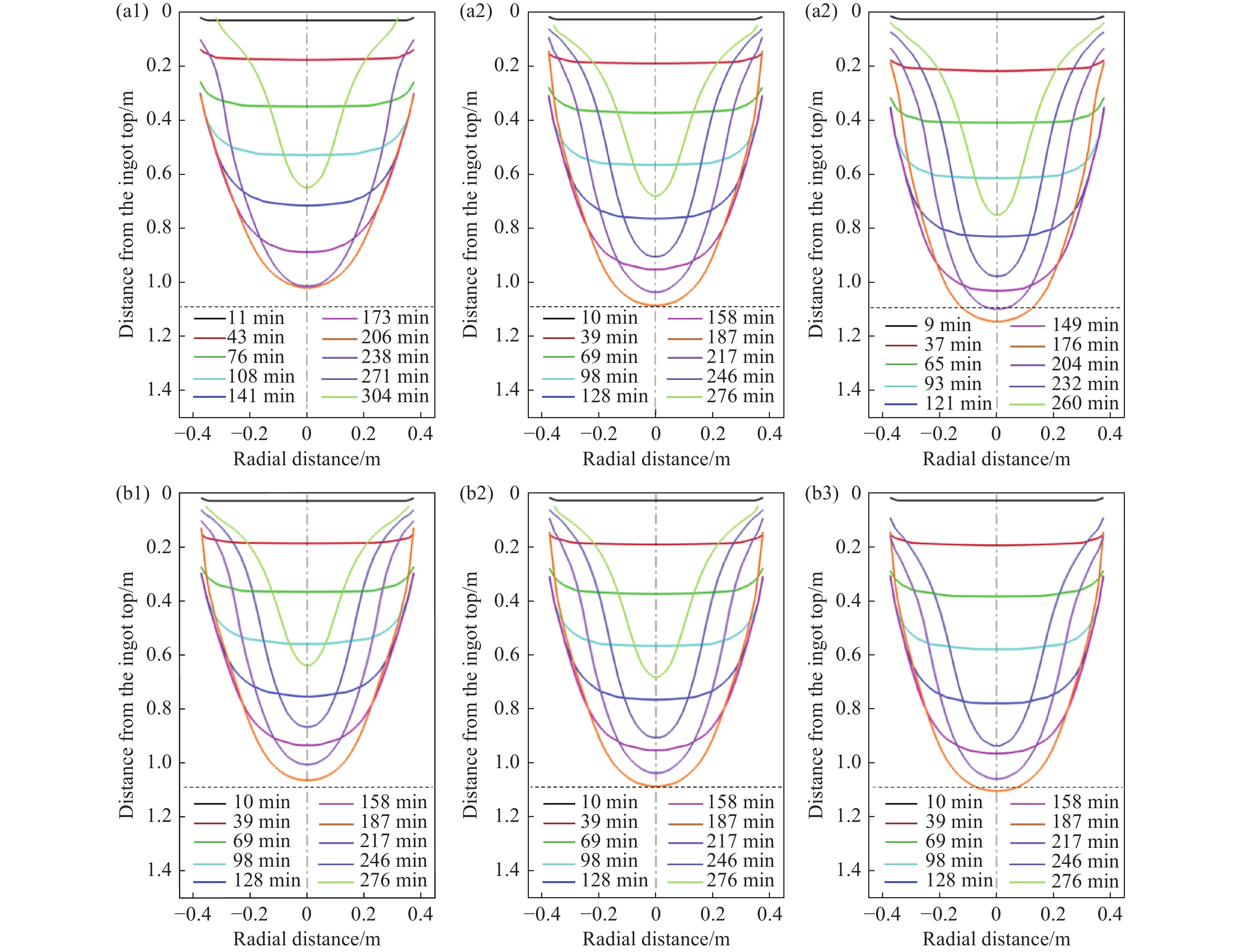
图 5 数值模拟计算熔炼电流和稳弧电流对熔池深度的影响
熔炼电流:(a1)工艺3,(a2)工艺1,(a3)工艺2;稳弧电流:(b1)工艺5,(b2)工艺1,(b3)工艺4
Figure 5. Effect of melting current and arc-stabilizing current on pool depth calculated by numerical simulation

图 6 3 t工业级Ti551钛合金的电极、铸锭及扒皮后光锭
(a)电极;(b)铸锭;(c)扒皮后光锭
Figure 6. Electrode, ingot and peeled ingot of 3 t industrial grade Ti551 titanium alloy
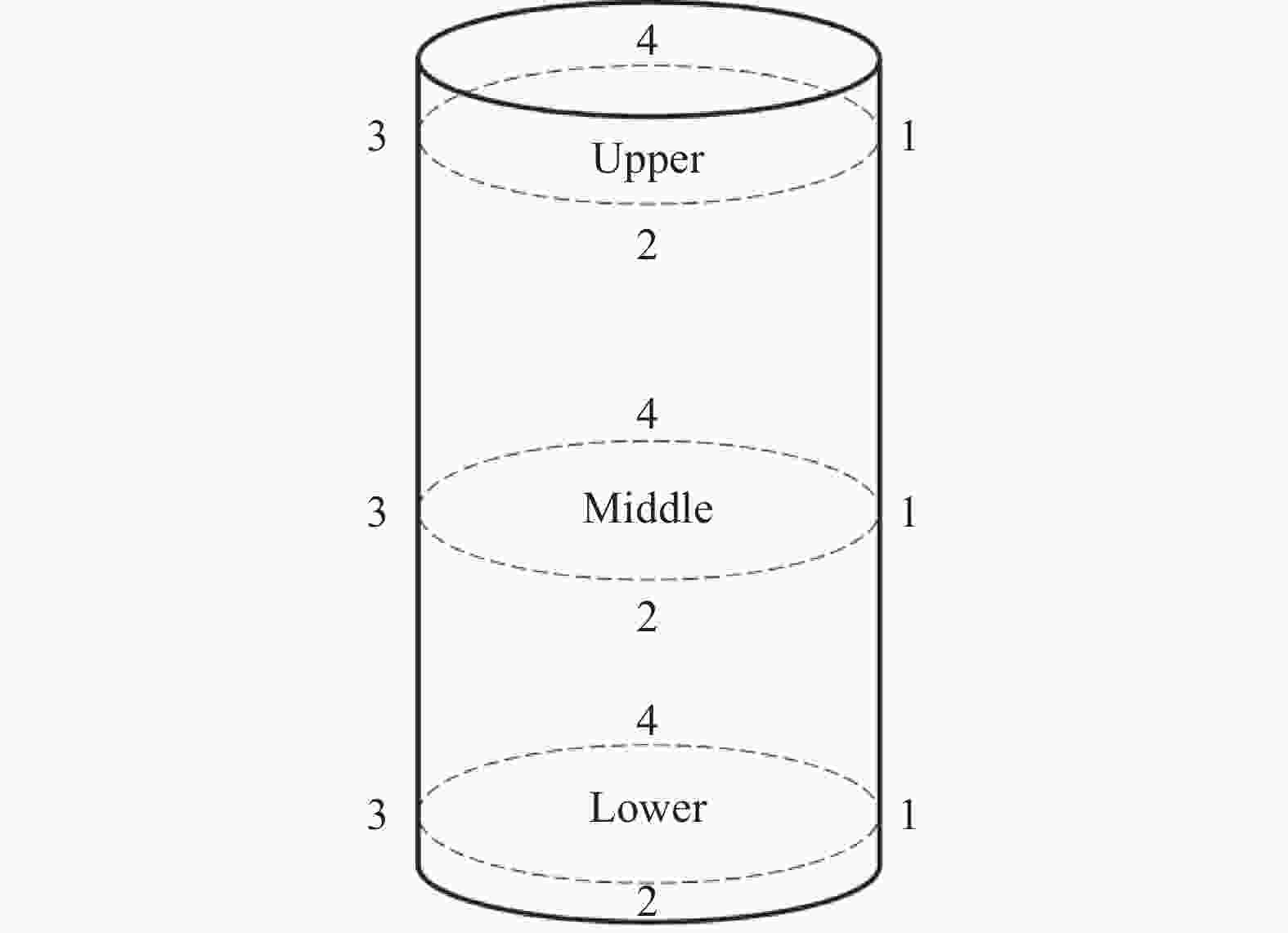
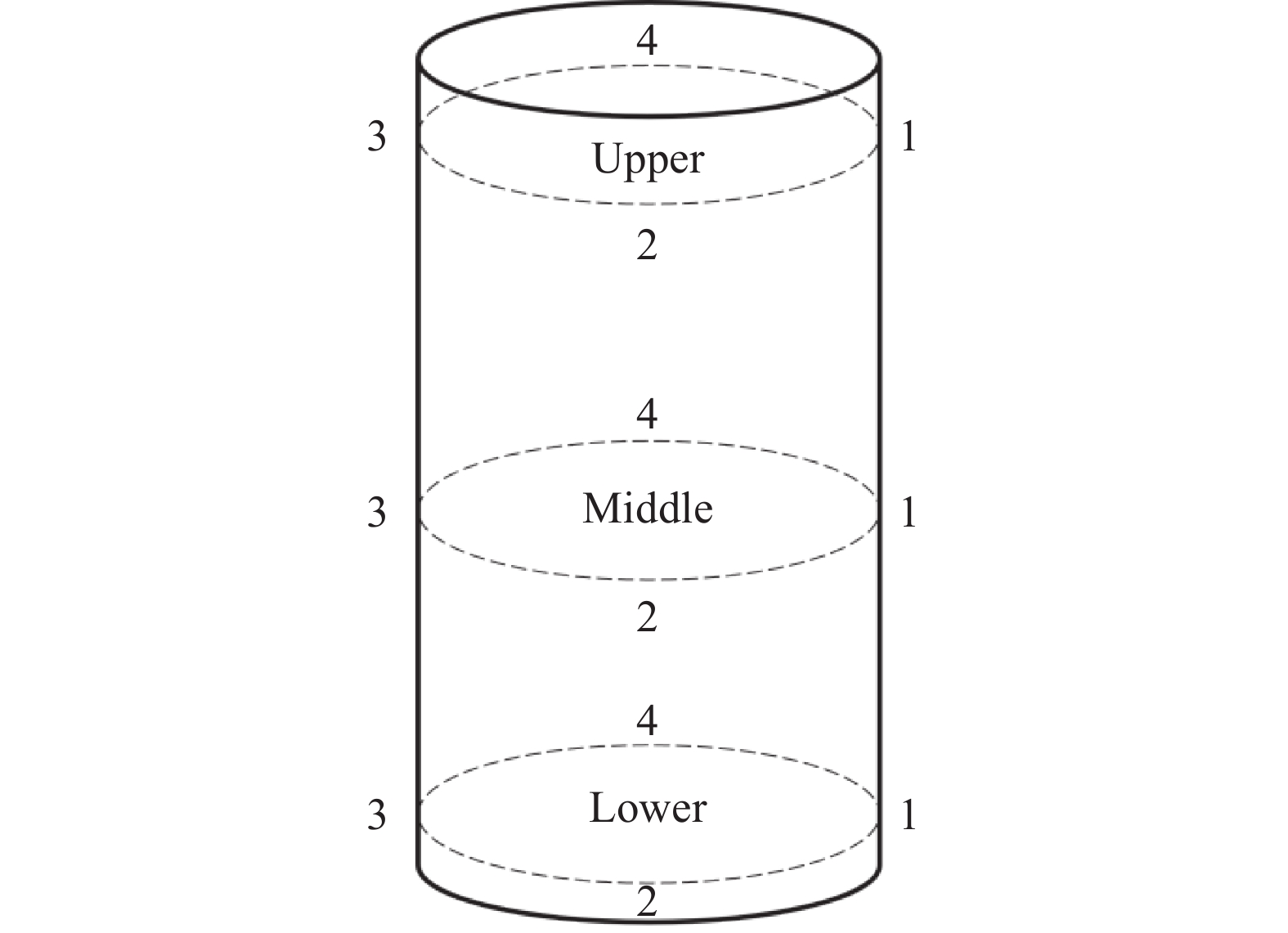
图 7 Ti551铸锭侧面多点(12 点)取样方案示意
Figure 7. Schematic diagram of multi-point (12 points) sampling scheme on the side of Ti551 ingot
表 1 计算采用的Ti551钛合金物性参数
Table 1. Physical parameters of Ti551 titanium alloy used in calculation
Liquid density/(kg·m−3) Solid density/(kg·m−3) Volume expansion
coefficient×105/K−1Solidus
temperature/KLiquidus
temperature/KLatent heat×
10−5/(J·kg−1)Electrical conductivity×
10−5/(A·V−1·m−1)4060 4510 9.35 1947 2000 3.20 8.5  下载: 导出CSV
表 2 3 t Ti551钛合金第三次VAR熔炼的不同模拟计算工艺参数
Table 2. Different simulation calculation process parameters for the third VAR melting of 3 t Ti551 titanium alloy
Melting condition Electric current/kA Arc stabilizing current /A Arc stabilizing AC time/s Process 1 Benchmark process 23~26 15 30 Process 2 Increase melting current 25~28 15 30 Process 3 Reduce melting current 21~24 15 30 Process 4 Increase arc stabilizing current 23~26 20 30 Process 5 Reduce arc stabilizing current 23~26 10 30
下载: 导出CSV
表 3 Ti551钛合金铸锭成分分析结果
Table 3. Composition analysis results of Ti551 titanium alloy ingot
% Cr Fe Sn V Zr Standard value 0.8~1.2 ≤0.20 0.8~1.2 0.8~1.2 0.8~1.2 Maximum value 0.96 0.16 1.04 1.03 1.01 Minimum value 0.93 0.15 1.03 1.00 0.98 Average value 0.96 0.15 1.04 1.02 1.00 Extreme difference 0.03 0.01 0.01 0.03 0.03
下载: 导出CSV
-
[1] LI Y H, ZHANG W X, CHEN X L, et al. Research and application status of titanium alloys for marine engineering[J]. Titanium Industry Progress, 2022, 39(1): 43-48. (李永华, 张文旭, 陈小龙, 等. 海洋工程用钛合金研究与应用现状[J]. 钛工业进展, 2022, 39(1): 43-48. doi: 10.13567/j.cnki.issn1009-9964.2022.01.004LI Y H, ZHANG W X, CHEN X L, et al. Research and application status of titanium alloys for marine engineering[J]. Titanium Industry Progress, 2022, 39(1): 43-48. doi: 10.13567/j.cnki.issn1009-9964.2022.01.004 [2] WILLIAMS J C, BOYER R R. Opportunities and issues in the application of titanium alloys for aerospace components[J]. Metals-Open Access Metallurgy Journal, 2020, 10(6): 705. doi: 10.3390/met10060705 [3] ORYSHCHENKO A S, LEONOV V P, MIKHAILOV V I, et al. Titanium in shipbuilding and other technical applications[J]. Matec Web of Conferences, 2020, 321: 02001. doi: 10.1051/matecconf/202032102001 [4] NAJAFIZADEH M, YAZDI S, BOZORG M, et al. Classification and applications of titanium and its alloys: A review[J]. Journal of Alloys and Compounds Communications, 2024, 3: 100019. doi: 10.1016/j.jacomc.2024.100019 [5] YANG J, ZHANG K F, CAO J H, et al. Research on preparation of oversized TC4 ELI titanium alloy ingots by VAR[J]. Titanium Industry Progress, 2023, 40(4): 1-5. (杨健, 张开发, 曹江海, 等. VAR熔炼制备超大规格TC4 ELI钛合金铸锭研究[J]. 钛工业进展, 2023, 40(4): 1-5.YANG J, ZHANG K F, CAO J H, et al. Research on preparation of oversized TC4 ELI titanium alloy ingots by VAR[J]. Titanium Industry Progress, 2023, 40(4): 1-5. [6] NIMER S, EVERETT R K, ZUPAN M. Microtensile characterization of titanium 5111 alloy mechanical properties and comparison of failure mechanisms at two microstructural length scales[J]. Materials & Design, 2019, 183: 108081. doi: 10.1016/j.matdes.2019.108081 [7] LIU H, LU L, ZHANG Y, et al. Comparative study of the mechanical properties and fracture mechanism of Ti-5111 alloys with three typical microstructures[J]. Metals, 2024, 14(6): 722. doi: 10.3390/met14060722 [8] WANG Z F, CHOLLOCOOP N, BRIANT C L, et al. Hydride formation and its effects on mechanical properties of Ti-5111[J]. Metallurgical and Materials Transactions, 2001, 32(6): 1552. doi: 10.1007/s11661-001-0243-2 [9] CZYRYCA E J, WELLS M E, TRAN K. Titanium alloy Ti-5111 for naval applications[J]. Proceedings, Advanced Marine Materials: Technology & Applications, 2003: 41-49. [10] CHANG M C, LUO C W, HUANG M S, et al. High-temperature microstructural characteristics of a novel biomedical titanium alloy[J]. Journal of Alloys and Compounds, 2010, 499(2): 171-175. doi: 10.1016/j.jallcom.2010.03.052 [11] BEEN J, FALLER K. Using Ti-5111 for marine fastener applications[J]. JOM, 1999, 51(6): 21-24. doi: 10.1007/s11837-999-0088-5 [12] LI M Y, YANG S F, LIU W, et al. Research process on segregation and control of titanium alloy during vacuum arc remelting[J]. China Metallurgy, 2023, 33(9): 1-10,18. (李明宇, 杨树峰, 刘威, 等. 真空自耗熔炼钛合金的偏析缺陷及控制研究进展[J]. 中国冶金, 2023, 33(9): 1-10,18. doi: 10.13228/j.boyuan.issn1006-9356.20230207LI M Y, YANG S F, LIU W, et al. Research process on segregation and control of titanium alloy during vacuum arc remelting[J]. China Metallurgy, 2023, 33(9): 1-10,18. doi: 10.13228/j.boyuan.issn1006-9356.20230207 [13] KARIMI-SIBAKI E, KHARICHA A, VAKHRUSHEV A, et al. Numerical modeling and experimental validation of the effect of arc distribution on the as-solidified Ti64 ingot in vacuum arc remelting (VAR) process[J]. Journal of Materials Research and Technology, 2022, 19: 183-193. doi: 10.1016/j.jmrt.2022.05.036 [14] LUO K, GENG N T, YOU Y J, et al. Optimization of VAR melting process of TB9 titanium alloy based on numerical simulation[J]. Iron Steel Vanadium Titanium, 2024, 45(3): 25-32. (罗坤, 耿乃涛, 游彦军, 等. 基于数值模拟的TB9钛合金VAR熔炼工艺优化[J]. 钢铁钒钛, 2024, 45(3): 25-32. doi: 10.7513/j.issn.1004-7638.2024.03.004LUO K, GENG N T, YOU Y J, et al. Optimization of VAR melting process of TB9 titanium alloy based on numerical simulation[J]. Iron Steel Vanadium Titanium, 2024, 45(3): 25-32. doi: 10.7513/j.issn.1004-7638.2024.03.004 [15] HUANG L Q, WU J Y, GUO J, et al. Effect of self-induced magnetic field on liquid flow and segregation during VAR process for titanium alloys[J]. Iron Steel Vanadium Titanium, 2023, 44(4): 55-61,84. (黄立清, 吴京洋, 郭杰, 等. 钛合金VAR过程中自感电磁场对流场与偏析行为的影响[J]. 钢铁钒钛, 2023, 44(4): 55-61,84. doi: 10.7513/j.issn.1004-7638.2023.04.008HUANG L Q, WU J Y, GUO J, et al. Effect of self-induced magnetic field on liquid flow and segregation during VAR process for titanium alloys[J]. Iron Steel Vanadium Titanium, 2023, 44(4): 55-61,84. doi: 10.7513/j.issn.1004-7638.2023.04.008 [16] WEN H, ZHENG Y B, CHEN F, et al. Research on melting technology of TC2 titanium alloy ingot depend on MeltFlow-VAR[J]. Metallurgical Smelting, 2022(14): 12-15. (文豪, 郑亚波, 陈峰, 等. 基于MeltFlow-VAR的TC2钛合金铸锭熔炼工艺研究[J]. 世界有色金属, 2022(14): 12-15.WEN H, ZHENG Y B, CHEN F, et al. Research on melting technology of TC2 titanium alloy ingot depend on MeltFlow-VAR[J]. Metallurgical Smelting, 2022(14): 12-15. [17] JING Z Q, SUN Y H, CHEN L, et al. Numerical simulation of current, magnetic field and electromagnetic force in vacuum arc remelting of titanium alloy[J]. Rare Metal Materials and Engineering, 2023, 52(6): 1994-2001. [18] KARIMI-SIBAKI E, KHARICHA A, ABDI M, et al. A numerical study on the influence of an axial magnetic field (AMF) on vacuum arc remelting (VAR) process[J]. Metallurgical and Materials Transactions B, 2021, 52(5): 3354-3362. doi: 10.1007/s11663-021-02264-w [19] KOU H, ZHANG Y, LI P, et al. Numerical simulation of titanium alloy ingot solidification structure during VAR process based on three-dimensional CAFE method[J]. Rare Metal Materials and Engineering, 2014, 43(7): 1537-1542. doi: 10.1016/S1875-5372(14)60120-X [20] ZHAO X H, WANG J C, LIU P, et al. Effect of electrode block’s mixing uniformity on titanium alloy ingot’s composition[J]. Titanium Industry Progress, 2021, 38(4): 1-4. (赵小花, 王锦程, 刘鹏, 等. 钛合金电极块混料均匀性对铸锭成分的影响[J]. 钛工业进展, 2021, 38(4): 1-4. doi: 10.13567/j.cnki.issn1009-9964.2021.04.001ZHAO X H, WANG J C, LIU P, et al. Effect of electrode block’s mixing uniformity on titanium alloy ingot’s composition[J]. Titanium Industry Progress, 2021, 38(4): 1-4. doi: 10.13567/j.cnki.issn1009-9964.2021.04.001 -


计量
- 文章访问数: 2
- HTML全文浏览量: 0
- PDF下载量: 1
- 被引次数: 0